White-headed Buffalo Weaver
White-headed Buffalo Weaver – Spec. Name: Dinemellia dinemelli
This is a species of passerine bird in the family Ploceidae native to East Africa. The buffalo part of its name derives from its habit of following the African buffalo, feeding on disturbed insects. Two subspecies are recognized.

White-headed Buffalo Weaver
The White-headed Buffalo Weaver is 170–190 mm (6.7–7.5 in) in length and 57–85 g (2.0–3.0 oz) in weight. In addition to its white head and underparts, the White-headed Buffalo Weaver has a vividly orange-red rump and undertail coverts. Its thighs are dark brown. Narrow white bands can be found on the wings. Both sexes are similar in plumage and hard to differentiate. The bill is conical and black. D. dinemelli has a brown tail, whereas D. boehmi has a black tail. Like the most weavers, it is a gregarious bird which forages on the ground for insects, especially beetles and butterflies, fruits, and seeds, often in groups with starlings. Foraging is often done in groups of 3–6 birds. Its sound is parrot-like: “skwieeer”, “kiiyerr”, a ringing and repetitious “tew”. In addition, variable sounds as chuckles and whistles can be heard at breeding and roosting sites. The sounds are slow and drawn out. They also make trills: “tsu-weely-weely-wair”. They often perch in trees and hang upside-down and can be very noisy. Breeding and roosting is done in groups and they can be defensive against intruders, usually by making noise. Altercations are rarely fatal and usually vocal.[7] Males display to females by spreading their wings to show their white wing-patches and red-orange tail-coverts.
Breeding pairs are monogamous and nests are built together. The breeding season depends according to rainfall and varies according to local conditions. Nest materials are pushed together, not interwoven, to form an oval 570 millimetres (22 in) wide. A short entrance tube opens downwards and is about 2 to 4 metres (6.6–13 ft) above the ground. Soft materials line the inner portions of the nest, which usually has several rooms, with defensive thorny branches on the outside. A large tree will have several of their nests, which other birds such as the African Pygmy-falcon are known to use instead of building their own. The female incubates 3–5 greyish to pale blue eggs with red, brown and olive markings for 11–14 days. Both parents feed the chicks.
All photographs are © H.J. Ruiz – Avian101
Text is available under the Creative Commons Attribution-ShareAlike License; additional terms may apply. See Terms of use for details.
Share this:

Red-winged Blackbird – Video
This is a beautiful video © Lang Elliott & Beth Bannister – The Music of Nature
Share this:

Red-crested Pochard
Red-crested Pochard – Spec. Name: Netta rufina
This is a large diving duck.Their breeding habitat is lowland marshes and lakes in southern Europe and southern and central Asia. They are somewhat migratory, and northern birds winter further south and into north Africa.

Red-crested Pochard
The adult male is unmistakable. It has a rounded orange head, red bill and black breast. The flanks are white, the back brown, and the tail black. The female is mainly a pale brown, with a darker back and crown and a whitish face.
These are gregarious birds, forming large flocks in winter, often mixed with other diving ducks, such as other pochards. They feed mainly by diving or dabbling. They eat aquatic plants, and typically upend for food more than most diving ducks.
Red-crested pochards build a nest by the lakeside among vegetation and lay 8-12 pale green eggs. The birds’ status in the British Isles is much confused because there have been many escapes and deliberate releases over the years, as well as natural visitors from the continent. However, it is most likely that they are escapees that are now breeding wild and have built up a successful feral population. They are most numerous around areas of England including Gloucestershire, Oxfordshireand Northamptonshire. Wild birds occasionally turn up at places such as Abberton Reservoir, Essex.
The Red-crested Pochard is one of the species to which the Agreement on the Conservation of African-Eurasian Migratory Waterbirds (AEWA) applies.
All photographs are © H.J. Ruiz – Avian101
Text is available under the Creative Commons Attribution-ShareAlike License; additional terms may apply. See Terms of use for details.
Share this:

Rosy-billed Pochard
Rosy-billed Pochard, a.k.a. Rosybill Pochard – Spec.Name: Netta peposaca
This is a duck with a distinctive red bill on males and a slate-colored bill on females. Though classified as a diving duck, this pochard feeds more like a dabbling duck. The species name peposaca is derived from a Guaraní word for “showy wings”, referring to the broad white stripe that is only visible with stretched out wings.
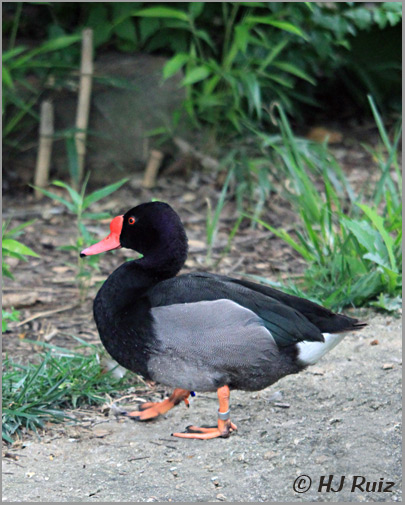
Rosy-billed Pochard
The Rosy-billed Pochard is endemic to South America. It is found in Argentina, central Chile, Paraguay, Uruguay and southern Brazil. The population in southern Argentina migrates northward during the austral winter, reaching Brazil and southern Bolivia. It is a vagrant to the Falkland Islands.
The Rosy-billed Pochard is found near freshwater lakes and marshes of temperate South America. “Although in the Pochard group, it behaves more like a dabbling duck.” Nests are hidden near the water’s edge or built in emergent vegetation. A typical clutch consists of 10 eggs and incubation is 25-26 days.
Rosy-billed are very easy to propagate in aviaries. The hens will prefer to nest on the ground among vegetation and lines the nest with down. 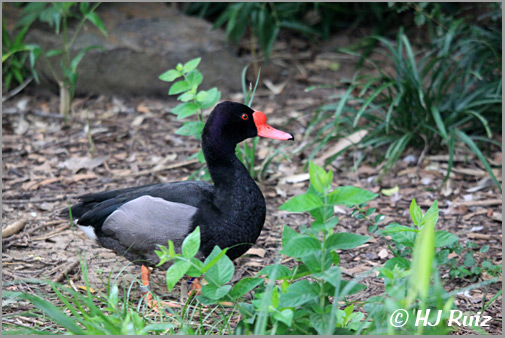
All photographs are © H.J. Ruiz – Avian101
Text is in part available under the Creative Commons Attribution-ShareAlike License; additional terms may apply. See Terms of use for details.
Share this:


Read Past Reviews

Book # 69

Quote from the Author
“A good chuckle is healthy, it helps you break the monotony of a serious life.” ~ H.J. Ruiz


You must be logged in to post a comment.