Texan Tweeties – Bob Zeller – Guest
Images from Hummer House Nature Retreat and Other Locations
I am still going through old images whenever I have extra time. Today I came across a few more from a trip in May 2010 to the Hummer House Nature Retreat, at Christoval, Texas. Here are a couple of those gems. I should have entered this in Karma’s Rainbow colored Photo hunt.
The Painted Bunting is truly a hand-painted masterpiece from the “Man” himself
.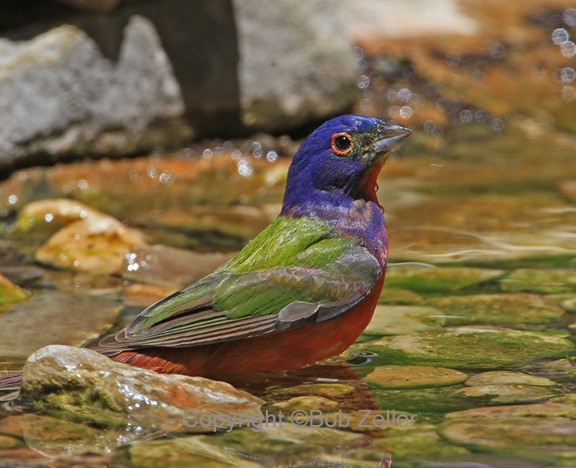
- Canon EOS 7D
- Canon 500mm IS lens with 1.4 tele-converter
- 1/640 sec. @ f9 – minus 2/3 EV adjustment
- ISO 250
- Lens focal distance – 700mm
- Metering – partial
- Aperture priority
It is amazing that I have never posted a photo of an Eastern Phoebebefore this. It could be that they are hard to get close to, and I have usually seen them only from a distance. For both of these shots, I was inside an air-conditioned observation room and photographing through a plate glass window.
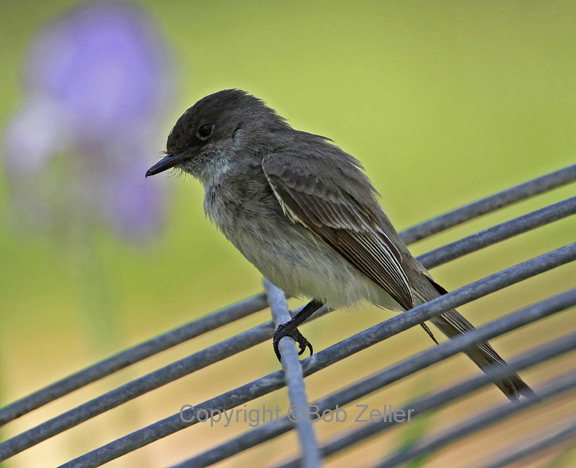
Eastern Phoebe
- Canon EOS 7D
- Canon 500mm IS lens with 1.4 tele-converter
- 1/400 sec. @ f7.1
- ISO 500
- Lens focal distance – 700mm
- Metering – partial
- Aperture priority
The Vermilion Flycatcher, ( Pyrocephalus rubinus) is one of my favorites of the species. It is such a vivid red. It also is a difficult bird to photograph, because it is very flighty and very tiny. For those reasons, I feel very lucky to have gotten up close and personal on a recent visit to Middle Concho Park. It also helped to have my big lens and a Puffin’ Pad window support, as I wouldn’t have had time to set up my tripod.
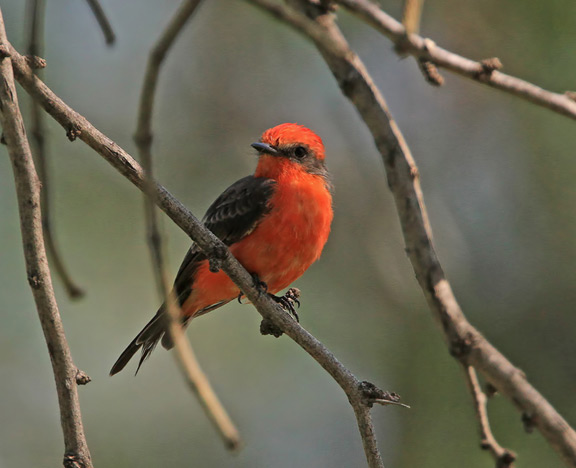
Vermillion Flycatcher
- Canon EOS 7D
- Canon 500mm IS lens with 1.4 tele-converter
- 1/2000 sec. @ f6.3 – minus 1/3 EV adjustment
- Lens focal distance – 700m
- ISO 500
- Metering – partial
- Shutter priority
Here is one, about the dove species that can be found in West Texas. Inca Dove – Colombina inca). Smallest of the doves found locally. Very secretive little bird. Small, deep-bellied, long-tailed dove with a short neck, small head, and short bill. Pale gray to sandy colored overall. All feathers brown-tipped to give a scaled look. To me, this bird is the cutest of the species.

Inca Dove
- Canon EOS 40D
- Canon 500mm IS lens with 1.4 -tele-converter
- 1/800 sec. @ f5.6 – ISO 800
- Lens focal distance – 700mm
- Metering – pattern
- Aperture priority
Text and Photographs are © Bob Zeller – Texan Tweeties
Share this:

Cliff Swallow
Cliff Swallow – Spec. Name: Petrochelidon Pyrrhonota
This is a member of the passerine bird family Hirundinidae — the swallows and martins.
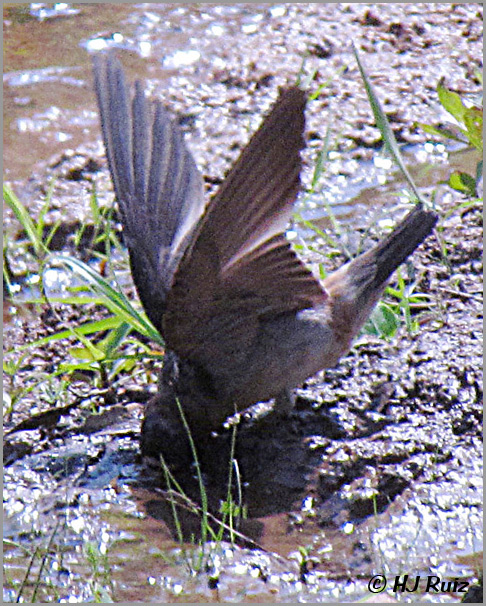
Cliff Swallow picking-up mud for nest
It breeds in North America, and is migratory, wintering in western South America from Venezuela southwards to northeast Argentina. This species is a very rare vagrant to western Europe.
This bird averages 13 cm (5 inches) long with a tiny bill. The adult Cliff Swallow has an iridescent blue back and crown, brown wings and tail, and buff rump. The nape and forehead are white. The underparts are white except for a red face. The tail is square-ended.
Young birds are essentially brown above and whitish below, except for the buff rump and dark face. The only confusion species is the closely related Cave Swallow, which is richer in colour and has a cinnamon rump and forehead.
Like all swallows and martins, Cliff Swallows subsist primarily on a diet of insects which are caught in flight.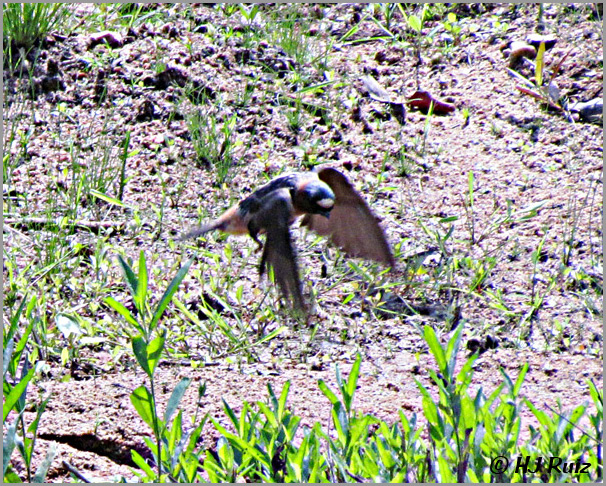
Cliff Swallows breed in large colonies. They build conical mud nests and lay 3-6 eggs. The natural nest sites are on cliffs, preferably beneath overhangs, but as with the Eurasian House Martin, man-made structures are now the principal locations for breeding. Female Cliff Swallows are known to lay eggs in and move previously laid eggs into the nests of other birds within the colony.
This species has always been plentiful in the west of North America, where there are many natural sites, but the abundance in the east has varied.
European settlement provided many new nest sites on buildings, but the population declined in the late nineteenth and early twentieth centuries as the supply of unpainted barns declined. There has been a subsequent revival as dams and bridges have provided suitable sites.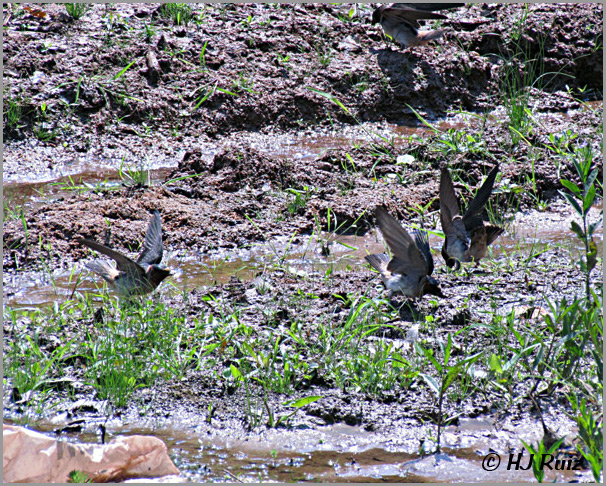
Photographs are © H.J. Ruiz – “My Backyard Visitors”
Text is available under the Creative Commons Attribution-ShareAlike License; additional terms may apply. See Terms of Use for details.
Wikipedia® is a registered trademark of the Wikimedia Foundation, Inc., a non-profit organization.
Share this:

Mute Swan
Mute Swan – Spec. Name: Cygnus olor
This is a species of swan, and thus a member of the duck, goose and swan family Anatidae. It is native to much of Europe and Asia, and (as a rare winter visitor) the far north of Africa. It is also an introduced species in North America, Australasia and southern Africa. The name ‘mute’ derives from it being less vocal than other swan species. Measuring 125 to 170 centimetres (49 to 67 in) in length, this large swan is wholly white in plumage with an orange bill bordered with black. It is recognisable by its pronounced knob atop the bill.

Mute Swan
Adults of this large swan range from 125 to 170 centimetres (49 to 67 in) long with a 200 to 240 centimetres (79 to 94 in) wingspan. They may stand over 120 centimetres (47 in) tall on land. Males are larger than females and have a larger knob on their bill.
The Mute Swan is one of the heaviest flying birds, with males (known as cobs) averaging about 12 kilograms (26 lb) and the slightly smaller females (known as pens) weighing about 9 kilograms (20 lb). An unusually big Polish cob weighed almost 23 kilograms (51 lb), surpassing the longer-bodied Trumpeter Swan to make it the heaviest waterfowl ever recorded. Its size, orange-reddish bill and white plumage make this swan almost unmistakable at close quarters. Compared with the other Northern white swans, the Mute Swan can easily be distinguished by its curved neck and orange, black-knobbed bill. Unlike most other Northern swan species (who usually inhabit only pristine wetlands without regular human interference), the Mute Swan has, in some parts of the world, become habituated and fearless towards humans. Such swans are often seen at close range in urban areas with bodies of water.
Young birds, called cygnets, are not the bright white of mature adults, and their bill is dull greyish-black, not orange, for the first year. The down may range from pure white to grey to buff, with grey/buff the most common. The white cygnets have a leucistic gene. All Mute Swans are white at maturity, though the feathers (particularly on the head and neck) are often stained orange-brown by iron and tannins in the water.
Mute Swans nest on large mounds that they build with waterside vegetation in shallow water on islands in the middle or at the very edge of a lake. They are monogamous and often reuse the same nest each year, restoring or rebuilding it as needed. Male and female swans share the care of the nest, and once the cygnets are fledged it is not uncommon to see whole families looking for food.
All photographs are © H.J. Ruiz – Avian101
Text is available under the Creative Commons Attribution-ShareAlike License; additional terms may apply. See Terms of use for details.
Share this:

Common Ground Dove
Common Ground Dove – Spec. Name: Columbina passerina
This is a small New World tropical dove. It is a resident breeder from Aruba, Bermuda, through the southmost United States, Mexico and the Caribbean, to South America, and is found as far south as northern Brazil.

Common Ground Dove
The Common Ground Dove inhabits scrub and other open country. It builds a flimsy stick nest in a tree and lays two white eggs. Its flight is fast and direct, with regular beats and an occasional sharp flick of the wings that are characteristic of pigeons in general.
Common Ground Doves are one of the world’s smallest pigeons, with a length of 17 centimeters (6.5 inches), wingspan of 7.5 cm (10.5 in) and mass of 31 grams (1.1 ounces). Adult birds have grey-brown back and upperwing plumage, with black spotting on their wing coverts. They have a scaly appearance to the breast and head. The tail is brown centrally, with black edges and white corners. In most subspecies, the bill is orange or reddish, tipped black. In flight, the underwings show extensive chestnut colouration.
The adult male has a pink head, neck and breast, and a pink unscaled belly. The nape is blue. The female and juvenile are light grey where the male is pink, and have grey napes.
Common Ground Doves feed mainly on seeds, but do eat some insects. Their call is a soft cooing wha-up.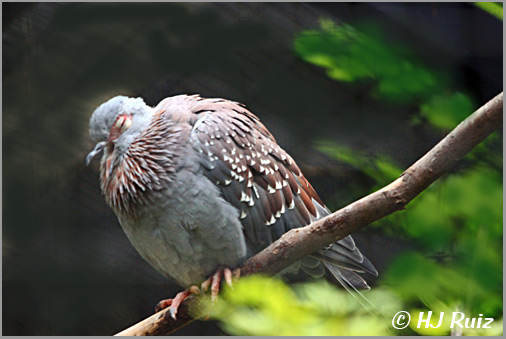
All photographs are © H.J. Ruiz -Avian101
Text is available under the Creative Commons Attribution-ShareAlike License; additional terms may apply. See Terms of use for details.
Share this:


Read Past Reviews

Book # 69

Quote from the Author
“A good chuckle is healthy, it helps you break the monotony of a serious life.” ~ H.J. Ruiz


You must be logged in to post a comment.