Chinese Bamboo Partridge
Chinese Bamboo Partridge – Spec. Name: Bambusicola thoracicus
This is a small partridge native to eastern mainland China and Taiwan, and introduced successfully to Japan. It is one of two species in the genus Bambusicola, along with the Mountain Bamboo Partridge of the Himalayas.

Chinese Bamboo Partridge
The Chinese Bamboo Partridge is smaller than most partridges, reaching a size of cm, with males being larger than the females. The breast and back are mottled in black, chestnut, and cream colors, with black spots on the flanks and above. The partridge’s face and throat are rufous, with a gray above the eye and down to the neck.
This species is found in warm forested areas and grasslands, but is not entirely dependent on bamboo, despite its name. Like other partridges, it prefers hiding to flight, but will readily flush if approached, startling pursuers with loud wingbeats. Its loud call, often rendered as ki-ko-kuai orkojukkei (the latter rendition being adopted as its Japanese name) is repeated several times before slowing to a stop. This call is heard far more than the bird is actually seen, and though this species is common throughout its limited range, it is considered somewhat elusive and secretive. Despite this, it has been kept in captivity in China for centuries, and has been intentionally introduced first to Japan in 1919 then with varying success to Hawaii, where it is listed as an introduced bird not protected by the Migratory Bird Treaty Act An introduced population also exists on remote Iwo Jima. Despite its success elsewhere, Chinese Bamboo Partridge has been extirpated from Hong Kong, and a reintroduction program in 1961 failed to produce a viable breeding population.
Note: There are two subspecies, B. t. thoracicus in mainland China and B. t. sonorivox in Taiwan, the latter of which is sometimes treated as a separate species known as Taiwan Bamboo Partridge.
All photographs are © H.J. Ruiz – Avian101
Text is available under the Creative Commons Attribution-ShareAlike License; additional terms may apply. See Terms of use for details.
Share this:

Backyard cleanup
I’ve been working outside in my backyard, trying to improve the look of it and gave me a chance to see in what conditions the birdhouses were. This is what I got:
All except one of the birdhouses that I had set in my backyard two years ago and repaired last year were ready to be disposed of .Inclemency of the weather on the past seasons, two much rain, wind and now heat have been the cause of the damage. Most houses were in precarious condition and were not worth a second -time repair.
I have to admit that the houses I bought were bought cheap hence made cheaply. In fact I didn’t expected them to last, which was the reason I had to practically rebuild them last year.
I’m not setting any up any new houses yet. I bought one already, made of real cedar wood, style made for bluebirds.
Changing to other things, let me tell you what happened while I was doing cleanup in the backyard.
One of the broken houses I retrieved had a wasp hive in it and I was chased for awhile by angry wasps but fortunately not stung once. After that incident I went to my garage and got my wasp killer spry that squirt from afar and got a good bunch of them down the rest just took off, that was the only way I was able to grab that house. In another house I found a Chickadee nest abandoned with a dead chickadee in it. I wonder what killed it?
I have another story : A couple of weeks ago I was using the weed-whacker, trimming weeds around the support of a bird house and I stepped on an ant hill without noticing. They crawled on my legs and gave me their best shots. I still have the marks from the stings.
I guess it’s the price you pay for tending your backyard and keep the birds happy!
I keep my feeders with seeds and many birds come and go as always.
I don’t spend a lot of time out nowadays because of the heat and drought that it gets too hot to be outdoors for too long. I like what I do and enjoy every moment. Do you think I’m nuts? 🙂
All photographs are © H.J. Ruiz – Avian101


Share this:

Golden-breasted Starling
Golden-breasted Starling a.k.a. Royal Starling – Spec. Name: Cosmopsarus regius
This is a medium-sized, up to 35cm long, passerine in the starling family. The adult has a metallic green head and upperback, bright golden-yellow breast and belly, dark bill and legs, white irisand metallic violet-blue on wings, back, neck and its long tail feathers. Both sexes are similar. The young is duller than adult.
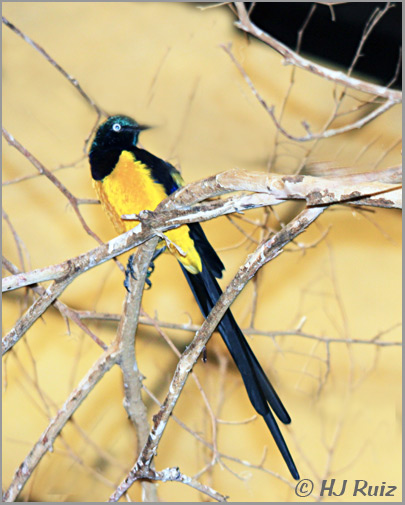
Golden-breasted Starling
The Golden-breasted Starling is distributed to the grassland, savanna and shrubland of East Africa, from Somalia, Ethiopia, Kenya and northern Tanzania.
The Golden-breasted Starling is a social animal, living in groups of three to twelve individuals. Its diet consists mainly of insects and termites. The Golden-breasted Starling molts once a year, after the breeding season.
The female usually lays between three to five pale green eggs with red speckles. It nests in tree holes. The nest is made from leaves, roots and other vegetation matters.
Widespread throughout its habitat range, the Golden-breasted Starling is evaluated as Least Concern on the IUCN Red List of Threatened Species.
Unlike most starlings which feed on a combination of insects and fruits, the Golden-breasted starling lives almost entirely on insects. Termites are caught by opening their ground tunnels with rapid flicks of its bill and other insects are caught in flight. Literature also suggests it eats snails, crabs, spiders and small vertebrates. In zoos, such as the Lincoln Park Zoo in Chicago, starlings are fed fruit, dog and/or cat chow, meat and insects. (According to Honolulu Zoo information.)
All photographs are © H.J. Ruiz – Avian101
Text is in part available under the Creative Commons Attribution-ShareAlike License; additional terms may apply. See Terms of use for details.
Share this:

Planning my next trip
In a few days my wife Lucy and grandson Tyler will be flying to New Jersey for a family reunion with some of her relatives living in Canada but in NJ for vacation. I’m staying home with our cats. 🙂
Actually, I have something planned to do while they enjoy their vacation up North: I’m driving Southwest in Georgia to Augusta. Not far from the city is Phinizy Swam Nature Park. We’re talking about 1100 acres of woods, swamps, miles of hiking trails, boardwalks, bridges and plenty of wild life. It sounds very promising. I’ll find out soon.
The park is located at about 175 miles as the crow flies from my home. It should be a good drive. In June I drove to the Florida gulf then down the west coast to Naples and across the Everglades to Miami and back to Georgia. That was a lot of driving!
I’m starting to prepare my photography gear and get everything in order for the trip. I’ll try to shoot some video also, let’s see what I come out with.
I’m trying my hand a bit into video. I made a trial video I posted on uTube ( See sample video taken of Tyler (16 months old), my grandson _ no birds, just a red balloon!
I’ll be using these two cameras at the swamp:
- Canon Rebel Ti1
- Canon SX30.
They both have HD video.
I might stay over lodged nearby for a couple of days so I can explore the area a bit more and try to find birds at different times of the day. All depends of what I find the first time.
I always have fun while I’m shooting, my mind is also in a shooting mode, concentrating in capturing the best angles!
I have promised to myself to take a little time and write more notes of my journey because it will be easier than writing from memory, It happens to me quite often that when I write I miss important details or the chronology of events.
Video is © H.J. Ruiz – Avian101
Share this:


Read Past Reviews

Book # 69

Quote from the Author
“A good chuckle is healthy, it helps you break the monotony of a serious life.” ~ H.J. Ruiz


You must be logged in to post a comment.