To cover more territory
I’m sure that by now you’ve realized that this blog being dedicated to my backyard visitors is kind of limited. I’m going to “extend” my backyard to other places and touch subjects and topics with relation to birds. It could be from my backyard in Georgia or any other place in the world. There’s so much information on the Web for countless topics, however it is a shame that not many people in proportion per capita in the world, writing about birds and unfortunately even less people interested in knowing about them.
Avians are descendants of some of the oldest creatures that roamed on Earth, millions of years before mankind appeared and we should be looking very closely on what allowed them to rule the world for so long and still survive. While mankind is living always in fear of extinction having lived only a meager few thousand years!
I’m going to do more research on the web and try to gather interesting information about birds, Who knows? I might get a bigger bunch of followers that will help propagate the word about caring for Nature, and birds mainly.
Here goes another example:
“Falconatics’ hope to inspire more love for birds of prey
SAN JOSE, Calif. – Some people are wine connoisseurs. Others collect stamps. Still other hobbyists fly fish or fill scrapbooks.
Then there are the types who go gaga over birds of prey.
It’s those folks – they’ve lovingly named themselves the “Falconatics” – who braved the windy weather Saturday on the top level of the Fourth Street Garage in downtown San Jose, Calif., watching, teaching and ooohing and aahing over the pair of peregrine falcons who have made a nest on a ledge at City Hall their home. The falcon watchers have discovered that the lofty perch on the garage has a great view.
“When you talk about birds of prey with some people, they say, ‘Oh that’s nice,’?” said Anna Stewart of Santa Cruz, Calif. “But with other people, you see a spark.”
And for the first time this year, this loosely knit bunch of falcon lovers hopes to ignite the spark in others: Each Saturday afternoon through mid-May, the group will head to the garage and offer their extensive bird knowledge to all who seek it.
Formally called the San Jose Peregrine Falcon Alliance, the group is modeled after one in San Francisco that has been meeting on Thursday nights for many years.
“This is for pure education and for people who have a conservation ethic,” said biologist Glenn Stewart, coordinator of the Predatory Bird Research Group at the University of California-Santa Cruz. “This a gateway activity. After this, someone might go buy a pair of binoculars and be able to tell the difference between a peregrine falcon and a red-tailed hawk.”
The whole Falconatics movement began with the sighting of two peregrine falcons on the City Hall ledge in 2007. Over the years, the males have come and gone, but the female – named Clara – has been dutifully laying eggs and mothering young chicks there ever since. With her most recent steady beau, Esteban, the parent falcons have four eggs that are expected to soon hatch.
The falcons’ lives, and sometimes their deaths, have captured global attention on a “Falconcam” (go to http://www.scpbrg.org).
The Web camera is what 6-year-old Mallory Robbins of San Jose saw in her first-grade class at St. Andrews School – and what prompted her to bring her parents to the top of the garage.
Mallory learned words like “swooping” and was taught the difference between a falcon and a gull. She even got to look in a telescope and watch as Clara and Esteban did a “nest exchange,” where mother was given a respite and Papa Bird took a turn warming his eggs.
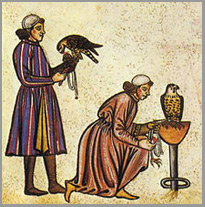
Falconry, An ancient art
And when Lori Michel isn’t on top of the garage helping to educate others about falcons, she’s tooling around on her lunch break as an IBM project manager, looking at other birds-of-prey hot spots in California: From the Campbell water tower to the Don Edward Wildlife Refuge to the Charleston Slough of the Palo Alto Baylands.
There’s no denying that Michel has the spark. And she’s hoping that by sharing her knowledge, others, maybe even little Mallory, might catch it too.
“Seeing these falcons in San Jose just captured my imagination,” Michel said. “Birds of prey are fierce. They circle and hunt, they stoop and grab prey, they pull off flesh and then they gently feed it to their young. I come here and can talk about topics like these, even though I don’t know people’s last names or what they do for a living.
“We just love our falcon circuit.”
By LISA FERNANDEZ – San Jose Mercury News
Share this:

Birds falling from the sky not unusual
The only unusual part of the recent spate of bird (and fish) die-offs is that people witnessed them.
THE GIST
- Thousands of birds and fish have died in large groups over the last January
- Scientists say events like these are normal in the wild and are usually caused by weather or disease.
- Most mass animal deaths occur far from human eyes, but that might change with development.
Red-winged blackbirds were among the animals that experienced a mass die-off over the past week.
It has been a bad week for wild animals.
Starting just before the turn of the New Year, 500 red-wing blackbirds died together in Louisiana. Some 100 jackdaws turned up dead on a street in Sweden. And in Arkansas, an estimated 100,000 fish went belly-up the day before 5,000 blackbirds slammed into roofs, mailboxes and the ground at full speed.
Such massive, dramatic and high profile events have fueled concerns that nature is coming to an end, or at least that something weird and disturbing is going on in the animal kingdom.
But, experts say, massive die-offs like these are not at all unusual.
From bats to whales to bees to frogs, wildlife health experts say, major mortality events happen every year for reasons that include bad weather, disease outbreaks and poisonings. The main reason this recent spate of events seems so strange is that, most of the time, mass deaths occur in places where nobody notices them.
“This is really not the unusual thing that people are trying to make it into,” said Robert Meese, an avian ecologist at the University of California, Davis. “A lot of this stuff happens without anyone documenting it.”
Dramatic die-offs are most common in animals that congregate or travel in large groups.
Migratory birds, for example, often become disoriented by fog or storms, causing them to run into towers, bridges, wind turbines and trees. On their long journeys, migratory birds may also accidentally ingest pesticides or even poisons that were left specifically for them. Weather can work against them, too, particularly if they migrate too soon in an unseasonably cold year.
Records kept by the United States Geological Survey list at least 16 die-offs of more than 1,000 blackbirds or starlings over the past 30 years, said Marisa Lubeck, a spokesperson for the USGS in Denver. But group deaths among animals have been going on for a lot longer than that.
In a review study published in 2007 in the journal Ibis, researchers looked through European and North American bird journals and other references dating back to the late 19th century. They found frequent reports of deaths of birds in the hundreds, thousands or more.
In one of the most extreme examples, an estimated 1.5 million Lapland Longspurs died during a March 1904 storm in Minnesota and Iowa.
And it’s not just birds that can die en masse. Tens of thousands of salmon died in Northern California’s Klamath River in 2002 when the water temperature got to high for them.
Strandings of whales, seals and turtles get occasional attention. In recent years, caves full of bats have been dying from white nose syndrome. And entire hives of bees have been going down for reasons that are still unclear.
Most of the time, when many animals die at once, they do it far from our daily lives in fields, caves, forests or national wildlife refuges, where animals often live at unusually high concentrations, and diseases can spread rapidly.
In Beebe, on the other hand, thousands of blackbirds had settled for the night in trees near people’s homes. After a series of fireworks blasts went off on New Year’s Eve, the birds were startled off their roosts. Because blackbirds can’t see at night, they ended up flying all over the place, mostly downward.
One bird made it into a house, when the homeowner opened the door to see what was causing the racket. Most landed on roofs and the ground, making loud clunking noises as they shattered themselves to death. Necropsies revealed internal hemorrhaging, with no sign of pesticides.
“They weren’t falling as dead carcasses,” Meese said. “They didn’t fall from the sky. They flew from the sky. That makes it less weird.”
Another unique aspect of the Beebe incident was that noise played a role, said Paul Slota, a spokesperson for the USGS National Wildlife Health Center in Madison, Wisc. While the Swedish birds also died after a fireworks event, he said, mass die-offs are more likely connected to disease or weather.
“I think people are very often surprised that this kind of phenomenon happens, that wildlife are susceptible to disease and that there are large outbreaks in the wild, because they often go unseen,” said Slota, who pointed out that the USGS investigates reports like these every year.
“I think people should be aware that mortality events in wildlife are normal. They are a fact of life.”
Reprinted from article By Emily Sohn – (Discovery News)
Share this:

Major Influence for Migrating Birds
Declining Rainfall Is a Major Influence for Migrating Birds
Instinct and the annual increase of daylight hours have long been thought to be the triggers for birds to begin their spring migration. Scientists at the Smithsonian Conservation Biology Institute, however, have found that that may not be the case. Researchers have focused on how warming trends in temperate breeding areas disrupt the sensitive ecology of migratory birds. This new research shows that changes in rainfall on the tropical wintering grounds could be equally disruptive.
The team’s findings are published in scientific journal Proceedings of the Royal Society B on March 30.
Many of the bird species that breed in the temperate forests, marshes and backyards of North America spend the winter months in the tropics of the Caribbean, and Central and South America. Insects are the primary food for many birds during the winter, and rainfall largely determines the amount of insects available. Climactic warming, however, is causing declining and more variable rainfall cycles in many areas, affecting the availability of insects and delaying when birds leave for their northern breeding grounds. To examine this, the Smithsonian scientists focused on American redstarts (Setophaga ruticilla), a member of the warbler family, at a non-breeding site in Jamaica where they conduct long-term studies.
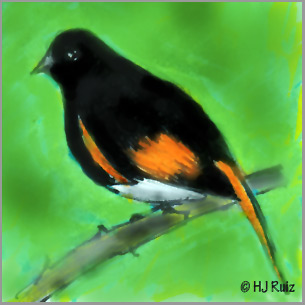
American Redstart © H.J. Ruiz illustration
“American redstarts were a perfect species for this study since they defend exclusive territories throughout the non-breeding period until they depart for spring migration and most return back to the same territory the following year,” said Pete Marra, research ecologist at the Smithsonian Conservation Biology Institute’s Migratory Bird Center. “These behaviors made it relatively easy to keep track of individual birds over multiple years and document changing spring departures. Each individual was fitted with a unique combination of colored leg bands.”
Precipitation in Jamaica is highly seasonal, with consistent rainfall from September to November and a pronounced dry season from January to March. The scientists observed the redstarts in their non-breeding territories for five years during the dry season. They paid special attention to the annual variation in dry season rainfall. The correlation between the amount of insects in a bird’s territory and the timing of its departure suggested to the team that annual variation in food availability was an important determining factor in the timing of spring migration. Had the redstarts relied on internal cues alone to schedule their spring departure, they would have all left their winter territories at the same time each year.
“Our results support the idea that environmental conditions on tropical non-breeding areas can influence the departure time for spring migration,” said Colin Studds, a postdoctoral fellow at the Smithsonian Conservation Biology Institute’s Migratory Bird Center and lead author of the study. “We found that the same birds changed their spring departure from one year to the next in relation to the amount of rainfall and food in March.”
During the past 16 years, the dry season in Jamaica has become both increasingly severe and unpredictable, leading to an 11 percent drop in total rainfall during the three-month annual drought. Making the future even more dire, climate models predict not only increased warming on temperate breeding areas but also continued drying in the Caribbean.
A critical question for the scientists is whether this variation in the onset of spring migration carries consequences for the birds. Delaying departure could be beneficial if food resources are low and the individual has not yet stored enough energy to migrate. However, delaying departure could affect arrival time to its breeding territory and result in less time to successfully reproduce. “Because American redstarts return to the same site to breed each year, arriving later may make it harder for them remain to remain in synch with their breeding cycle,” Studds said.
Story reprinted form ScienceDaily.
Share this:

Moving feeders to safer place
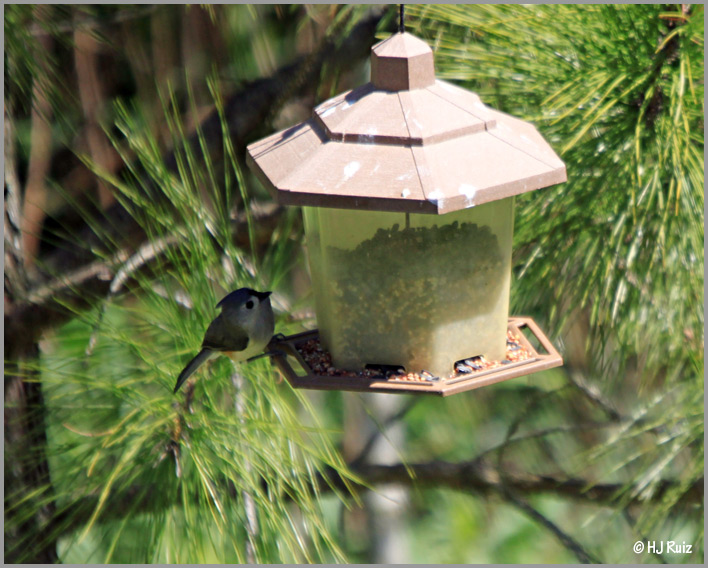
Yesterday I spent some time rearranging positions for my feeders, closer to the trees and bushes. It’s a lot safer for all birds. Not they don’t have to be eating in an open area where they are more vulnerable to predators.
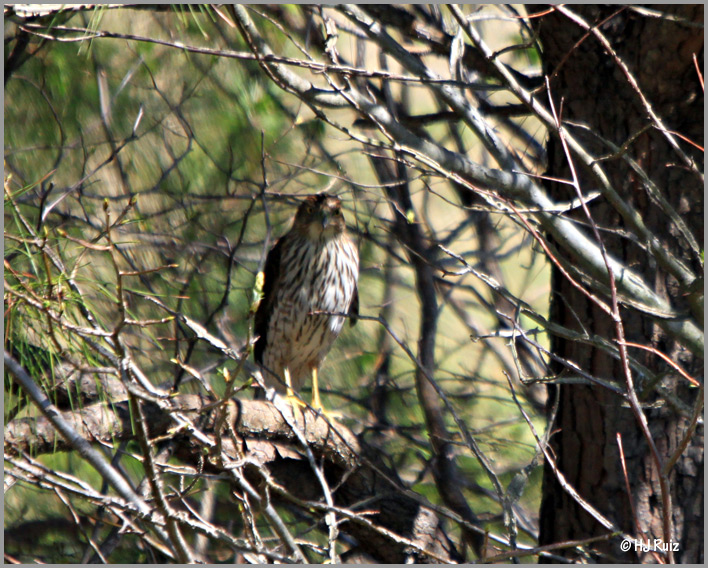
After I moved the feeders, didn’t take very long when a Cooper’s Hawk showed up but after a while, left with nothing, no casualties. I was glad in a way.
I also had a chance to photograph a Tufted Titmouse, not to easy to shoot because it moves to fast and never stays longer that a few seconds, It eats only the sunflower seeds, which I saw him cracking them open against the tree branch.
I’m not very happy with this set-up because it’s difficult to blur the background being so closed to the subject.
But I suspect that I’ll be getting more variety of species because it looks much safer for the birds. The sunlight is important for them related to safety. In an open area the sun may conceal a predator flying on a dive opposite to the sun.
I’ll be shooting from my deck now on in a different angle, I’ll try what I have now if not I’ll move the feeder to a more productive location.
-
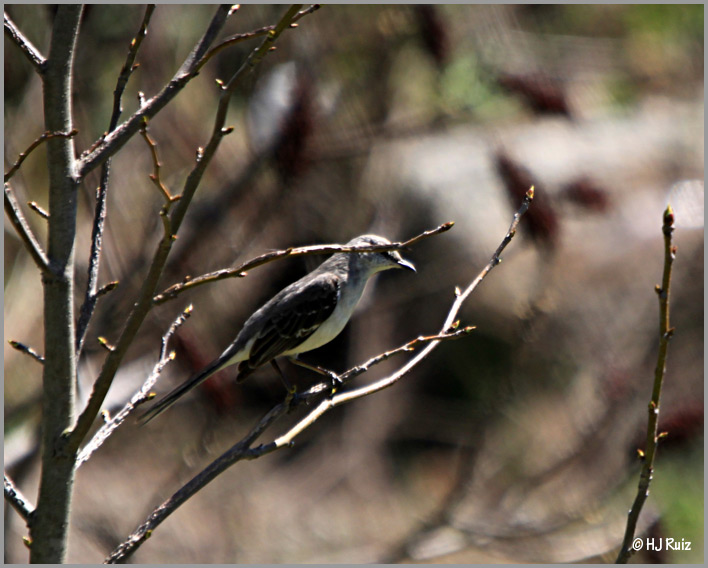
- Northern Mockingbird
-
- Tufted Titmouse
-
- Cooper’s Hawk
Share this:


Read Past Reviews

Book # 69

Quote from the Author
“A good chuckle is healthy, it helps you break the monotony of a serious life.” ~ H.J. Ruiz


You must be logged in to post a comment.