Kori Bustard
Kori Bustard – Spec. Name: Ardeotis kori
This is a large bird native to Africa. It is a member of the bustard family. It may be the heaviest bird capable of flight.
The Kori Bustard is mostly grey in color, with a black crest on its head and yellow legs. Kori Bustards are often found with bee-eaters riding on their backs as they stride through the grass. The bee-eaters make the most of their walking perch by hawking insects from the bustard’s back that are disturbed by the bustard’s wandering. This is a large and heavy bird, and it avoids flying if possible. It spends most of its time on the ground, foraging for the seeds and lizards which make up most of its diet.
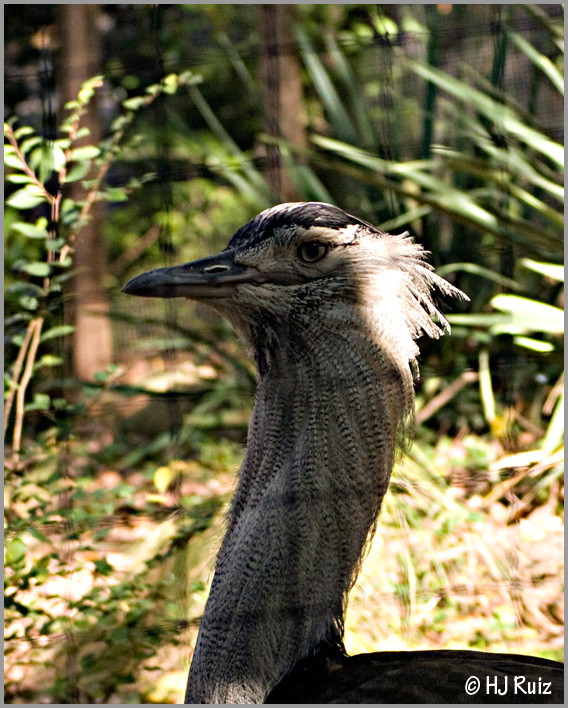
Kori Bustard
The male Kori Bustard averages about 110 cm (3.6 ft) in length, stands 60–90 cm (2.0–3.0 ft) tall and have a wingspan about cm 230 to 275 cm (7.5 to 9.02 ft). An average male bird would weigh about 12.4 kg (27 lb), but exceptional birds may weigh over 20 kg (44 lb). A report exists of a 34 kg (75 lb) bird, but it is not verified and must be held with skepticism because it so much heavier than any other recorded weight for a Kori Bustard. The female Kori Bustard averages 5.7 kg (13 lb) and is usually 20% shorter than a male.
Like all bustards, Kori Bustards have polygynous breeding habits, where one male displays to attract several females and mates with them all. He then leaves the females to care for the young by themselves. The females build a nest on the ground and incubate the eggs, foregoing eating for days. When the chicks hatch, the mother brings them a steady stream of food, most of it soft so the chicks can eat it easily.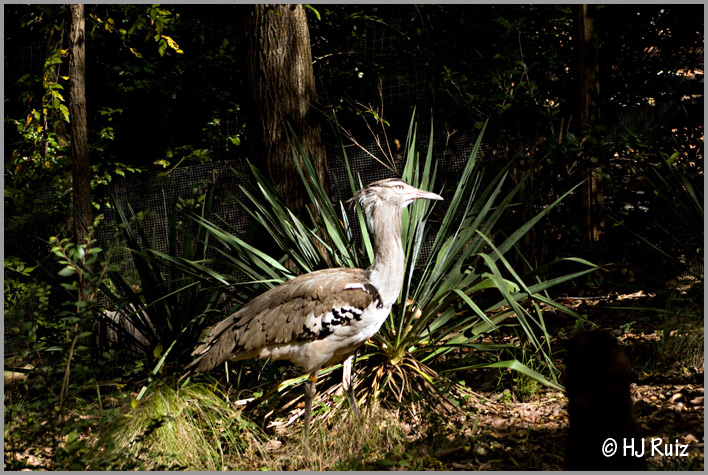
Kori Bustards are omnivorous birds, although they tend to be more carnivorous than other species of bustards. Insects form a large portion of their diet, especially when they are chicks. They also eat a variety of small mammals, lizards, snakes, seeds, and berries of plants. They have been observed eating carrion. They are purported to eat the gum from the Acacia tree. Discrepancy exists however, as to whether they are eating the gum itself, or the insects that might be stuck to the gum. Kori Bustards are one of the few species of birds that drink water using a sucking motion rather than scooping it up as most birds do.
Share this:

Southern Ground Hornbill
Southern Ground Hornbill – Spec. Name: Bucorvus Leadbeateri
This is one of two species of ground hornbill and is the largest species of hornbill.It is a large bird, at 90 to 129 cm (36 to 51 in) long. Females weigh 2.2 to 4.6 kg (4.8 to 10.1 lbs), while the larger males weigh 3.5 to 6.2 kg (7.6 to 13.6 lbs).[2] It is characterized by black coloration and vivid red patches of bare skin on the face and throat (yellow in juvenile birds). The white tips of the wings (primary feathers) seen in flight are another diagnostic characteristic. The beak is black and straight and presents a casque, more developed in males. Female Southern Ground Hornbills are smaller and have violet-blue skin on their throats.

Southern Ground Hornbill
Its habitat comprises savannahs, woodlands and grasslands. It can be found from northern Namibia and Angola to northern South Africa to Burundi and Kenya. The Southern Ground Hornbill is a vulnerable species, mainly confined to national reserves and national parks. They live in groups of 5 to 10 individuals including adults and juveniles. Often, neighbouring groups are engaged in aerial pursuits. They forage on the ground, where they feed on reptiles, frogs, snails, insects andmammals up to the size of hares. Juveniles are dependent on adults for 6 to 12 months.The other species of the genus Bucorvus is the Abyssinian Ground Hornbill, B. abyssinicus.
Share this:

Boat-tailed Grackle
Boat-tailed Grackle- Spec. Name: Quiscalus major
This is a passerine bird of the family Icteridae found as a permanent resident on the coasts of the southeastern USA. It is found in coastal saltwater marshes, and, in Florida, also on inland waters. The nest is a well-concealed cup in trees or shrubs near water; three to five eggs are laid.
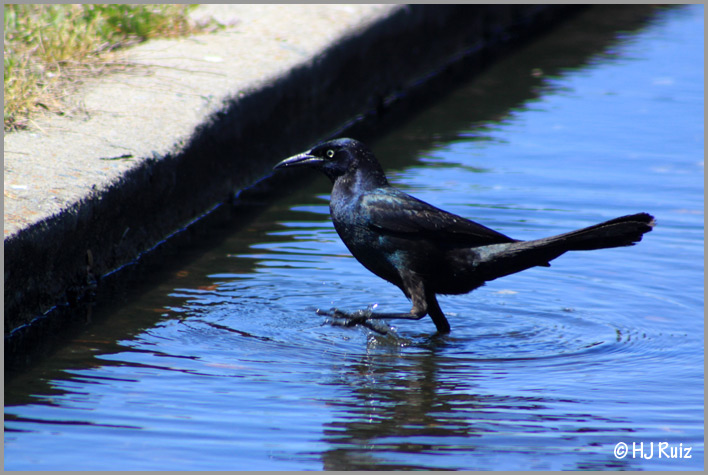
The male Boat-tailed Grackle is 42 cm (17 in) long. Adult males have entirely iridescent black plumage, a long dark bill, a pale yellowish or brown iris and a long keel-shaped tail. The 37 cm (15 in) long adult female is shorter tailed and tawny-brown in colour apart from the darker wings and tail.

Boat-tailed Grackle (M)
Young males are black but lack the adult’s iridescence. Immature females are duller versions of the adult female and have blotches or spots on the breast.
The Boat-tailed Grackle was first described by French naturalist Louis Jean Pierre Vieillot in 1819. Its specific epithet major, means “larger” in Latin. Despite its restricted range, there are four subspecies of the Boat-tailed Grackle, differing in size and iris colour. The Boat-tailed Grackle was once considered the same species as the Great-tailed Grackle. The Great-tailed species is of slightly smaller body size, but has a longer tail and lacks this species’ distinct domed head shape.
These birds forage on the ground, in shallow water, or in shrubs; they will steal food from other birds. They are omnivorous, eating insects, minnows, frogs, eggs,berries, seeds, and grain, even small birds.
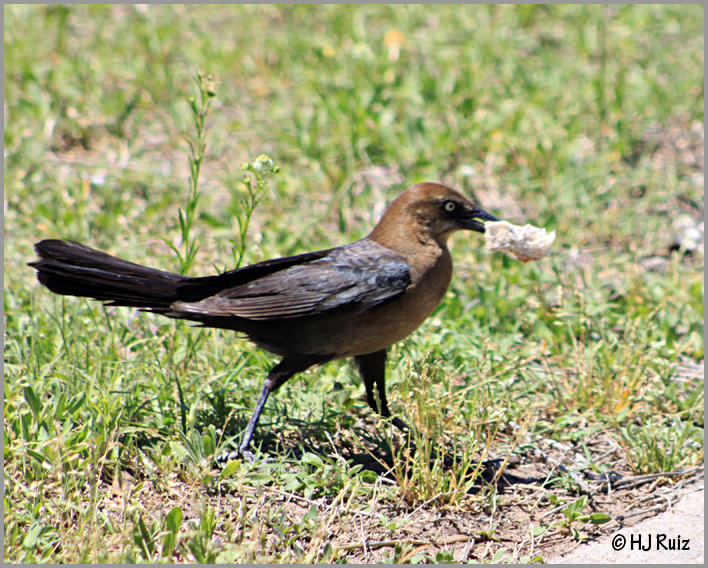
Boat-tiled Grackle (F)
Boat-tailed Grackles have established significant populations in several United States Gulf Coast cities and towns where they can be found foraging in trash bins, dumpsters, and parking lots.
This bird’s song is a harsh jeeb, and it has a variety of typically grackle-like chatters and squeaks.
The photographs I’m posting in this article were shot at Jeckyll Island offshore the coast of Georgia. The graclkes were everywhere foraging on discarded food from the picnic areas and parking lots.
Share this:

Peruvian Gull
Peruvian Gull (Band-tailed Gull) – Spec. Name: Larus Belcheri
Fairly common resident in nearshore waters along the coast. Mainly breeds on offshore islands north to Lambayeqye, also locally on mainland.
A large gull but slightly smaller than Kelp Gull.
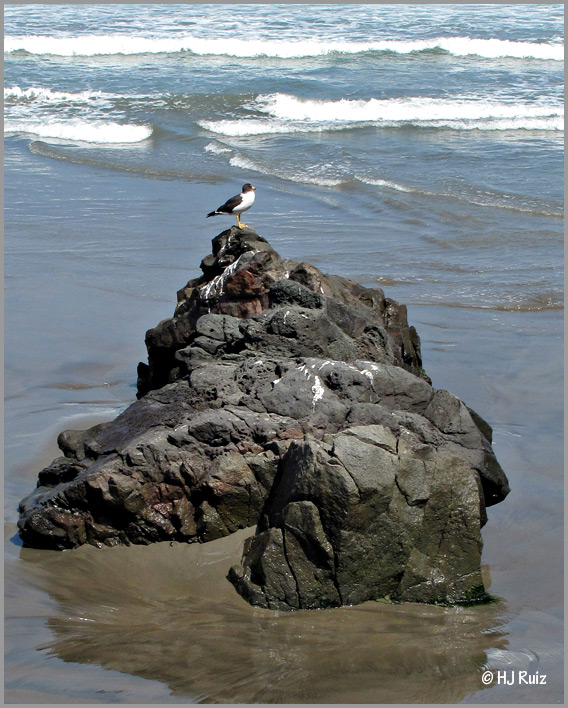
Peruvian Gull aka Band-tailed Gull
White-headed alternate adult distinguished from Kelp by black band on tail, brighter yellow (less greenish) tarsi, entirely dark wing tips and red tip to bill (red not restricted to a spot on mandible) Dark headed unmistakable. First-year birds also dark-headed unlike dark headed Kelp.
Voice:
Calls a clear, short “Yap” and “Yeow”. Laugh series is of clear notes that accelerate “Yaaah, yaaah – yah-yah-yah-yah-yah” Sometimes without the introductory notes.
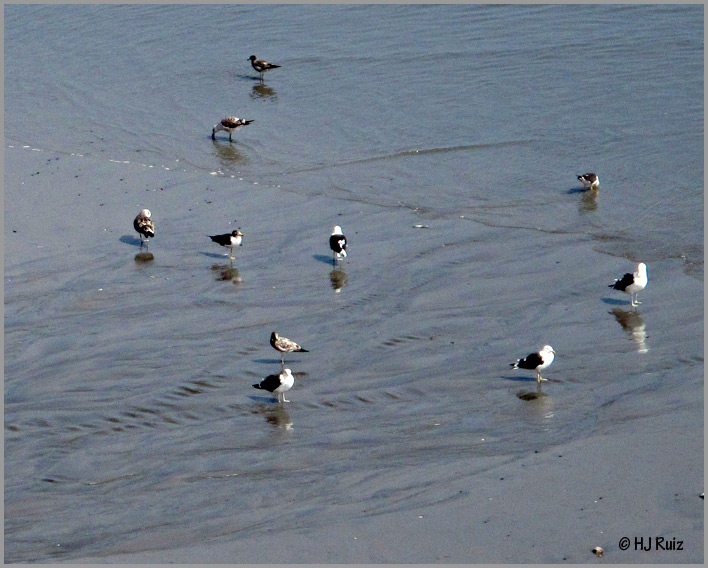
Group of Peruvian Gulls
Share this:


Read Past Reviews

Book # 69

Quote from the Author
“A good chuckle is healthy, it helps you break the monotony of a serious life.” ~ H.J. Ruiz


You must be logged in to post a comment.