Oldest Known Wild Bird in US Returns to Midway to Raise Chick
The bird, a Laysan albatross named Wisdom, was spotted a few weeks ago with a chick by John Klavitter, a U.S. Fish and Wildlife Service biologist and the deputy manager of the Midway Atoll National Wildlife Refuge.
The bird has sported and worn out 5 bird bands since she was first banded by U.S. Geological Survey scientist Chandler Robbins in 1956 as she incubated an egg. Chandler rediscovered Wisdom in 2001. In 1956, he estimated Wisdom to be at least 5 years old then since this is the earliest age at which these birds breed, though they more typically breed at 8 or 9 after an involved courtship lasting several years. This means, of course, that Wisdom is likely to be in her early sixties.
There must be something to all that fish oil she consumes because Wisdom does not look her age (see photo).
“She looks great,” said Bruce Peterjohn, the chief of the North American Bird Banding Program at the USGS Patuxent Wildlife Research Center in Laurel, Md. “And she is now the oldest wild bird documented in the 90-year history of our USGS-FWS and Canadian bird banding program,” he added. “To know that she can still successfully raise young at age 60-plus, that is beyond words. While the process of banding a bird has not changed greatly during the past century, the information provided by birds marked with a simple numbered metal band has transformed our knowledge of birds.”

A Laysan albatross named Wisdom, is at least 60 years old and was spotted in February 2011 raising a chick at the Midway Atoll National Wildlife Refuge in the Pacific Islands. The bird has sported and worn out 5 bird bands since she was first banded by U.S. Geological Survey scientist Chandler Robbins in 1956 as she incubated an egg. Robbins estimated Wisdom to be at least 5 years old then since this is the earliest age at which these birds breed, though they more typically breed at 8 or 9 after an involved courtship lasting several years. This means, of course, that Wisdom is more likely to be in her early sixties. (Credit: John Klavitter, U.S. Fish & Wildlife Service)
Wisdom, Peterjohn said, has likely raised at least 30 to 35 chicks during her breeding life, though the number may well be higher because experienced parents tend to be better parents than younger breeders. Albatross lay only one egg a year, but it takes much of a year to incubate and raise the chick. After years in which they have successfully raised and fledged a chick — which on Midway is about two-thirds of the time — the parents may take the occasional next year off from parenting. Klavitter said that Wisdom also nested in 2006, 2008, 2009 and 2010.
And since adult albatross mate for life, with both parents raising the young, it makes one wonder if Wisdom has had the same partner all these years or not.
Almost as amazing as being a parent at 60 is the number of miles this bird has likely logged — about 50,000 miles a year as an adult — which means that Wisdom has flown at least 2 to 3 million miles since she was first banded. Or, to put it another way, that’s 4 to 6 trips from Earth to the moon and back again with plenty of miles to spare.
One reason for all these miles is that Laysan albatross spend the first 3 to 5 years after fledging at sea, never touching land. Then they return to breed in the northwestern Hawaiian Island chain but some of their feeding grounds are actually off the coast of western North America, including the Gulf of Alaska. The parents tend to feed closer to the islands where their nests are when the chicks are very young, but they regularly commute to the northern Pacific Ocean and even the Gulf of Alaska when the chicks are older or when the adults are incubating. They convert the fish eggs and squid oil they eat into a rich, oily liquid, which they regurgitate and feed to their chick.
In the non-breeding part of the year, albatross do not touch land — the birds, scientists believe, often even sleep while flying over the ocean.
Peterjohn noted that Wisdom’s remarkable record is just one example of the valuable data provided by bird banding. In addition to establishing longevity records for birds, banding data from the North American Bird Banding Program documents migratory patterns, provides critical harvest and survival information used to manage populations of migratory game birds, and supports research activities on many issues from toxicology to disease transmission and behavior. Since 1920, approximately 64.5 million birds have been banded by this Interior Department-Canadian Wildlife Service program, and of those, nearly 4.5 million bands have been recovered.
About albatross
Albatross are legendary birds for many reasons — in Samuel Coleridge’s poem, “The Rime of the Ancient Mariner,” a sailor has to wear an albatross around his neck as punishment for killing the bird. According to seafaring legends, albatross are the souls of lost sailors and should not be killed. However, as reported by James Cook, sailors regularly killed and ate albatross.
Albatross are remarkable fliers who travel thousands of miles on wind currents without ever flapping their wings. They do this by angling their 6-foot wings to adjust for wind currents and varying air speeds above the water.
Nineteen of 21 species of albatross are threatened with extinction, according to the International Union for the Conservation of Nature. Present threats to the birds include lead poisoning of chicks on Midway from lead paint used in previous decades; longline fishing, where the birds are inadvertently hooked and drowned, though conservation groups have banded with fishermen and dramatically lowered the number of deaths from this cause; and pollution, especially from garbage floating on the ocean.
The birds ingest large amounts of marine debris — by some estimates 5 tons of plastic are unknowingly fed to albatross chicks each year by their parents. Although the plastic may not kill the chicks directly, it reduces their food intake, which leads to dehydration and most likely lessens their chance of survival. In addition, albatross are threatened by invasive species such as rats and wild cats, which prey on chicks, nesting adults and eggs. Albatross evolved on islands where land mammals were absent, so have no defenses against them.
The above story is reprinted (with editorial adaptations by ScienceDaily staff) from materials provided by United States Geological Survey.
Share this:

House Finches expecting!
Yesterday was a bright and invigorating day weather wise. I made those remarks going shopping with my wife Lucy and grandson Tyler. It is the “perfect” weather to my opinion. It’s the combination of warmth, soothing cool breeze and bright sunshine added to a wonderful blue sky and snow like white clouds.
We returned home from shopping and a few minutes later, my next door neighbor Jennifer knock on the door to let me know that there’s a bird nest with eggs in the wreath hanging at her front door.

Four eggs in the nest of Finch family
She came to me to ask me what to do, I asked her to let them be and wait until they hatch and grow enough to fly away and then she can remove the nest. Meanwhile I took some pictures of the nest and we waited a short while and I saw the proud parents getting closer then I took some more pictures.
She told me that I was welcomed to go any time and shoot more pictures. She also gets very enthusiastic about seeing the nest and will be even more exciting when the eggs hatch and have little chicks. I’m excited too. I hope I’d be able to photo document this event.
Wish me luck on that project.
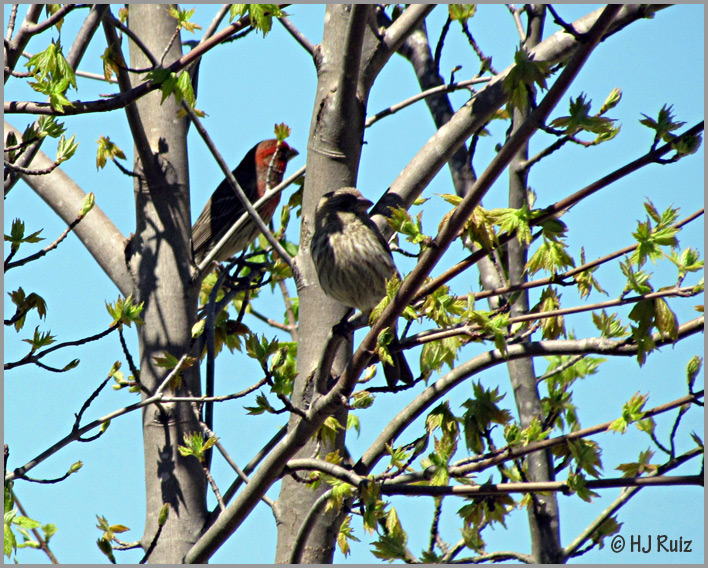
This couple of House Finches are the proud parents
Share this:

Saving One of the World’s Most Endangered Birds
The Tuamotu Kingfisher is a multicolored, tropical bird with bright blue feathers, a dusty orange head, and a bright green back. The entire population of these birds — less than 125 — lives on one tiny island in the south Pacific, and without serious intervention, they will no longer exist. One University of Missouri researcher is trying to stop the birds’ extinction by working with farmers and residents on the island inhabited by the kingfishers.
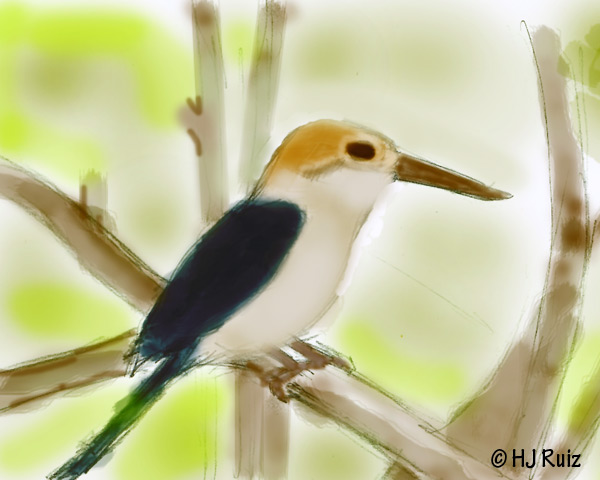
Tuamotu Kingfisher
“If we lose these birds, we lose 50,000 years of uniqueness and evolution,” said Dylan Kesler, assistant professor in fisheries and wildlife at the University of Missouri’s School of Natural Resources in the College of Agriculture, Food and Natural Resources. “Because it has lived in isolation for a very long time, it’s unlike any other bird. There is no other bird like this on the planet.”
In new studies published in the journal The Auk (published by the American Ornithologists Union) and the Journal of Wildlife Management, Kesler and his team of researchers have uncovered important information to help ensure the birds’ survival and a unique way to attach radio transmitters to the birds to track them.
To survive, the kingfishers need several specific habitat characteristics:
- Hunting Perches about 5 feet off the ground — The birds hunt by “pouncing.” They watch their prey and then fall on them from hunting perches about 5 feet high. Without the perches in broadleaf trees at the appropriate height, the birds have no way to hunt.
- Exposed ground — the birds’ food consists mainly of lizards, which are easier to spot where the ground is clear of vegetation. When coconut farmers conduct intermediate burns on their land — which are hot enough to kill brush, but do not lead to widespread fires or kill the lizards — it exposes more ground and the birds can see the lizards.
- Dead trees for nesting — the birds create nests by flying into dead trees and hollowing cavities. Live trees are too hard and many farmers cut down their dead coconut trees. By encouraging farmers to leave some dead trees, the birds will continue to be able to build nests.
- Lessoning the impact of predators — cats and rats, which were introduced to the island by humans, now hunt the Tuamotu Kingfisher. By wrapping metal bands around the trees, the predators are less likely to get into the nests, but Kesler is still searching for other solutions that might alleviate the pressure on the birds.
In a separate study, Kesler also developed a “weak-link” radio harness for the birds to wear. In previous studies with different birds, scientists have reported unintentional harm to the birds after attaching radio transmitters. That harm included scratching the birds, making the birds act peculiarly and introducing infections. Using this new harness, Kesler was able to track the birds during the study, and the harness was shed within two months.
“Unfortunately, even with all our work to date, the population is still crashing,” Kesler said. “We’re seeing some turnover, but each year when we return, there are more empty territories and the population decreases. At this rate, these birds will be gone within our lifetime.”
Story Source:
The above story is reprinted (with editorial adaptations by ScienceDaily staff) from materials provided by University of Missouri-Columbia.
Share this:

Don’t miss this one!
One absolutely interesting adventure! Simply marvelous computer generated animation. Pure art and entertainment!
Share this:


Read Past Reviews

Book # 69

Quote from the Author
“A good chuckle is healthy, it helps you break the monotony of a serious life.” ~ H.J. Ruiz


You must be logged in to post a comment.