The amazing flyers!
The fact that birds can fly is amazing enough for my neophyte birder mind. But when observing closely when they fly, those skills are beyond our comprehension of physical abilities. Seeing a bird flying at an accelerated rate of speed and cut that fly to a dead stop and stand on a branch or a twig. It blows my mind!

C. Chickadee flying from feeder to bird house
I see it happen everyday in my backyard! Such as when a Carolina Chickadee flies from his nest in a bird house (with a circular opening that is hardly big enough to accommodate the passage of his body) to the feeder then pick a sunflower seed and at a tremendous speed head back to the bird house… (at this moment is when it comes my amazement)
The bird never hesitates or stops to aim for the hole, he just shoots directly into the house like a bullet! No slowing down! The inside of the bird house is approximately 4 inches deep.
Here is what’s in play:
- – High speed flying.
- – Stopping in a short confined space.
- – Principals of Inertia- velocity, momentum factors of motion
- – Calculations of speed-distance-direction and drag.
- – All these factors calculated in fractions of a second as we say on the fly (No pun)

I figure that birds, since they are descendant of the dinosaurs (as we know to be some of the oldest species that inhabited the Earth) have evolved not so much on intellect but on superior motor-reflexes and have developed superb flying techniques.
If you ask me,birds are indeed amazing creatures!
Share this:

House Finches II
Do you remember the House Finches nest that is in my neighbor’s wreath? (Blog April 14th)
The nest held 4 House Finch eggs… not anymore!, Today those eggs have hatched and now we have 4 little chicks!
_ I congratulated my neighbor, I told her that she’s a mother again! She smiled!
This morning while I was in my backyard looking around I met a friend neighbor that walks his dog daily he stopped by to talk a bit , he was making some comments about trees and feeders, when suddenly I saw my next door neighbor approaching and with emotion in her voice she told me that the eggs from the nest are hatching! I went quickly not before grabbing a camera.

Three new chicks just hatched!
Believe me I was excited myself when I saw the little creatures that had just come out from the eggs. I counted only three chicks and one egg not hatched.
I used my camera for some shots but it was kind of hard because the chicks were all bunched up and covered with feather down from the nest.
I decided to leave them alone because I saw the desperate mother flying nearby trying to get to the nest.
Half hour later I took a look again and noticed that the fourth egg had just hatched because the chick was still in the process of getting out of the shell.
I’m going to let them settle and dry a bit before I visit them again. I saw the mother flying around also, I do not want to interfere. I shot some pictures but in a haste. I’ll get better ones later I’m sure.

One egg wasn't hatched yet!
Describing the chicks: They are so tiny and fragile, they have bare skin and reddish. their beaks look so big in comparison to their heads. They move constantly and then bunch together to keep warm I guess.
I wish them the best in their lives, I thank them for giving me the opportunity to see them come to life, it’s been a great experience.
My next project will be to keep track of them if I can; until the day they will fly away.

The fourth egg did hatch!
Share this:

Bird Houses Damaged
Two nights ago we had tremendous storms pounding our area; with high winds, thunder and lightning, a relentless rain dumping lots of water and damaging many trees and homes in many places near our County.
You’ve very likely seen on TV the news giving information about the storms moving all through the deep South. Everybody was mainly concerned about the creation of tornados. In several States tornados touched ground causing tremendous amount of physical damage, destroying many homes and the unfortunate loss of lives.
Of course we did not get tornados in our area, however the wind was very strong. Rained buckets if you ask me. I keep track of the weather alerts for any warnings as a precaution.
Next morning I went down to my backyard to assess the situation, I found no trees down, the ground was soft and muddy, then I found four bird houses damaged beyond repair 😦
It;s a pity that this happened even when they’re replaceable wooden things. We had those on our backyard for three years.
Now, can you imagine how would one feel when your home is totaled by a tornado? My goodness! That’s terrible! I really feel bad for the people that lost their home and my heart bleeds for the ones that lost a member of their family.


Share this:

Mallard
Mallard, or wild duck – Spec. Name: Anas Platyrhynchos
This is a dabbling duck which breeds throughout the temperate and subtropical Americas, Europe, Asia, and North Africa, and has been introduced to New Zealand and Australia.
The male birds have a bright green head, while the female’s is light brown. The Mallard lives in wetlands, eats water plants, and is gregarious. It is also migratory. The Mallard is the ancestor of all domestic ducks, and can interbreed with other species of genus Anas. However, a potentially terminal side effect of this vast interbreeding capability is gradual genetic dilution, which is causing rarer species of ducks to become at risk for extinction.
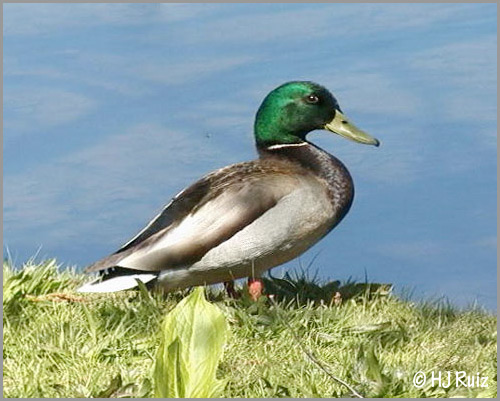
Mallard (M)
Taxonomy and evolution
The Mallard was one of the many bird species originally described by Linnaeus in his 18th century work, Systema Naturae, and still bears the first binomial name given to it.
The Mallard is the ancestor of almost all of the varieties of domestic ducks. Ducks belong to the subfamily Anatinae of the waterfowl family Anatidae. The wild Mallard and Muscovy duck (Cairina moschata) are believed to be the ancestors of all domestic ducks.
The name is derived from the Old French malart or mallart “wild drake”, although its ultimate derivation is unclear. It may be related to an Old High German masculine proper name Madelhart, clues lying in the alternate English forms “maudelard” or “mawdelard”.
Mallards frequently interbreed with their closest relatives in the genus Anas, such as the American Black Duck, and also with species more distantly related, for example the Northern Pintail, leading to various hybrids that may be fully fertile. This is quite unusual among different species, and apparently is because the Mallard evolved very rapidly and not too long ago, during the Late Pleistocene only. The distinct lineages of this radiation are usually kept separate due to non-overlapping ranges and behavioural cues, but are still not fully genetically incompatible. Mallards and their domesticated conspecifics are, of course, also fully interfertile.
Mallards appear to be closer to their Indo-Pacific relatives than to their American ones judging from biogeography. Considering mtDNA D-loop sequence data, they may have evolved more probably than not in the general area of Siberia; Mallard bones rather abruptly appear in food remains of ancient humans and other deposits of fossil bones in Europe, without a good candidate for a local predecessor species. The large ice age paleosubspecies which made up at least the European and west Asian populations during the Pleistocene has been named Anas platyrhynchos palaeoboschas.

Two Mallards and a Pekin duck
Haplotypes typical of American Mallard relatives and Spotbills can be found in Mallards around the Bering Sea. The Aleutian Islandsturned out to hold a population of Mallards that appear to be evolving towards a subspecies, as gene flow with other populations is very limited.
The size of the Mallard varies clinally, and birds from Greenland, although larger than birds further south, have smaller bills and are stockier. It is sometimes separated as subspecies, the Greenland Mallard (A. p. conboschas).
The Mallard is 56–65 centimetres (22–26 in) long (of which the body makes up around two-thirds), has a wingspan of 81–98 centimetres (32–39 in), and weighs 0.9–1.2 kilograms (32–42 oz). The breeding male is unmistakable, with a bright bottle-green head, black rear end and a yellowish orange (can also contain some red) bill tipped with black (as opposed to the black/orange bill in females). It has a white collar which demarcates the head from the purple-tinged brown breast, grey brown wings, and a pale grey belly. The dark tail has white borders. The female Mallard is a mottled light brown, like most female dabbling ducks, and has buff cheeks, eyebrow, throat and neck with a darker crown and eye-stripe. However, both the female and male Mallards have distinct purple speculum edged with white, prominent in flight or at rest (though temporarily shed during the annual summer moult). Upon hatching, the plumage coloring of the duckling is yellow on the underside and face (with streaks by the eyes) and black on the backside (with some yellow spots) all the way to the top and back of the head. Its legs and bill are also black but they gradually change color with age. As it nears the end of the fledgling period, the duckling is now a juvenile and its plumage becomes drab, looking more like the female (though its plumage is more streaked), but its gender can be easily distinguished by the coloring of its bill: Black/orange for females and yellow for males plus a slightly reddish breast. During the final period of maturity leading up to adulthood, the plumage of female juveniles remains the same while the plumage of male juveniles slowly changes to its recognizable colors. This also applies to adult Mallard males near the end of the molting period when they transition out of their non-breeding (eclipse) plumage.
Several species of duck have brown-plumaged females which can be confused with the female Mallard. The female Gadwall (A. strepera) has an orange-lined bill, white belly, black and white speculum which is seen as a white square on the wings in flight, and is a smaller bird.
In captivity, domestic ducks come in wild-type plumages, white, and other colours. Most of these colour variants are also known in domestic Mallards not bred as livestock, but kept as pets, aviary birds, etc., where they are rare but increasing in availability.
A noisy species, the male has a nasal call, and a high-pitched whistle, while the female has a deeper “quack” stereotypically associated with ducks.
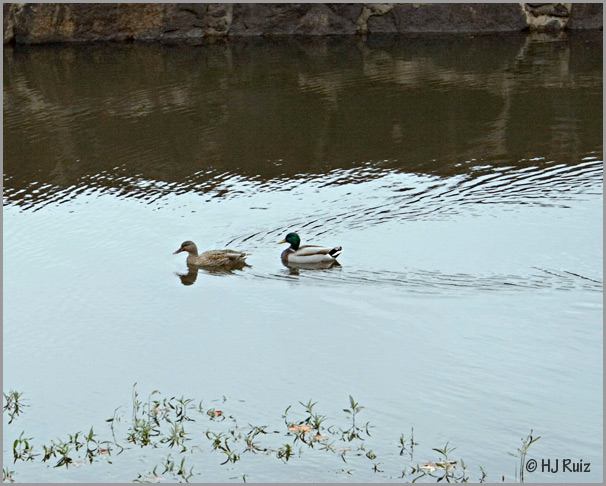
Mallards swimming, Female leads.
The Mallard is a rare example of both Allen’s Rule and Bergmann’s Rule in birds. Bergmann’s Rule, which states that polar forms tend to be larger than related ones from warmer climates, has numerous examples in birds. Allen’s Rule says that appendages like ears tend to be smaller in polar forms to minimize heat loss, and larger in tropical and desert equivalents to facilitate heat diffusion, and that the polar taxa are stockier overall. Examples of this rule in birds are rare, as they lack external ears. However, the bill of ducks is very well supplied with blood vessels and is vulnerable to cold.
Text is available under the Creative Commons Attribution-ShareAlike License; additional terms may apply. See Terms of Use for details.
Wikipedia® is a registered trademark of the Wikimedia Foundation, Inc., a non-profit organization.
Share this:


Read Past Reviews

Book # 69

Quote from the Author
“A good chuckle is healthy, it helps you break the monotony of a serious life.” ~ H.J. Ruiz


You must be logged in to post a comment.