
Not so frequent visitor…
Yesterday as busy day for us with lots of things to do in the house. Our kitchen froor was being replaced, we had to move lots of things out. I’m sure that you get the picture.
Despite all the work and disarray we were happy to see how nice it looked when it was ready.

American Goldfinch (M)
Then my day got even better when I had a very precious and not so frequent visitor in my backyard. An American Goldfinch!.
Being a common bird in this part of Georgia, it is very rarely that they stop to eat at my feeders. Maybe they feel intimidated by other birds or I don’t know what other reason they have but sometimes I see them flying by and look around but the don’t stay. For yesterday’s rare occasion there was no other birds around.
I couldn’t get better shots unfortunately, I was far and had to shoot through a window.
But I’m happy to have seen an A. Goldfinch stop in my backyard. These birds are so beautiful and bright… By the way I wonder about how it manages to survive being so visual? Might be the reason why they are so cautious about going to the feeders.
I think that I’ll do some research on that a bit, I’m intrigued!
Share this:

Feminine Bird Beauty Thrives on Competition
In African Starling species where several adults tend the chicks of one mother, females tend to grow as big and flashy as the males, says Dustin Rubenstein of Columbia University. In nests without extra helpers, dad tends to outshine mom in finery.
What’s likely pushing these female starlings to iridescent glory in cooperative breeding species is an intense rivalry to be the nesting group’s egg-layer, according to Rubenstein and Irby Lovette of Cornell Laboratory of Ornithology in Ithaca, N.Y.
Having to compete with other female starlings for any advantage — in food or status or outright male attention — cranks up the evolutionary pressures on females, Rubenstein and Lovette argue in the Dec. 10 Nature. Among cooperative breeders, females face evolutionary forces such as the sexual selection that drives competitive males to peacock extravagance.
The study represents the first time researchers have analyzed how female ornamentation relates to cooperative breeding, says behavioral ethologist Trond Amundsen of the Norwegian University of Science and Technology in Trondheim, who was not involved in the study.
“Why females are beautiful in the animal world is a question that has been neglected until the last decade or two,” Amundsen says. In plenty of the well-studied bird species, for example, females look drab compared with males. Darwin and most evolutionary biologists after him focused on male colors, tails, crests and other ornaments when musing about how such frippery evolves without obviously contributing to survival.
Rubenstein and Lovette looked at female ornamentation in African starling species, which come in a range of fancy feathers in iridescent purples and greens and blues. The researchers worked out a family tree of 45 starling species and mapped out breeding and physical traits by examining 1,614 museum specimens as well as published descriptions of these species.
The researchers found that more than 80 percent of the cooperative breeders had females that looked like males, but only about 30 percent of the noncooperative breeders did. The variations among the species suggest that the females are catching up with the males’ ornamentation instead of males drabbing down to match females, the researchers say.
In theory, this link between social living and intense selection on females could show up in other animals, Rubenstein suggests.

Competition, competition!
“The longstanding dogma has been that males are subject to more intense sexual selection,” says Eileen Lacey of the University of California, Berkeley. But some research on cooperative-breeding mammals has found evidence of strong competition among females to reproduce. Now, there’s a growing realization that, depending on the species, rivalries can vary in intensity, she says, “and may even be more intense on females than males.”
Reprinted from: By Susan Milius, Science News
Share this:

Know about ancient birds: Confuciusornis
Confuciusornis
Is a genus of primitive crow-sized birds from the Early Cretaceous Yixian and Jiufotang Formations of China, dating from 125 to 120 million years ago. Like modern birds, Confuciusornis had a toothless beak, but close relatives of modern birds such as Hesperornis and Ichthyornis were toothed, indicating that the loss of teeth occurred convergently in Confuciusornis and living birds. It is the oldest known bird to have a beak. It was named after the Chinese moral philosopher Confucius (551–479 BCE). Confuciusornis is one of the most abundant vertebrates found in the Yixian Formation, and several hundred complete, articulated specimens have been found. Confuciusornis was about the size of a modern pigeon, with a wingspan of up to 0.7 meters (2.3 ft) and a weight of up to 0.5 kilograms. Fossils of Confuciusornis show that it had an exceptionally large humerus (upper arm bone), and a characteristic hole near its shoulder-end may have reduced the bone’s weight. The furcula or wishbone was a simple bar, like that of Archaeopteryx. The sternum (breastbone) was relatively large and had a low keel which was raised at the back end. This bony keel may or may not have anchored a larger, cartilaginous, keel for enlarged pectoral muscles. The scapula (shoulder blades) were fused to the coracoid bones and may have formed a solid base for the attachment of wing muscles. The orientation of the shoulder joint was sideways, instead of angled upward as in modern birds; this means thatConfuciusornis was unable to lift its wings above its back. Like Archaeopteryx, it was thus incapable of the upstroke required for flapping flight.
Confuciusornis was more advanced than Archaeopteryx in possessing a short tail with a pygostyle (a bone formed from a series of short, fused tail vertebrae), but more primitive than modern birds in retaining large claws on the forelimbs, a primitive skull, and relatively small breastbone. The proportions of the toes suggest that they were used for both walking and perching, while the large claws of the thumb and third finger were probably used for climbing. The head probably had a small crest or tuft similar to that in today’s mousebirds or turacos.
Feathers and flight
The wing feathers of Confuciusornis were long and modern in appearance. The primary wing feathers of a 0.5 kilogram individual reached 20.7 centimeters in length, about the same proportions as in the Common Wood Pigeon, which is similar in size and overall wingspan. The longest primary feathers (remiges) were more than three times the length of the hand and relatively longer than those of any living bird, while the secondary feathers were rather short by comparison. Thus, the wing shape was very unlike that of living birds, being long and narrow. In 2010, Nudds and Dyke published a study arguing that in both Confuciusornis and Archaeopteryx, the rachis(central shaft) of the primary feathers were too thin and weak to have remained rigid during the power strokes required for true flight.
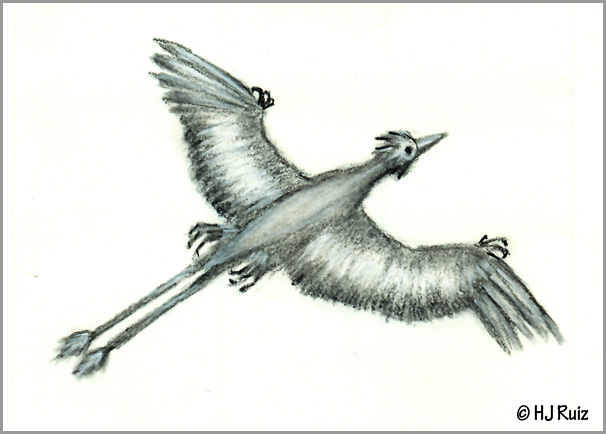
Confuciusornis - Graphic © HJ Ruiz
Instead, they argued, Confuciusorniswould have employed gliding flight, which is also consistent with the unusual adaptations seen in its upper arm bones. Gregory Paul, however, disagreed with their study. He argued that Nudds and Dyke had overestimated the weights of these early birds, and that more accurate weight estimates allowed powered flight even with relatively narrow rachises. Nudds and Dyke assumed a weight of 1.5 kilograms for Confuciusornis, as heavy as the modern teal. Paul argued that a more reasonable body weight estimate is about 180 grams, less than that of a pigeon. Paul also noted that Confuciusornis is commonly found as large assemblages in lake bottom sediments with little to no evidence of extensive postmortem transport, and that it would be highly unusual for gliding animals to be found in such large numbers in deep water. Rather, this evidence suggests that Confuciusornis traveled in large flocks over the lake surfaces, a habitat consistent with a flying animal.
Many individuals show long, streamer-like tail feathers that may indicate sexual dimorphism and could have been used in courtship display, but the rest of the tail feathers were small and probably of little use in flight.
Diet
There are immature specimens known, and from the analysis of bone growth patterns of young adults it has been estimated that Confuciusornis reached maturity somewhat slower than extant small birds, but faster than advanced dinosaurs (de Ricqlès et al., 2003), which might indicate an omnivorous diet similar to modern crows.
It has been hypothesized that Confuciusornis fed on plant materials due to its toothless beak, but no gastroliths or stomach contents had been reported (Zhou & Zhang, 2003). Dalsätt and colleagues (2006) described a specimen (IVPP V133) that preserves 7 to 9 vertebrae and several ribs of a fish (probably Jinanichthys). These fish bones are formed into a tight cluster about 6 millimeters across, and the cluster is in contact with the seventh and eighth cervical vertebrae of the bird. In this position it was likely in the crop of the bird, which may have been preparing to regurgitate a pellet when it died. No other fish remains are present in the slab. (Dalsätt et al., 2006).
The paradise kingfishers (genus Tanysiptera) of modern Australia and New Guinea have elongated “racket plumes” as their central tail feathers, giving them a superficial resemblance to Confuciusornis. These kingfishers also take fish as prey, but they are not specialized fishers. They take many insects and other small prey from their forest habitat.
Colouration
In early 2010, a group of scientists led by Zhang Fucheng examined fossils with preserved melanosomes (organelles which contain colors). By studying such fossils with an electron microscope, they found melanosomes preserved in a fossil Confuciusornis specimen, IVPP V13171. The melanosomes where of two types, eumelanosomes andpheomelanosomes. This indicates that Confuciusornis had hues of grey, red/brown and black, possibly something like the modern zebra finch. It was also the first time an early bird fossil has been shown to contain preserved pheomelanosomes.
Text is available under the Creative Commons Attribution-ShareAlike License; additional terms may apply. See Terms of Use for details.
Wikipedia® is a registered trademark of the Wikimedia Foundation, Inc., a non-profit organization.
Share this:

White-crowned Sparrow
White-crowned Sparrow – Spec.Name: Zonotrichia Leucophrys
This is a medium-sized sparrow native to North America.
Adults are 18 cm (7 in) long and have black and white stripes on their head, a grey face, brown streaked upper parts and a long tail. The wings are brown with bars and the underparts are grey. Their bill is pink or yellow. They are similar in appearance to the White-throated Sparrow but do not have the white throat markings.
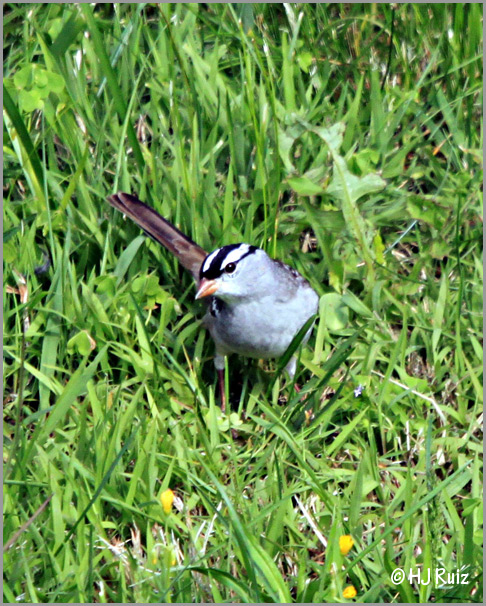
White-crowned Sparrow
Breeding
Their breeding habitat is brushy areas across northern Canada and the western United States. They nest either low in bushes or on the ground under shrubs and lay 3-5 brown-marked grey or greenish-blue eggs.
Subspecies
There are five currently recognized subspecies of white-crowned sparrow (pugetensis, gambelii, nuttalli, oriantha, and leucophrys), varying in migratory behaviour and breeding habitat. The Nuttall’s subspecies are permanent residents in California, while the Gambel’s subspecies may migrate as far as the Arctic Circle during the summer breeding season. Northern birds migrate to the southern United States.
Vagrancy
White-crowned Sparrow is a very rare vagrant to western Europe. One was present in County Cork, Ireland in May 2003. Another was found in Norfolk, England in January 2008. A young sparrow was also observed in Ona, Norway in October 2009. A young bird was seen in Surrey, England in May 2010.
Behavior
These birds forage on the ground or in low vegetation, but sometimes make short flights to catch flying insects. They mainly eat seeds, other plant parts and insects. In winter, they often forage in flocks.
Migration alertness
The White-crowned Sparrow is known for its natural alertness mechanism, which allows it to stay awake for up to two weeks during migration. This effect has been studied for possible human applications, such as shift-work drowsiness or truck driving.
Note:
From H.J. Ruiz (Avian101)
For the first time I’ve been able to photograph the White-crowned Sparrow in my backyard. At first I thought that it was the White-throated Sparrow from the distance. Then I noticed the lack of the yellow markings on the brow.
I’m very happy to add one more species of birds on my list.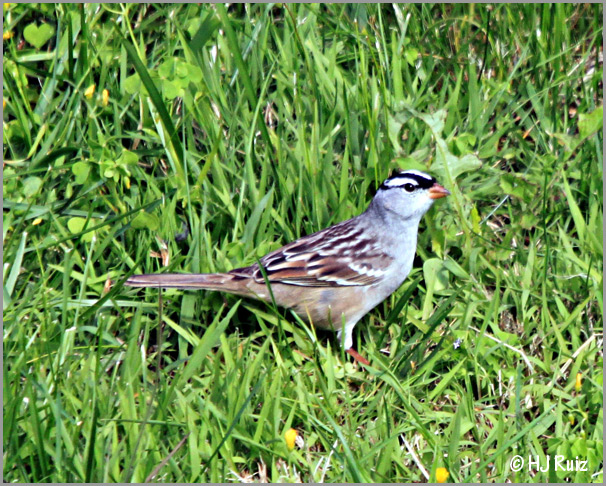
Share this:


Read Past Reviews

Book # 69

Quote from the Author
“A good chuckle is healthy, it helps you break the monotony of a serious life.” ~ H.J. Ruiz


You must be logged in to post a comment.