
Learn how to build a nest from the best!
There’s no doubt, survival is the best incentive to advance your knowledge.
Share this:

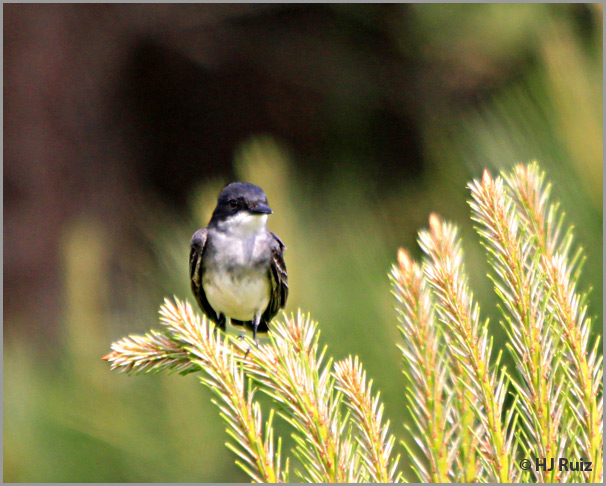
Eastern Kingbird
I’m very happy to add another species of bird visiting my backyard. It makes me so proud to introduce:
Eastern Kingbird – Spec.Name: Tyrannus Tyrannus
This is a large Tyrant flycatcher. Adults are grey-black on the upperparts with light underparts; they have a long black tail with a white end and long pointed wings. They have a red patch on their crown, seldom seen. They are of average size for a kingbird, at 19–23 cm (7.5–9 in), 33–38 cm (13–15 in) across the wings and weighing 33-55 g (1.2-1.9 oz).
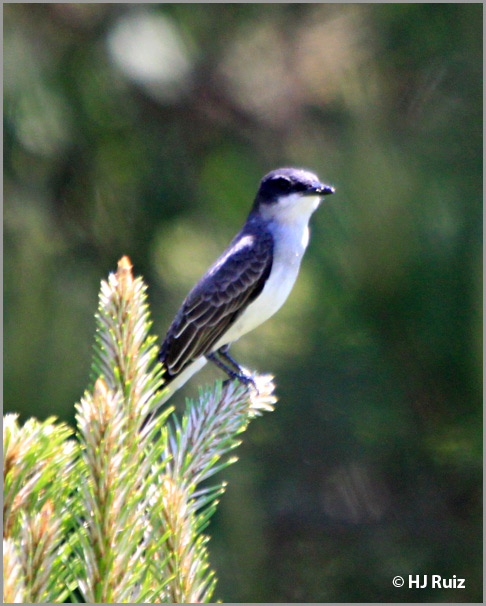
Eastern Kingbird
The call is a high-pitched, buzzing and unmusical chirp, frequently compared to an electric fence.
Their breeding habitat is open areas across North America. They make a sturdy cup nest in a tree or shrub, sometimes on top of a stump or pole. These birds aggressively defend their territory, even against much larger birds.
These birds migrate in flocks to South America.
They wait on an open perch and fly out to catch insects in flight, sometimes hovering to pick food off vegetation. They also eat berries and fruit, mainly in their wintering areas.
Some Eastern Kingbirds place their nests in the open while others hide nests very well. Eastern Kingbirds in Southern British Columbia can nest in open fields; in shrubs over open water; high in tall trees and even in the tops of small stumps. It has been shownthat those pairs that hide their nests well tend to be less aggressive towards intruders near the nest (perhaps relying on nest cover), while pairs that nest in the open tend to be more overtly aggressive to intruders. Both male and female participate in nest defense, but females may stay on well-hidden nests longer than females with open nests who may leave nests earlier to chase away predators. Those pairs nesting in the open may be able to see predators coming earlier and rely on aggressive behavior to protect their young.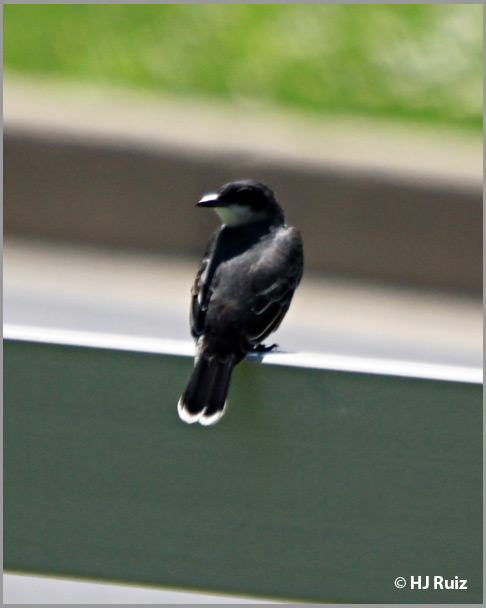
The aggressive behavior of Eastern Kingbirds has been shown to keep ravens and crows from finding experimental nests placed near kingbird nests. Similar experimental nests placed far from the kingbird nests were found far more often by crows and ravens. They can also recognize and remove cowbird eggs from their nests. Still, blue jays, american crows, squirrels and tree-climbing snakes are occasion nest predators. American kestrel are probable predators of adults.
Photographs are © 2011 H.J. Ruiz “My backyard Visitors”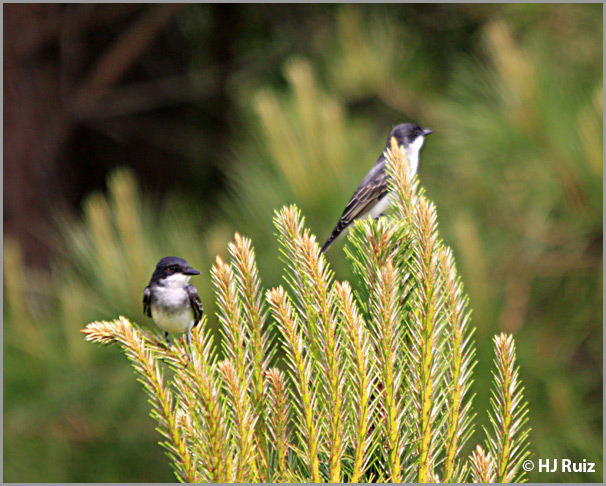
 Text is available under the Creative Commons Attribution-ShareAlike License; additional terms may apply. See Terms of Use for details.
Wikipedia® is a registered trademark of the Wikimedia Foundation, Inc., a non-profit organization.
Share this:

Fly away little friends! Special News
Today’s a great day for me. Especially when my interest for birds has grown more and more.I’d like to give my sincere thanks to my friend Mrs. Jennifer G. for her tremendous cooperation and unlimited patience. She has been an essential factor in this process.

Getting ready to fledge
I’ve been able to witness the House Finch hatching and growth of the nestling all the way to becoming fledglings.
From the first steps.
I have learned a bit about how the House Finches built the nests: First with dried grass blades they weave them in circular shape on what looks like of an inverted hat .
Then when eggs were laid, some fibers and threads were added as well as down feathers making a warm bed and comfortable (Delicate eggs) .
Day by day the nestlings grew bigger, new steps were taken: the nest had to be expanded and made strong to hold the occupants. The Finches parents proceeded to use their feces to reinforce the edge as if was cement, thus creating a bowl like cavity strong enough to support the nestlings and the weight of the parents.(Amazing) (1)

It's almost time!
Finally the day came, Jennifer came to tell me that the four baby Finches had fledged the nest! At 7:30 am to be exact. I chased one of them across the street and took a couple of shots of it.(2) They all went in different directions. I saw the Finch parents watching from the roof (3). Good luck for all the Finch family!
I guess that this account of events got to an end. A happy ending indeed!

It's a go!

Nest (1)

Across the street (2)

Worried parents watching (3)
Photographs are © HJ Ruiz and Jennifer G.
Share this:

Gambel’s Quail
Gambel’s Quail – Spec. Name: Callipepla Gambelii
The Callipepla gambelii birds are easily recognized by their top knots and scaly plumage on their undersides. Gambel’s quail have gray plumage on much of their bodies, and males have copper feathers on the top of their heads, black faces, and white stripes above their eyes. The bird’s average length is 11 inches (30 cm) with a wingspan of 14-16 inches (35–40 cm). These birds have relatively short, rounded wings and long, featherless legs. Its diet consists primarily of plant matter and seeds.
Gambel’s quail can be commonly confused with California Quail due to similar plumage. They can usually be distinguished by range, but when this does not suffice, California quail have a more scaly appearance and the black patch on the lower breast of the male Gambel’s Quail is absent in the California Quail. The two species are sister taxa which diverged during the Late Pliocene or Early Pleistocene, 1 to 2 mya (Zink & Blackwell, 1998).

Gambel's Quail
Gambel’s quail primarily move about by walking, and can move surprisingly fast through brush and undergrowth. They are a non-migratory species and are rarely seen in flight. Any flight is usually short and explosive, with many rapid wingbeats followed by a slow glide to the ground.
In the late summer, fall and winter, the adults and immature young congregate into coveys of many birds. In the spring, Gambel’s quail pair off for mating and become very aggressive toward other pairs. The chicks are decidedly more insectivorous than adults, gradually consuming more plant matter as they mature. Gambel’s quail are monogamous, and rarely breed in colonies. The female typically lays 10-15 eggs in a simple scrape concealed in vegetation, often at the base of a rock or tree. Incubation lasts from 21–24 days, usually performed by the female and rarely by the male. The chicks are precocial, leaving the nest with their parents within hours of hatching.
Photograph © H. j. Ruiz, “My backyard Visitors”
Text is available under the Creative Commons Attribution-ShareAlike License; additional terms may apply. See Terms of Use for details.
Wikipedia® is a registered trademark of the Wikimedia Foundation, Inc., a non-profit organization.
Share this:


Read Past Reviews

Book # 69

Quote from the Author
“A good chuckle is healthy, it helps you break the monotony of a serious life.” ~ H.J. Ruiz


You must be logged in to post a comment.