
Stone Mountain
Yesterday I spent some leisure time by visiting Stone Mountain Park which is located approximately 40 miles from where I live. It wasn’t my first time but it’s such a nice park that is worth visiting again, especially when we had a cool but bright day such as yesterday’s.

Stone Mountain
The center of attention is a natural landmark, a gigantic dome of solid granite 825 feet high. An outstanding natural oddity, that protrudes out of the ground, in a fairly flat large area.
Aside from the natural peculiarity, on it is a man made carving. This is a bas-relief carving that is the largest in the world. The carving depicts three figures of the Confederate States of America: Thomas Jackson, Robert E. Lee, and Jefferson Davis.
I had the opportunity to shoot some pictures that includes a Turkey Vulture in fly and some American Robins running around.
In general we had a great time a a great time hiking.


Share this:

Peruvian Booby
Peruvian Booby– Spec. Name: Sula Variegata
This is an endemic bird of the Peruvian current whose distribution is restricted to the west coast of South America from Punta Pariñas (4.6°S) in Peru to Concepción in Chile (Harrison 1988). It is the second most abundant seabird species that inhabits the Peruvian Coast and the second most important guano-producing seabird. During the mid-twentieth century, the Peruvian Booby population reached 3 million birds (Tovar et al. 1987).

Peruvian Booby
After ENSO 1982-83, less than 0.2 million birds were left. Peruvian Booby population was recovering since 1984 and reached in 1996 more than 2.6 million birds. ENSO 1997-98 started after most boobies finished the breeding season and caused a southward migration of birds. The number of Peruvian Boobies in Peru decreased through 1997 in about 87.1% due to this reason, few birds were found dead along the coast.
Peruvian Boobies breed throughout the year. Main breeding season occurs during the austral spring-summer period (September to March) and most pairs may attempt to breed for a second time during the year depending on food availability. Peruvian Boobies clutch size varies from one to four eggs, but clutches of two or three eggs, pale blue in color, are usually found. Eggs are incubated during approximately 4 to 5 weeks, both adults share the nest attendance. The rearing period lasts about 3 months. Breeding success depends on food availability and is related to colony location, colony size and timing of breeding.
Photograph was taken in Chancay’s shore, Peru © H.J. Ruiz- “My Backyard Visitors”
Text is available under the Creative Commons Attribution-ShareAlike License; additional terms may apply. See Terms of Use for details.
Wikipedia® is a registered trademark of the Wikimedia Foundation, Inc., a non-profit organization.
Share this:

Images of Birds
Here are some photos that I shot recently:
-

- Female Cardinal vs. female Red-winged Blackbird

-

- Northern Cardinal (M)

-

- Blue Jay

-

- Female Brown-headed Cowbird & Female N. Cardinal

Share this:

Verreaux’s Eagle-Owl a.k.a. Milky Eagle Owl
Verreaux’s Eagle-Owl a.k.a. Milky Eagle Owl – Spec. Name: Bubo Lacteus
This owl is a member of the family Strigidae and is the largest African owl. This owl is claimed to be the world’s third largest owl; after the Blakiston’s Fish Owl and Eurasian Eagle Owl.
Verreaux’s Eagle-owl ranges from 66–75 cm (26-30 in) in length. This species can attain a wingspan 2 m (6.5 ft) and weighs from 1600 to 3115 grams (equal to 3.5 to 7 pounds). In appearance, they are distinguished by a whitish oval disk face with a black border, pink eyelids, orange eyes and two feather tufts on their ears. Their feathers are dark brown on top and light grey below.
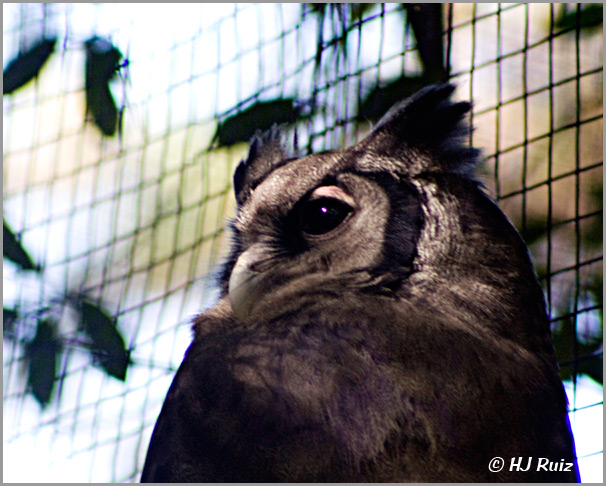
Verreaux's Eagle-Owl - aka (Milky Eagle Owl)
They are nocturnal birds and roost in tall trees. They sleep lightly and will awaken very quickly to defend themselves from attack in daylight hours.
They hunt in early evening. Full-grown owls feed on hares, mongoose and many other small game animals. They are one of the very few birds to feed on hedgehogs. Near cities their prey include rats and pigeons.
Breeding takes place from March to September. The female lays two eggs and incubates them for thirty-eight days. She remains on the nest for the entire incubation period while the male hunts for food for both of them. The first egg to hatch is the first to be fed, and if food is not plentiful only the first one hatched will be fed. If food is abundant, both owlets will be fed. The chicks are ready to leave the nest at nine weeks but may remain with the parents for up to three months.
Photograph © H. J. Ruiz – “My Backyard Visitors”
Text is available under the Creative Commons Attribution-ShareAlike License; additional terms may apply. See Terms of Use for details.
Wikipedia® is a registered trademark of the Wikimedia Foundation, Inc., a non-profit organization.
Share this:


Read Past Reviews

Book # 69

Quote from the Author
“A good chuckle is healthy, it helps you break the monotony of a serious life.” ~ H.J. Ruiz


You must be logged in to post a comment.