Toco Toucan
Toco Toucan – Spec. Name: Ramphastos Toco
This is the largest and arguably best known species in the toucan family. It is found in semi-open habitats throughout a large part of central and eastern South America. It is a common attraction in zoos.
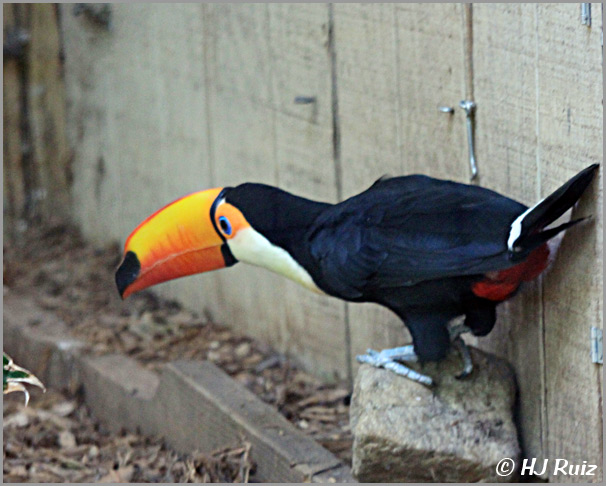
Toco Toucan
The Toco Toucan has a striking plumage with a mainly black body, a white throat, chest and uppertail-coverts, and red undertail-coverts. What appears to be a blue iris is actually thin blue skin around the eye. This blue skin is surrounded by another ring of bare, orange skin. The most noticeable feature, however, is its huge bill, which is yellow-orange, tending to deeper reddish-orange on its lower sections and culmen, and with a black base and large spot on the tip. It looks heavy, but as in other toucans it is relatively light because the inside largely is hollow. The tongue is nearly as long as the bill and very flat. With a total length of 55–65 cm (22–26 in), incl. a bill that measures almost 20 cm (8 in), and a weight of 500–860 g (17.5-30 oz), it is the largest species of toucan and the largest representative of the order Piciformes. Males are larger than females, but otherwise both are alike. Juveniles are duller and shorter-billed than adults. Its voice consists of a deep, coarse croaking, often repeated every few seconds. It also has a rattling call and will bill-clack.
It is, unlike the other members of the genus Ramphastos, essentially a non-forest species. It can be found in a wide range of semi-open habitats such as woodland, savanna and other open habitats with scattered trees, Cerrado, plantations, forest-edge, and even wooded gardens. It is mainly a species of lowlands, but occurs up to 1750 m (5750 ft) near the Andes in Bolivia. Because it prefers open habitats it is likely to benefit from the widespread deforestation in tropical South America. It has a large range and except in the outer regions of its range, it typically is fairly common. It is therefore considered to be of Least Concern by Bird Life International. It is easily seen in the Pantanal.
The bill is largest beak relative to body size of all birds providing 30 to 50% of its body surface area. It was called by Buffon a “grossly monstrous” appendage. Diverse functions have been suggested. Charles Darwin suggested it was a sexual ornament: “toucans may owe the enormous size of their beaks to sexual selection, for the sake of displaying the diversified and vivid stripes of colour with which these organs are ornamented”. Further suggestions have included aid in peeling fruit, intimidating other birds when robbing their nests, social selection related to defense of territory, and as a visual warning.
Research has shown that one function is as a surface area for heat exchange. The bill has the ability to modify blood flow and so regulate heat distribution in the bird, allowing it to use its bill as a thermal radiator. In terms of surface area used for this function, the bill relative to the bird’s size is amongst the largest of any animal and has a network of superficial blood vessels supporting the thin horny sheath on the bill made of keratin called the rhamphotheca.
In its capacity to remove body heat the bill is comparable to that of elephant ears. The ability to radiate heat depends upon air speed: if this is low only 25% of the adult bird’s resting heat production to as much as four times this heart production. In comparison the bill of a duck and the ears of elephant can shed only 9 to 91% of resting heat production. The bill normally is responsible for 30 to 60% of heat loss. The practice of Toco Toucan’s of placing their bills under their wings may serve to insulate the bill and reduce heat loss during sleep. It has been observed that “complexities of the vasculature and controlling mechanisms needed to adjust the blood flow to the bill may not be completely developed until adulthood.”

Photographs are © H. J. Ruiz – “My Backyard Visitors”
Text is available under the Creative Commons Attribution-ShareAlike License; additional terms may apply. See Terms of Use for details.
Wikipedia® is a registered trademark of the Wikimedia Foundation, Inc., a non-profit organization.
Share this:

Ostrich – Photo Album

Share this:

Bali Mynah
Bali Mynah – Spec. Name: Leucopsar Rothschildi
This bird is also known as Rothschild’s Mynah, Bali Myna, or Bali Mynah, locally known as Jalak Bali, is a medium-sized (up to 25 cm long), stocky myna, almost wholly white with a long, drooping crest, and black tips on the wings and tail. The bird has blue bare skin around the eyes, greyish legs and a yellow bill. Both sexes are similar.

Bali Mynah
Endangered
The Bali Starling, Bali’s regional mascot, is critically endangered, hovering immediately above extinction in the wild for several years now (BirdLife International 2006). The Bali Starling is listed in Appendix I of CITES. Trade even in captive-bred specimens is strictly regulated and the species is not generally available legally to private individuals. However, experienced aviculturalists may become affiliated with the captive-breeding program, allowing them to legally keep this species. About 1,000 individuals are believed to be held in captivity legally. The number of captive birds bought on black market is estimated to be twice the number of legally-acquired individuals in the captive breeding program.
There are 2 remaining locations on Bali where the birds exist in the wild: the West Bali National Park; and Bali’s small island of Nusa Penida
There were an estimated 350 birds in the West Bali National Park in the 1980s. During the 1990s over 400 cage-bred birds were released into the park to increase their numbers. But by 2005, the park authorities estimated the number to have fallen to less than 10. This decline was caused primarily by poachers responding to the lucrative demand for rare birds in the caged bird market.
The second and much larger population of Bali Starlings now exists on the island of Nusa Penida and its sister islands of Nusa Ceningan, Nusa Lembongan, which are 14km off the south east coast of Bali. 64 cage-bred Bali Starlings were released onto Nusa Penida over 2 years from 2006 by Friends of the National Parks Foundation (FNPF), the Indonesian NGO that operates the bird rehabilitation and release program on Nusa Penida. FNPF’s monitoring of the released birds state that their numbers had increased to +100 by 2009, and had spread across Penida, with small numbers also breeding on Ceningan and Lembongan.
The success of the project to create a wild population on Nusa Penida is primarily due to the threat of poachers being removed, combined with a successful breeding, rehabilitation and release program.
The removal of the threat from poachers was achieved by Drh I. Gede Nyoman Bayu Wirayudha (veterinarian) and his Indonesian NGO, Friends of the National Parks Foundation (FNPF) by persuading all Penida communities to protect birds. FNPF spent 2 years counseling all of the key people of influence on the Penida islands on the benefits of protecting birds and conservation. In 2006 all 35 villages (now 41 villages) unanimously agreed to make bird protection part of their traditional regulations (“awig-awig”), making it a social and spiritual obligation for all Penida residents to protect birds. Bali Starlings and other endangered birds that are released by FNPF onto Nusa Penida are now protected by the local communities. Monitoring of the birds by FNPF indicate that none of the released Bali Starlings or their subsequent offspring have been stolen. FNPF retains the ongoing commitment of the Penida communities to protect birds through a variety of community development and community education projects … all of which bring social and economic benefits to the local residents.
The birds released onto Nusa Penida were bred by the Begawan Foundation in Ubud, Bali, under expert supervision by Bali’s leading avian veterinarian, Drh I. G. N. Bayu Wirayudha. His methodology ensured that the birds were bred and prepared to survive in the wild. Two pairs of birds were purchased from the aviaries of Mr Nick Wileman, a successful and knowledgeable breeder living near London, and brought to the Begawan Foundation’s breeding facility in Bali on 24 June 1999. By November 2005, the Begawan Foundation’s captive population had grown to 97 birds.
The birds and cages were then transferred to FNPF’s bird centre on Nusa Penida and over a period of 2 years, FNPF rehabilitated and released 64 birds onto Nusa Penida.
On July 10, 2006, 25 micro-chipped birds were released into the wild during a ceremony that involved local villagers, temples and provincial and local government officials. Microchips were supplied by Theo Pagel, Director of the Cologne Zoo in Germany.
Within two weeks of their release, several birds had paired up and were observed bringing nesting materials to a variety of local trees, ficus, sugar palms and coconuts. Their first eggs had hatched by September 10, and on September 28, three birds instead of two were observed on the nesting tree.
Twelve more birds were released on December 12, 2006, and this flock was soon joined by two young birds that were the offspring of birds from the first release. On April 28, 2007, President Susilo Bambang Yudhoyono of the Republic of Indonesia and First Lady Kristiani Herawati accepted an invitation from FNPF’s founder, Drh I. G. N. Bayu Wirayudha, to release a further 12 birds, when they visited Nusa Penida to celebrate the launch of a ferry service to mainland Bali.
Further official recognition came during a visit to Nusa Penida on August 25 by the Indonesian Forestry Minister M. S. Kaban and Dr Ir Tonny Suhartono, the Director General for Forestry Preservation and Nature Conservation. These two dignitaries officially announced that the island was a suitable site for further releases of Bali Starlings.
FNPF and the Begawan Foundation continue to monitor and observe the birds in the wild, tracking where the birds nest and breed, ensuring that each bird released or born is followed throughout its life. This important role ensures that any future releases will be made with planned knowledge of how the bird survives in the wild, what food is required, and how it breeds.
Photographs are © H. J. Ruiz “My Backyard Visitors”
Text is available under the Creative Commons Attribution-ShareAlike License; additional terms may apply. See Terms of Use for details.
Wikipedia® is a registered trademark of the Wikimedia Foundation, Inc., a non-profit organization.
Share this:

Antarctic Wildlife: A Visitor’s Guide – Book Review
James Lowen is the author of Antarctic Wildlife: A Visitor’s Guide.
He has in a very smart way compiled a plethora of information about wildlife in the form of birds and mammals that thrive in the remote locations of Antarctica, also known for being one of the coldest places in the world.

Antarctic Wildlife: A Visitor's Guide
This book is a genuine true guide for any person interested in wildlife for that part of the planet. He has identified and categorized the different species and described with great precision not only the species in question but provides also the locations where to find them whether it is any bird or any mammal. This makes it a no guessing situation for any traveler. I must say that I was very impressed with the excellent photography and the digital work done for this book. I believe that is was a good idea placing images of species next to each other digitally, offering the reader a great sense of scale and way for size comparison. Very smart idea indeed.
After reading about all these icy remote places where you brave such low temperatures I couldn’t help but to think:Thank you Mr.Lowen for being so brave and endure such harsh environment to provide us with this great guide. I will recommend it to all my friends, in Peru, Argentina and Chile as well as in the USA. They’ll be thrilled to read it.
Review made by: H.J. Ruiz “My Backyard Visitors” – May 2011
Book published by: Princeton University Press
Share this:


Read Past Reviews

Book # 69

Quote from the Author
“A good chuckle is healthy, it helps you break the monotony of a serious life.” ~ H.J. Ruiz


You must be logged in to post a comment.