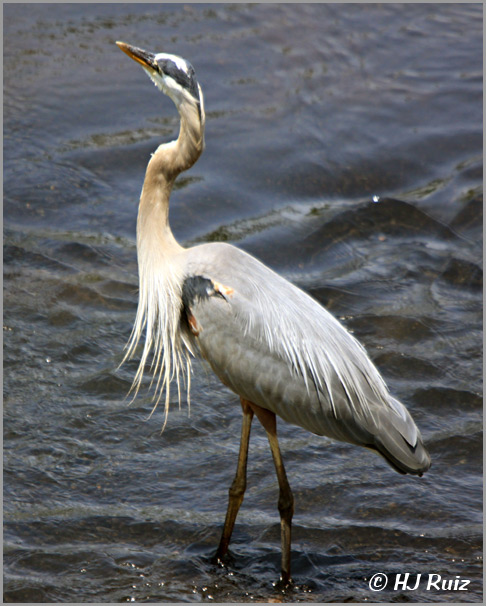
Great Blue Heron
Great Blue Heron – Spec. Name: Ardea Herodias
It is the largest North American heron, with a head-to-tail length of 91–140 cm (36–55 in), a wingspan of 167–201 cm (66–79 in), and a weight of 2–3.6 kg (4.4-8 lbs). Notable features include slaty flight feathers, red-brown thighs, and a paired red-brown and black stripe up the flanks; the neck is rusty-gray, with black and white streaking down the front; the head is paler, with a nearly white face, and a pair of black plumes running from just above the eye to the back of the head. The feathers on the lower neck are long and plume-like; it also has plumes on the lower back at the start of the breeding season. The bill is dull yellowish, becoming orange briefly at the start of the breeding season, and the lower legs gray, also becoming orangey at the start of the breeding season. Immature birds are duller in color, with a dull blackish-gray crown, and the flank pattern only weakly defined; they have no plumes, and the bill is dull gray-yellow.
Great Blue Heron
The heron stride is around 22 cm (9 in), almost in a straight line. Two of the three front toes are generally closer together. In a track the front toes as well as the back often show the small talons.
The subspecies differ only slightly in size and plumage tone, with the exception of subspecies occidentalis, which as well as normal colored birds, also has a distinct white morph, known as the Great White Heron (not to be confused with the Great Egret, for which “Great White Heron” was once a common name). It is found only in south Florida and some parts of the Caribbean. The Great White Heron differs from other Great Blues in bill morphology, head plume length, and in having a total lack of pigment in its plumage. This is mainly found near salt water, and was long thought to be a separate species. Birds intermediate between the normal morph and the white morph are known as Würdemann’s Heron; these birds resemble a “normal” Great Blue with a white head.
The theory that Great White Heron may be a separate species from Great Blue Heron has again been given some support by David Sibley.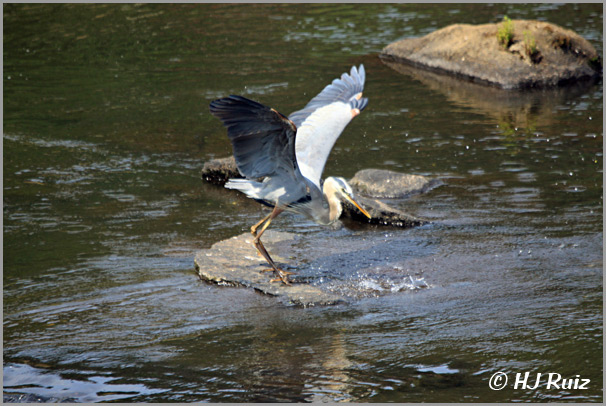
The “Great White Heron” could be confused with Great Egret but is larger, with yellow legs as opposed to the Great Egret’s black legs. The Reddish Egret and Little Blue Heron could be mistaken for the Great Blue Heron, but are much smaller, and lack white on the head and yellow in the bill. In the southern reaches of its range, the Great Blue sometimes overlaps in range with the closely-related and similarly-sized Cocoi Heron. The Cocoi is distinguished by a striking white neck and solid black crown, but the duller juveniles are more easily confused. More superficially similar is the slightly smaller Grey Heron, which may sometimes vagrate to the Northern coasts of North America. The Grey (which occupies the same ecological niche in Eurasia as the Great Blue Heron) has very similar plumage but has a solidly soft-gray neck. Erroneously, the Great Blue Heron is sometimes referred to as a “crane”.
Diet
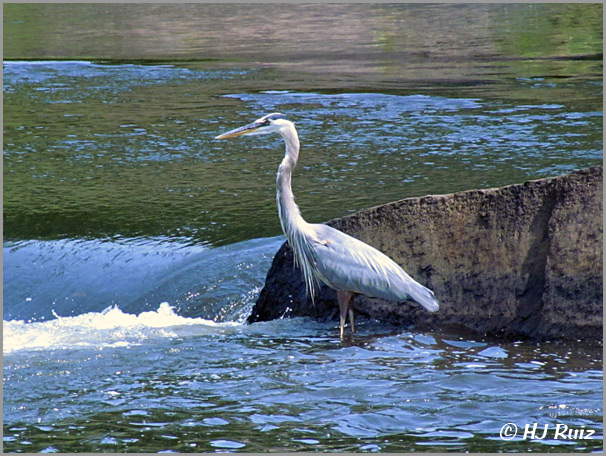
The primary food for Great Blue Heron is small fish, though it is also known to opportunistically feed on a wide range of shrimp, crabs, aquatic insects, rodents and other small mammals,amphibians, reptiles, and small birds. Herons locate their food by sight and usually swallow it whole. Herons have been known to choke on prey that is too large. It is generally a solitaryfeeder. Individuals usually forage while standing in water, but will also feed in fields or drop from the air, or a perch, into water. As large wading birds, Great Blue Herons are able to feed in deeper waters, and thus are able to harvest from niche areas not open to most other heron species.
It feeds in shallow water or at the water’s edge during both the night and the day, but especially around dawn and dusk. It uses its long legs to wade through shallow water, and spears fish or frogs with its long, sharp bill.
All photographs are © H. J. Ruiz -“My Backyard Visitors”
Text is available under the Creative Commons Attribution-ShareAlike License; additional terms may apply. See Terms of Use for details.
Wikipedia® is a registered trademark of the Wikimedia Foundation, Inc., a non-profit organization.
Share this:

Albino Peafowl
Albino Peafowl a.k.a. White Peafowl – Spec.Name: Pavo Cristatus mut. Alba
The term peafowl can refer to the two species of bird in the genus Pavo of the pheasant family, Phasianidae. The African Congo Peafowl is placed in its own genus Afropavo and is not dealt with here. Peafowl are best known for the male’s extravagant tail, which it displays as part of courtship. The male is called a peacock, and the female a peahen. The female peafowl is brown or toned grey and brown.
The two species are:
- Indian Peafowl, Pavo cristatus, a resident breeder in South Asia. The peacock is designated as the national bird of India and the provincial bird of the Punjab.
- Green Peafowl, Pavo muticus. Breeds from Burma east to Java. The IUCN lists the Green Peafowl as vulnerable to extinction due to hunting and a reduction in extent and quality of habitat.
Plumage
The male (peacock) Indian Peafowl has iridescent blue-green or green colored plumage. The peacock tail (“train”) is not the tail quill feathers but the highly elongated upper tail coverts. The “eyes” are best seen when the peacock fans its tail. Both species have a crest atop the head. The female (peahen) Indian Peafowl has a mixture of dull green, brown, and grey in her plumage. She lacks the long upper tail coverts of the male but has a crest. The female can also display her plumage to ward off female competition or signal danger to her young.
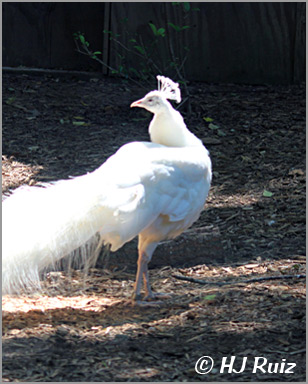
Albino Peafowl (Peacock)
The Green Peafowl appears different from the Indian Peafowl. The male has green and gold plumage and has an erect crest. The wings are black with a sheen of blue. Unlike the Indian Peafowl, the Green Peahen is similar to the male, only having shorter upper tail coverts and less iridescence. It is difficult to tell a juvenile male from an adult female.
As with many birds, vibrant plumage colours are not primarily pigments, but optical interference Bragg reflections, based on regular, periodic nanostructures of the barbules (fiber-like components) of the feathers. Slight changes to the spacing result in different colours. Brown feathers are a mixture of red and blue: one colour is created by the periodic structure, and the other is a created by a Fabry–Pérot interference peak from reflections from the outer and inner boundaries. Such interference-based structural colour is important for the peacock’s iridescent hues that change and shimmer with viewing angle, since unlike pigments, interference effects depend on light angle.
Colour mutations exist through selective breeding, such as the leucistic White Peafowl and the Black-Shouldered Peafowl.
The peafowl are forest birds that nest on the ground but roost in trees. They are terrestrial feeders.
Both species of Peafowl are believed to be polygamous. However, it has been suggested that “females” entering a male Green Peafowl’s territory are really his own juvenile or sub-adult young (K. B. Woods in lit. 2000) and that Green Peafowl are really monogamous in the wild. The male peacock flares out his feathers when he is trying to get the female’s attention.
During the mating season they will often emit a very loud high pitched cry.
Peafowl are omnivorous and eat most plant parts, flower petals, seed heads, insects and other arthropods, reptiles, and amphibians.
In common with other members of the Galliformes, males possess metatarsal spurs or “thorns” used primarily during intraspecific fights.
Peafowl have left captivity and developed permanent, free-roaming populations in several parts of the world including India.
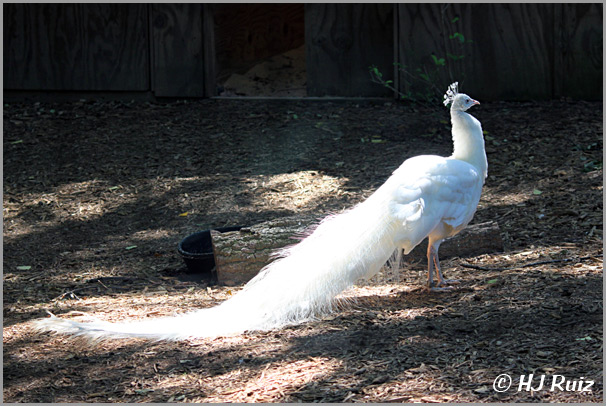
Photographs are © H. J. Ruiz – “My Backyard Visitors”
Text is available under the Creative Commons Attribution-Share Alike License; additional terms may apply. See Terms of Use for details.
Wikipedia® is a registered trademark of the Wikimedia Foundation, Inc., a non-profit organization.
Share this:

Lappet-faced Vulture
Lappet-faced Vulture a.k.a. Nubian Vulture – Spec. Name: Torgos Tracheliotos
This bird is a mostly African Old World vulture belonging to the bird order Accipitriformes, which also includes eagles, kites, buzzards and hawks. It is the only member of the genus Torgos. A distinct subspecies T. t. negevensisoccurs in the Sinai, the Negev desert, and probably north-west Saudi Arabia. It is not closely related to the superficially similar New World vultures, and does not share the good sense of smell of some members of that group.

Lappet-faced Vulture
The Lappet-faced Vulture is about 95–115 cm (37–45 in) in body length, with a wingspan of 2.5–3 m (8–10 ft). Wild vultures, of the subspecies T. t. tracheliotus, range from 4.4 to 9.4 kg (9.8-20.7 lb) and, in East Africa, average only 6.2 kg (13.6 lb). On the other hand, captive vultures of the slightly larger T. t. negevensis subspecies, weighed 6.5-9.2 kg (14.3-20.2 lb) in males and 10.5-13.9 kg (23.1–30.6 lb) in females.
Like many vultures, it has a bald head. The pink (sometimes reddish) coloration is a distinctive feature. The head is bald, because a feathered head would become spattered with blood and other fluids, and thus be difficult to keep clean.
The Lappet-faced Vulture is a scavenging bird, feeding mostly from animal carcasses, which it finds by sight or by watching other vultures. Large carcasses, since they provide the most subsistence at a sitting, are preferred. Lappet-faced Vultures, perhaps more than any other vulture, will on occasion attack young and weak living animals and raid the nests of other birds. Locally, Lesser Flamingoes, among others, have been reported to be culled by Lappet-faces in this way.
They are the most powerful and aggressive of the African vultures, and other vultures will usually cede a carcass to the Lappet-faced Vulture. This is often beneficial to the less powerful vultures because the Lappet-face can tear through the tough hides and muscles of large mammals that the others cannot penetrate, although hyenas are even more efficient in this regard.

Photographs are © H. J. Ruiz – “My Backyard Visitors”
Text is available under the Creative Commons Attribution-Share Alike License; additional terms may apply. See Terms of Use for details.
Wikipedia® is a registered trademark of the Wikimedia Foundation, Inc., a non-profit organization.
Share this:

Do you know about the “anting” bird activity?
Anting
In the behavior called anting, birds rub insects on their feathers, usually ants, which secrete liquids containing chemicals such as formic acid, that can act as an insecticide, mitecide, fungicide, bactericide, or to make them edible by removing the distasteful acid. It possibly also supplements the bird’s own preen oil. Instead of ants, birds can also use millipedes. Over 250 species of bird have been known to ant.
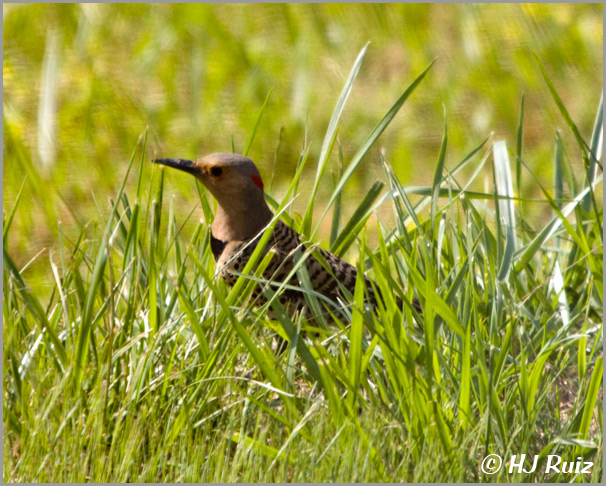
Northern Flicker
History
This behaviour was first described by Erwin Stresemann in German as einemsen in Ornithologische Monatsberichte XLIII. 138 in 1935. Salim Ali interpreted an observation by his cousin Humayun Abdulali in the 1936 volume of Journal of the Bombay Natural History Society with discussion on Stresemann’s paper and the suggestion that the term could be translated into English as “anting”.
Some birds have been seen dusting themselves with soil from ant-hills and this has been considered by some as equivalent to anting.
Function
It has been suggested that anting acts as way of reducing feather parasites such as mites or in controlling fungi or bacteria, although there has been little convincing support for any of the theories. It is possible that the use of certain kinds of ants indicates the importance of the chemicals they release. Some cases of antinginvolved the use of millipedes or Puss Moth caterpillars, and these too are known to release powerful defensive chemicals.
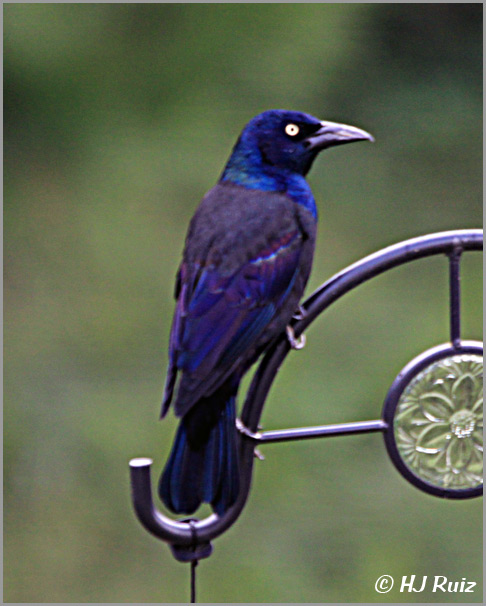
Common Grackle
Another suggested function, based on observation of Blue Jays, is that the bird makes the insects edible, by discharging the harmful acid onto their feathers. The birds were found to show anting behaviour only if the ants had a full acid sac, and with subjects whose acid sacs had been experimentally removed, the behaviour was absent.
Finally, it has also been suggested that anting is related to feather moulting. However, the correlation may also be attributed to the greater activity of ants in summer.

Blue Jay
All photographs are © H. J. Ruiz – “My Backyard Visitors”
Text is available under the Creative Commons Attribution-ShareAlike License; additional terms may apply. See Terms of Use for details.
Wikipedia® is a registered trademark of the Wikimedia Foundation, Inc., a non-profit organization.
Share this:


Read Past Reviews

Book # 69

Quote from the Author
“A good chuckle is healthy, it helps you break the monotony of a serious life.” ~ H.J. Ruiz


You must be logged in to post a comment.