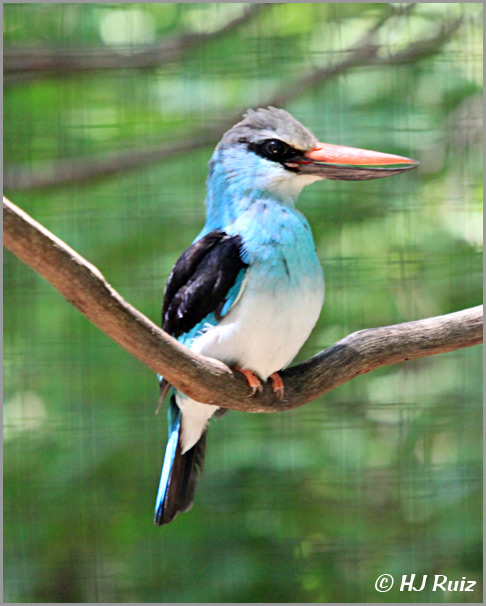
Blue-winged Kookaburra
Blue-winged Kookaburra – Spec. Name: Dacelo Leachii
This is a large species of kingfisher native to northern Australia and southern New Guinea.
Measuring around 40 cm (16 in), it is slightly smaller than the more familiar Laughing Kookaburra. It has cream-coloured upper- and underparts barred with brownish markings. It has blue wings and brown shoulders and blue rump. It is sexually dimorphic, with a blue tail in the male, and a rufous tail with blackish bars in the female.
Blue-winged Kookaburra
The adult Blue-winged Kookaburra measures around 38 to 42 cm (15-17 in) in length and weighs 260 to 330 g. Compared to the related Laughing Kookaburra, it is smaller, lacks a dark mask, has more blue in the wing, and striking white eye. It has a heavier bill than its larger relative. The head and underparts are cream-coloured with brownish streaks. It is sexually dimorphic, with a blue tail in the male, and a rufous tail with blackish bars in the female. Immature birds have more prominent brown bars and marks in their plumage, giving a ‘dirty’ appearance, and their eyes are predominantly brown for the first two years of life.
The call has been described as a maniacal cackling or barking.
The Blue-winged Kookaburra has a distribution from southern New Guinea and the moister parts of northern Australia, to the vicinity of Brisbane in southern Queensland across the Top End, and as far down the Western Australian coast as the Shark Bay area. However, it does not occur between Broome and Port Hedland in northwestern Australia. Widespread and common throughout its large range, the Blue-winged Kookaburra is evaluated as Least Concern on the IUCN Red List of Threatened Species. Found in family groups of up to 12 individuals, it lives in open savannah woodland and Melaleuca swamps, as well as farmlands such as sugar cane plantations.
The Blue-winged Kookaburra hunts and eats a great variety of animals that live on or close to the ground.In the summer wet season,insects, lizards and frogs make up a higher proportion of their diet, while they eat arthropods such as crayfish, scorpions, spiders, fish,earthworms, small birds and rodents at other times. They have even been recorded waiting for and snatching insects flushed out by bushfires.
The Blue-winged Kookaburra is a cooperative breeder, a group being made up of a breeding pair and one or more helper birds who help raise the young. Breeding occurs once a year in late spring (September to December). The nest is a hollow high up in a tree, often 25 m (80 ft) or so above the ground. Three or four white slightly shiny eggs measuring 44 x 35 mm or a little larger are laid. The female incubates the eggs for around 26 days, and nestlings spend another 36 days in the nest before fledging. Chicks are born pink, blind and naked, and break their way out of the egg with an egg tooth on the bill. Feathers appear by seven days and their eyes open from the tenth day onwards. Kookaburra babies are often highly aggressive in the first week of life, and the youngest chick is often killed by the older chicks during this period. Once fledged, juvenile birds need to be taught how to hunt by their parents for a further 6-10 weeks before they can properly fend for themselves.
Photograph © H. J. Ruiz – “My Backyard Visitors”
Text is available under the Creative Commons Attribution-ShareAlike License; additional terms may apply. See Terms of Use for details.
Wikipedia® is a registered trademark of the Wikimedia Foundation, Inc., a non-profit organization.
Share this:

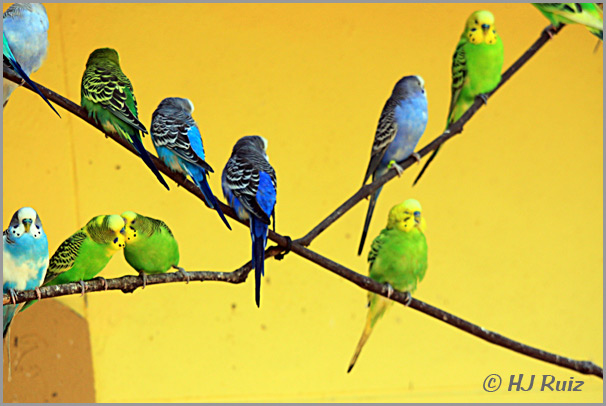
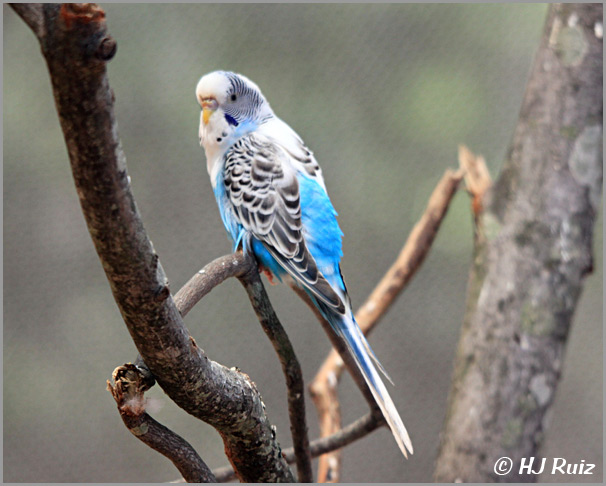
Parakeets – Photo Album
I’m sure many of our friends will enjoy seeing these lovely creatures. Have fun! 🙂
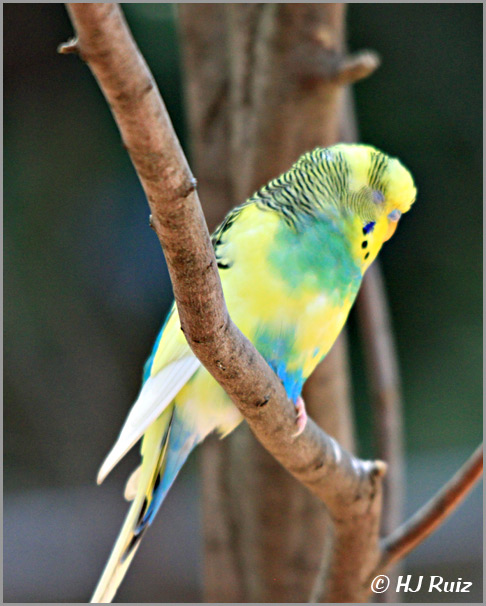
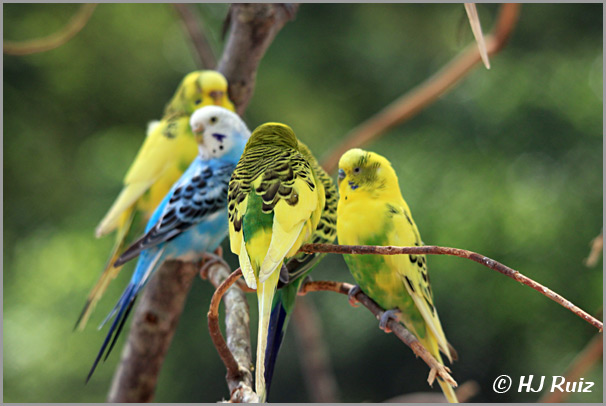
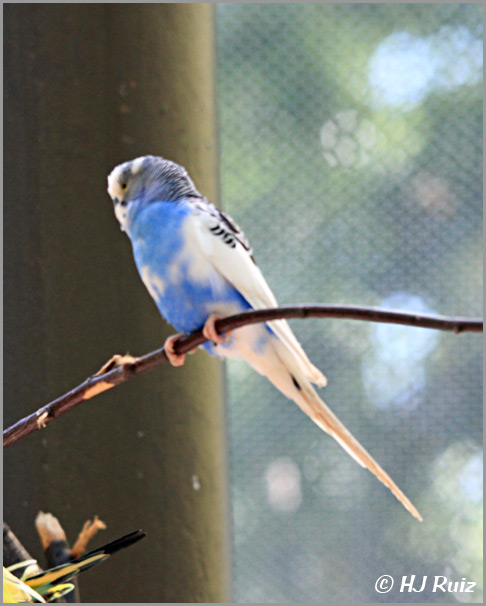

Share this:

Major Mitchell’s Cockatoo
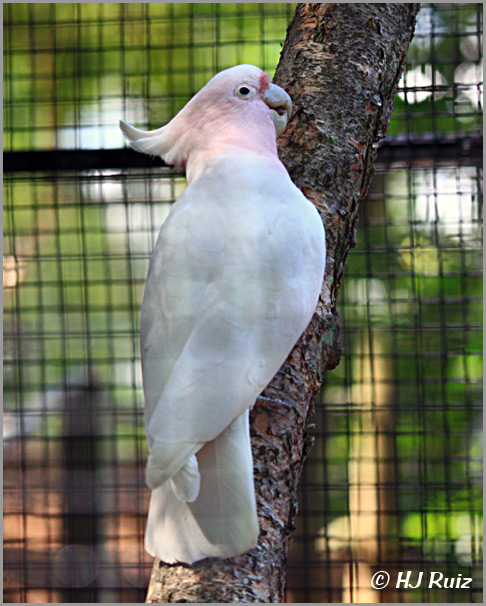
Major Mitchell’s Cockatoo – Spec. Name: Lophochroa Leadbeateri
It is also known as Leadbeater’s Cockatoo or Pink Cockatoo, is a medium-sized cockatoo restricted to arid and semi-arid inland areas of Australia. It is here placed in its own monotypic genus Lophochroa, though to include it in Cacatuaas others do is not wrong as long as the corellas are also included there.
Major Mitchell's Cockatoo
With its soft-textured white and salmon-pink plumage and large, bright red and yellow crest, it is generally recognised as the most beautiful of all cockatoos. It is named in honour of Major Sir Thomas Mitchell, who wrote “Few birds more enliven the monotonous hues of the Australian forest than this beautiful species whose pink-coloured wings and flowing crest might have embellished the air of a more voluptuous region“.
Systematics and naming
It is possibly (though not certainly) a little closer related to Cacatua than the Galah, and its lineage diverged around the time of or shortly after the acquisition of the long crest – probably the former as this crest type is not found in all Cacatua cockatoos and therefore must have been present in an early or incipient stage at the time of the divergence of the Major Mitchell’s Cockatoo’s ancestors. Like the Galah, this species has not lost the ability to deposit diluted pigments dyes in its body plumage, although it does not produce melanin coloration anymore, resulting in a lighter bird overall compared to the Galah. Indeed, disregarding the crest, Major Mitchell’s Cockatoo looks almost like a near-leucistic version of that species. Another indication of the early divergence of this species from the “white” cockatoo lineage is the presence of features found otherwise only in corellas, such as the plaintive yodeling cry, as well as others which are unique to Major Mitchell’s and the true white cockatoos, for example the large crest and rounded wing shape.
The scientific name commemorates the British naturalist, Benjamin Leadbeater. In Central Australia south of Alice Springs, the Pitjantjatjara term is kakalyalya.

Photographs are © H. J. Ruiz “My Backyard Visitors”
Text is available under the Creative Commons Attribution-ShareAlike License; additional terms may apply. See Terms of Use for details.
Wikipedia® is a registered trademark of the Wikimedia Foundation, Inc., a non-profit organization.
Share this:

“My Backyard Visitors” – Vacation
DEAR FRIENDS OF “MY BACKYARD VISITORS”, MY BLOGGING WILL RESUME AFTER MY VACATION. STARTING NOW UNTIL JUNE 4TH, 2011. THANK YOU FOR YOUR PATIENCE.
© H. J. Ruiz – Avian 101
Share this:


Read Past Reviews

Book # 69

Quote from the Author
“A good chuckle is healthy, it helps you break the monotony of a serious life.” ~ H.J. Ruiz


You must be logged in to post a comment.