Vulturine Guineafowl
Vulturine Guineafowl – Spec. Name: Acryllium vulturinum
This is the largest extant guineafowl species. Systematically, Acryllium are only distantly related to other guineafowl genera. Their closest living relative, the White Breasted Guineafowl, Agelastes meleagrides inhabit primary forests in Central Africa. bird family, Numididae, and is the only member of the genus Acryllium. It is a resident breeder in northeast Africa, from southern Ethiopia through Kenya and just into northern Tanzania.
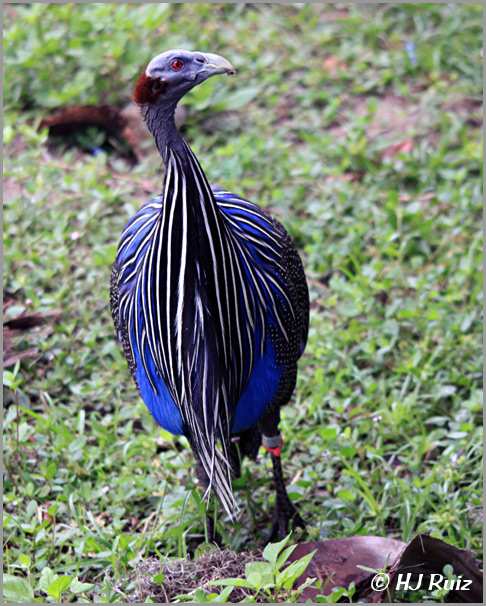
Vulturine Guineafowl
Vulturine Guineafowl is a large (61–71 cm) bird with a round body and small head. It is longer in the wings, neck, legs and tail than other guineafowl. The adult has a bare blue face and black neck, and although all other guineafowl have unfeathered heads, this species looks particularly like a vulture because of the long bare neck and head.
The slim neck projects from a cape of long, glossy, blue and white hackles. The breast is cobalt blue, and the rest of the body plumage is black, finely spangled with white. The wings are short and rounded, and the tail is longer than others in the family Numididae.
The sexes are similar, although the female is usually slightly smaller than the male and with smaller tarsal spurs. Young birds are mainly grey-brown, with a duller blue breast and short hackles.
Vulturine Guineafowl is a gregarious species, forming flocks outside the breeding season typically of about 25 birds. This species’ food is seeds and small invertebrates. This guineafowl is terrestrial, and will run rather than fly when alarmed. Despite the open habitat, it tends to keep to cover, and roosts in trees. It makes loud chink-chink-chink-chink-chink calls.
It breeds in dry and open habitats with scattered bushes and trees, such as savannah or grassland. It usually lays 4-8 cream-coloured eggs in a well-hidden grass-lined scrape.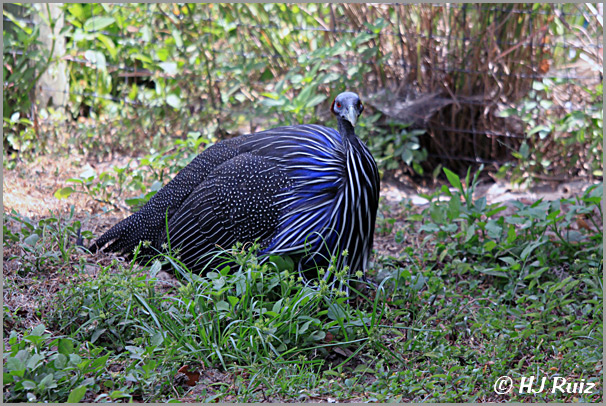
Photographs are © H.J. Ruiz – “My Backyard Visitors”
Text is available under the Creative Commons Attribution-ShareAlike License; additional terms may apply. See Terms of Use for details.
Wikipedia® is a registered trademark of the Wikimedia Foundation, Inc., a non-profit organization.
Share this:

White-crested Laughing Thrush
White-crested Laughing Thrush – Spec. Name: Garrulax Leucolophus
These birds are found inhabiting mountainous forests of Indonesia, forming flocks that share areas of territory. They are very active good looking birds that forage for insects or fruits.

White-crested Laughing Thrush
Their names describe exactly the chattering among them while they hop around brush or fallen leaves, these birds create a noisy environment in the forest that sounds like laughter.
They are medium size birds with dark eyes, gray nape, white crest, their back and wings are cinnamon-brown color and their chest is white.
These species are not endangered.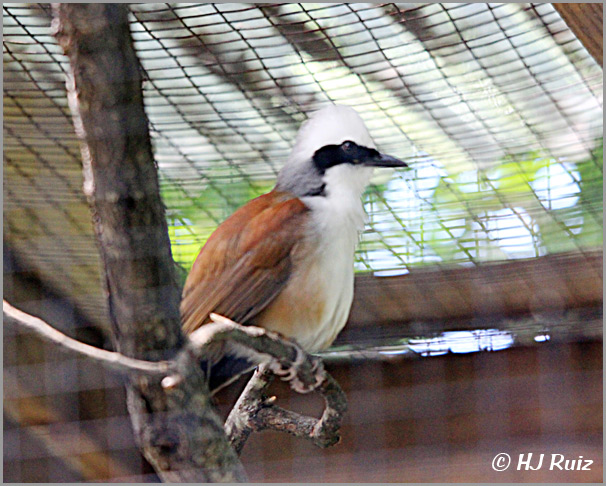
Photographs are © H.J. Ruiz – “My Backyard Visitors”
Share this:

“AVIAN ARCHITECTURE” – Book Review
Princeton University Press has just released a new book: “AVIAN ARCHITECTURE” How Birds Design, Engineer & Build by author PETER GOODFELLOW.
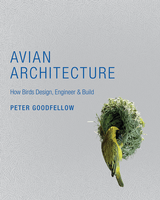
"Avian Architecture
“I found this book extremely fascinating! People generally are reading about birds, their colors, shapes and sizes, however, there’s more beyond seeing birds fly around. This bring us the questions: How do they live, where do they live and how do they build their nests? Well, Mr. Goodfellow has done a heck of a job with his book that answers all these questions. Descriptions, photos, illustrations, schematics, comparisons and analysis give a clear comprehensive account of the process for building the bird’s nests.
Interesting and informative from beginning to end, this is a great book I recommend”
Book Review made by H.J. Ruiz – “My Backyard Visitors” – June 2011
Share this:

Taveta Golden Weaver
Taveta Golden Weaver – Spec. Name: Ploceus Castaneiceps
This is a species of bird in the Ploceidae family. It is found in Kenya and Tanzania. The name of the bird comes from the unique markings/coloration of the bird, as well as how these birds weave intricate nests.
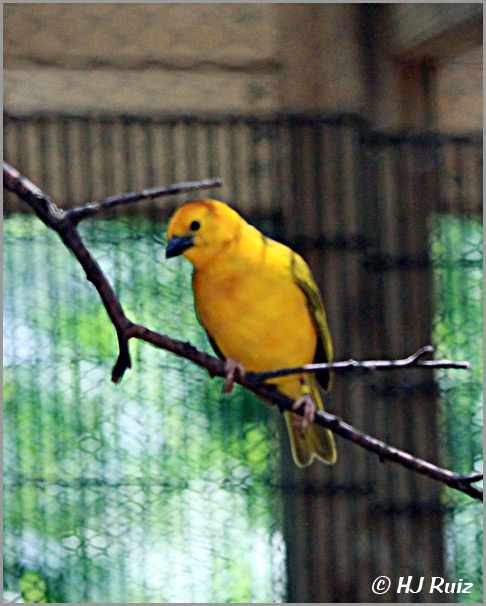
Taveta Golden Weaver
The male Taveta Golden Weaver is a vibrant golden yellow color; this color is duller on its back. The wings and tail are a greener color, whereas brown spots are located on the chest. The back of the head is red, and the bill, or beak, is red. The female is an olive color with paler streaks. In general, the Taveta Golden Weaver is a small bird, around the size of the finch and closely related to the sparrow.
This bird can be found in coastal east Africa from eastern Tanzania to southeastern Kenya. It prefers to live in bulrushes, woodland, and swampy areas. Some Asian species of this bird have been found.
The Taveta Golden Weaver eats mostly seeds. The offspring of the receive food from the mother. This bird also feeds off of corn and grasses.
These birds live in large groups, or colonies. Weavers often make a unique — often described as “weird” — noise to communicate. Male weavers build extravagant oval nests over water attatched to stems of reeds or grasses. The Taveta Golden Weavers lay two or three glossy, dark, olive-green eggs. The female bird chooses who she will mate, depending on how impressed she is with a male’s skill to construct a nest.
The Taveta Golden Weaver has strong claws and bills which enable the bird to weave complex nests. Nests can sometimes fill an entire tree; the Weaver usually breeds within the colonies. Even though they are considered songbirds, the sounds that the bird makes is not pleasing to past human observers. The Taveta Golden Weaver is currently not endangered.
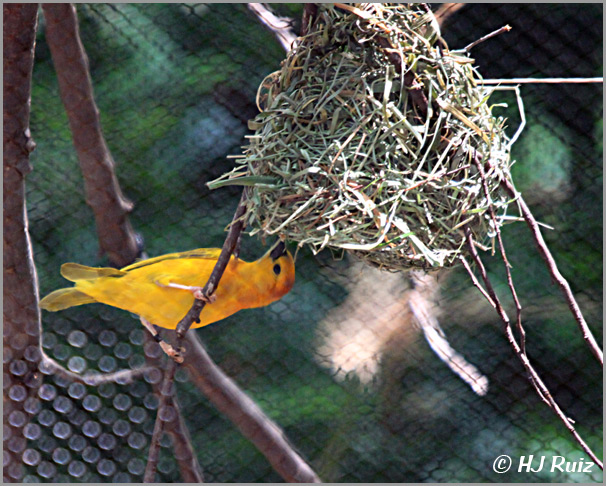
Taveta building nest
Photographs are © H. J. Ruiz – “My Backyard Visitors”
Text is available under the Creative Commons Attribution-ShareAlike License; additional terms may apply. See Terms of Use for details.
Wikipedia® is a registered trademark of the Wikimedia Foundation, Inc., a non-profit organization.
Share this:


Read Past Reviews

Book # 69

Quote from the Author
“A good chuckle is healthy, it helps you break the monotony of a serious life.” ~ H.J. Ruiz


You must be logged in to post a comment.