
Red-bellied Woodpecker
Red-bellied Woodpecker– Spec. Name: Melanerpes Carolinus
This is a medium-sized woodpecker of the Picidae family. It breeds in southern Canada and the northeastern United States, ranging as far south as Florida and as far west as Texas.

Red-bellied Woodpecker (M)
Adults are mainly light gray on the face and underparts; they have black and white barred patterns on their back, wings and tail. Adult males have a red headside going from the bill to the nape; females have a red patch on the nape and another above the bill. The reddish tinge on the belly that gives the bird its name is difficult to see in field identification. They are 9 to 10.5 inches long, and have a wingspan of 15 to 18 inches.
These birds mainly search out arthropods on tree trunks. They may also catch insects in flight. They are omnivores, eating insects, fruits, nuts and seeds. Their breeding habitat is usually deciduous forests. They nest in the decayed cavities of dead trees, old stumps, or in live trees that have softer wood such as elms, maples, or willows; both sexes assist in digging nesting cavities.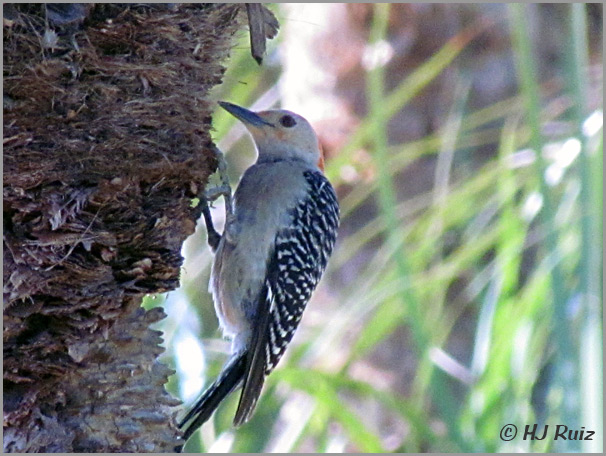
Though the species is not globally threatened, it depends on large trees for nesting. In areas that are extensively deforested, the birds will sometimes utilize gardens, but for the most part simply will not be present in any numbers.
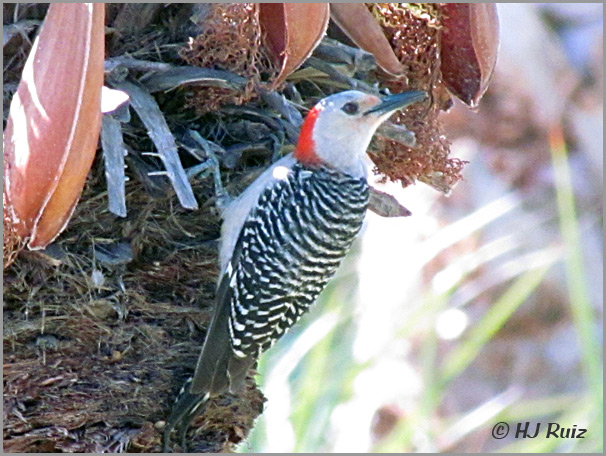
Photographs are © H.J. Ruiz – “My Backyard Visitors” Taken in Bradenton Beach, Florida.
Text is available under the Creative Commons Attribution-ShareAlike License; additional terms may apply. See Terms of Use for details.
Wikipedia® is a registered trademark of the Wikimedia Foundation, Inc., a non-profit organization.
Share this:

Racket-Tailed Roller
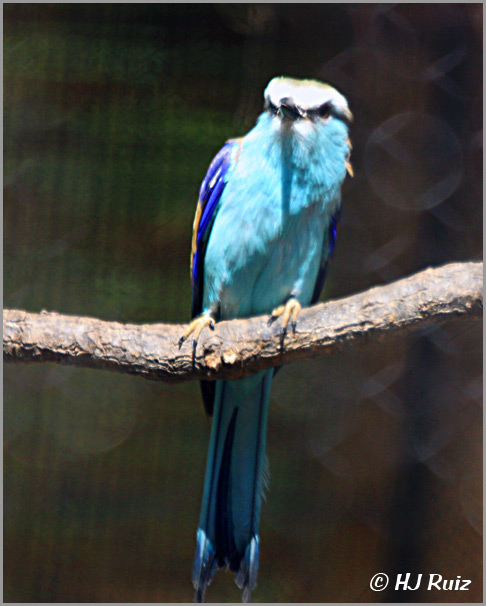
Racket-tailed Roller
Racket-tailed Roller – Spec. Name: Coracias Spatulatus
The Racket-tailed Roller is a bird about the same size as a starling. The height of the Racket-tailed Roller is about 30 cms and its weight is about 100 gms
The male and female Racket-tailed Roller are similar in size and shape.
Head is green and brown, their bills are black, eyes are brown. Blueish throat and greenish back, legs are light gray.
The Racket-tailed Roller feeds on the ground, mostly invertebrates.
The Racket-tailed Roller is monogamous, however, in case of a partner dying it will seek out a new mate.
They nest in a hole or burrow in a tree. Their eggs are white and lay two or three.The Racket-tailed Roller live in woodlands and do not seek to form flocks or birds communities. They are solitary kind of birds.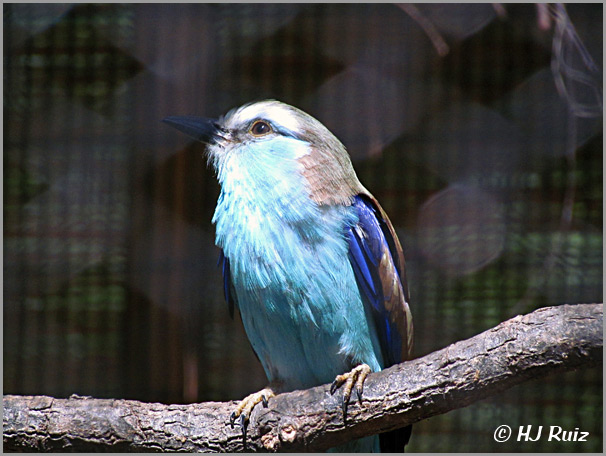
Photographs are © H.J. Ruiz – “My Backyard Visitors”
Share this:

Do you know about Leucism?
Leucism is a condition characterized by reduced pigmentation in animals and humans. Unlike albinism, it is caused by a reduction in all types of skin pigment, not just melanin.
Leucism (occasionally spelled leukism)is a general term for the phenotype resulting from defects in pigment cell differentiation and/or migration from the neural crest to skin, hair or feathers during development. This results in either the entire surface (if all pigment cells fail to develop) or patches of body surface (if only a subset are defective) having a lack of cells capable of making pigment.
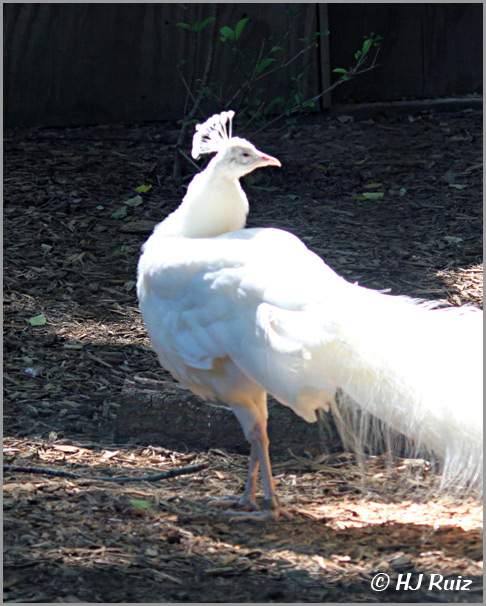
Albino Peacock
Since all pigment cell-types differentiate from the same multipotent precursor cell-type, leucism can cause the reduction in all types of pigment. This is in contrast to albinism, for which leucism is often mistaken. Albinism results in the reduction of melanin production only, though the melanocyte (or melanophore) is still present. Thus in species that have other pigment cell-types, for example xanthophores, albinos are not entirely white, but instead display a pale yellow colour.
More common than a complete absence of pigment cells is localized or incomplete hypopigmentation, resulting in irregular patches of white on an animal that otherwise has normal colouring and patterning. This partial leucism is known as a “pied” or “piebald” effect; and the ratio of white to normal-coloured skin can vary considerably not only between generations, but between different offspring from the same parents, and even between members of the same litter. This is notable in horses, cows, cats, dogs, the urban crow and the ball python but is also found in many other species.
A further difference between albinism and leucism is in eye colour. Due to the lack of melanin production in both the retinal pigmented epithelium (RPE) and iris, albinos typically have red eyes due to the underlying blood vessels showing through. In contrast, leucistic animals have normally coloured eyes. This is because the melanocytes of the RPE are not derived from the neural crest, instead an outpouching of the neural tube generates the optic cup which, in turn, forms the retina. As these cells are from an independent developmental origin, they are typically unaffected by the genetic cause of leucism.
Genes that, when mutated, can cause leucism include, c-kit, mitf[ and ednrb.

Albino Alligator
Photographs are © H. J. Ruiz – “My Backyard Visitors”
Text is available under the Creative Commons Attribution-ShareAlike License; additional terms may apply. See Terms of Use for details.
Wikipedia® is a registered trademark of the Wikimedia Foundation, Inc., a non-profit organization.
Share this:

Grey-crowned Crane
Grey Crowned Crane – Spec. Name: Balearica Regulorum
This is a bird in the crane family Gruidae. It occurs in dry savannah in Africa south of the Sahara, although it nests in somewhat wetter habitats. This animal does not migrate.
There are two subspecies. The East African B. r. gibbericeps (Crested Crane) occurs from eastern Democratic Republic of the Congo through Uganda, of which it is the national bird, and Kenya to eastern South Africa. It has a larger area of bare red facial skin above the white patch than the smaller nominate species, B. r. regulorum (South African Crowned Crane), which breeds from Angola south to South Africa.
This species and the closely related Black Crowned Crane are the only cranes that can roost in trees, because of a long hind toe that can grasp branches. This habit, amongst other things, is a reason why the relatively small Balearica cranes are believed to closely resemble the ancestral members of the Gruidae.
The Grey Crowned Crane has a breeding display involving dancing, bowing, and jumping. It has a booming call which involves inflation of the red gular sac. It also makes a honking sound quite different from the trumpeting of other crane species.

Gray-crowned Crane
The nest is a platform of grass and other plants in tall wetland vegetation. The Grey Crowned Crane lays a clutch of 2-5 eggs. Incubation is performed by both sexes and lasts 28–31 days. Chicks fledge at 56–100 days.
The Grey Crowned Crane is about 1 m (3.3 ft) tall and weighs 3.5 kg (7.7 lbs). Its body plumage is mainly grey. The wings are also predominantly white, but contain feathers with a range of colours. The head has a crown of stiff golden feathers. The sides of the face are white, and there is a bright red inflatable throat pouch. The bill is relatively short and grey, and the legs are black. The sexes are similar, although males tend to be slightly larger. Young birds are greyer than adults, with a feathered buff face.
Although the Grey Crowned Crane remains common over much of its range, it faces threats to its habitat due to drainage, overgrazing, and pesticide pollution.
Like all cranes, it feeds on insects and other invertebrates, reptiles, small mammals, as well as grass seeds.
The Grey Crowned Crane is the national bird of Uganda and features in the country’s flag and coat of arms.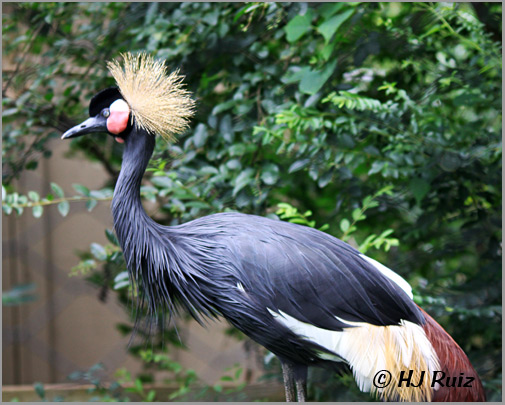
Photographs are © H.J. Ruiz – “My Backyard Visitors”
Text is available under the Creative Commons Attribution-ShareAlike License; additional terms may apply. See Terms of Use for details.
Wikipedia® is a registered trademark of the Wikimedia Foundation, Inc., a non-profit organization.
Share this:


Read Past Reviews

Book # 69

Quote from the Author
“A good chuckle is healthy, it helps you break the monotony of a serious life.” ~ H.J. Ruiz


You must be logged in to post a comment.