
Bald Eagle
Bald Eagle – Spec. Name: Haliaeetus Leucocephalus
This is a bird of prey found in North America. It is the national bird and symbol of the United States of America. This sea eagle has two known sub-species and forms a species pair with the White-tailed Eagle.

Bald Eagle
Its range includes most of Canada and Alaska, all of the contiguous United States, and northern Mexico. It is found near large bodies of open water with an abundant food supply and old-growth trees for nesting.
The plumage of an adult Bald Eagle is evenly brown with a white head and tail. The tail is moderately long and slightly wedge-shaped. Males and females are identical in plumage coloration, but sexual dimorphism is evident in the species in that females are 25 percent larger than males. The beak, feet, and irises are bright yellow. The legs are feather-free, and the toes are short and powerful with large talons. The highly developed talon of the hind toe is used to pierce the vital areas of prey while it is held immobile by the front toes. The beak is large and hooked, with a yellow cere.
The plumage of the immature is brown, speckled with white until the fifth (rarely fourth, very rarely third) year, when it reaches sexual maturity. Immature Bald Eagles are distinguishable from the Golden Eagle in that the former has a more protruding head with a larger beak, straighter edged wings which are held flat (not slightly raised) and with a stiffer wing beat, and feathers which do not completely cover the legs.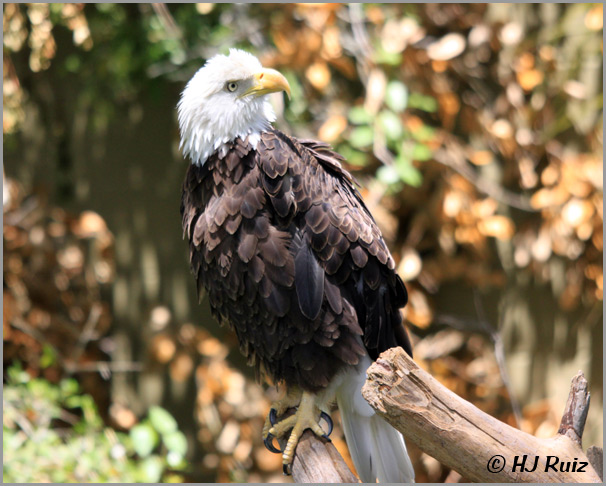
The Bald Eagle is a large bird, with a body length of 28–40 in, a wingspan of between 66 in and 96 in, and a mass of 5.5–15 lbs; females are about 25 percent larger than males, adult females averaging 13 lbs. and males averaging 9.0 lbs. The size of the bird varies by location; the smallest specimens are those from Florida, where an adult male may barely exceed 5.1 lbs and a wingspan of 5.9 ft. The largest are Alaskan birds, where large females may exceed 17 lbs. and have a wingspan of over 7.9 ft.
Its diet consists mainly of fish, but it is an opportunistic feeder. It hunts fish by swooping down and snatching the fish out of the water with its talons. It is sexually mature at four years or five years of age. In the wild, Bald Eagles can live up to thirty years, and often survive longer in captivity. The Bald Eagle builds the largest nest of any North American bird, up to 13 ft deep, 8.2 ft wide, and 1.1 tons in weight.
The call consists of weak chirping whistles, harsher and more shrill from young birds than adults.
The average lifespan of Bald Eagles in the wild is around 20 years, with the oldest living to be about 30. In captivity, they often live somewhat longer. In one instance, a captive individual in New York lived for nearly 50 years. As with size, the average lifespan of an eagle population appears to be influenced by its location.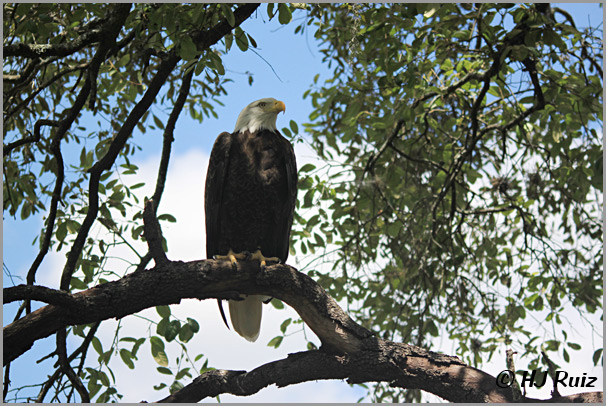
Photographs are © H. J. Ruiz – “My Backyard Visitors”
Text is available under the Creative Commons Attribution-ShareAlike License; additional terms may apply. See Terms of Use for details.
Wikipedia® is a registered trademark of the Wikimedia Foundation, Inc., a non-profit organization.
Share this:

Great Egret
Great Egret – a.k.a. the Great White Egret Spec. Name: Ardea alba
This is a large, widely-distributed egret. Distributed across most of the tropical and warmer temperate regions of the world, in southern Europe it is rather localized. In North America it is more widely distributed, and it is ubiquitous across the Sun Belt of the United States and in the rainforests of South America.

Great Egret
It is sometimes confused with the Great White Heron in Florida, which is a white morph of the closely related Great Blue Heron (A. herodias). Note, however, that the name Great White Heron has occasionally been used to refer to the Great Egret.
The Great Egret is a large bird with all-white plumage that can reach one meter in height, weigh up to 2.1 lbs and a wingspan of 65 to 85 in. It is thus only slightly smaller than the Great Blue or Grey Heron (A. cinerea). Apart from size, the Great Egret can be distinguished from other white egrets by its yellow bill and black legs and feet, though the bill may become darker and the lower legs lighter in the breeding season. In breeding plumage, delicate ornamental feathers are borne on the back. Males and females are identical in appearance; juveniles look like non-breeding adults. It is a common species, usually easily seen.
It has a slow flight, with its neck retracted. This is characteristic of herons and bitterns, and distinguishes them from storks, cranes, ibises, and spoonbills, which extend their necks in flight.
The Great Egret is not normally a vocal bird; at breeding colonies, however, it often gives a loud croaking cuk cuk cuk.
The Great Egret is partially migratory, with northern hemisphere birds moving south from areas with colder winters. It breeds in colonies in trees close to large lakes with reed beds or other extensive wetlands. It builds a bulky stick nest.

Photographs are © H. J. Ruiz – “My Backyard Visitors”
Text is available under the Creative Commons Attribution-ShareAlike License; additional terms may apply. See Terms of Use for details.
Wikipedia® is a registered trademark of the Wikimedia Foundation, Inc., a non-profit organization.
Share this:

Cinnamon Teal
Cinnamon Teal – Spec. Name: Anas Cyanoptera
This is a small, reddish dabbling duck found in marshes and ponds of western North and South America.

Cinnamon Teal (M)
The adult male has a cinnamon-red head and body with a brown back, a red eye and a dark bill. The adult female has a mottled brown body, a pale brown head, brown eyes and a grey bill and is very similar in appearance to a female Blue-winged Teal; however its overall color is richer, the lore spot, eye line, and eye ring are less distinct. Its bill is longer and more spatulate. Male juvenile resembles a female Cinnamon or Blue-winged Teal but their eyes are red. They are 16 inches long, have a 22-inch wingspan, and weigh 14 ounces. They have 2 adult molts per year and a third molt in their first year.
Their breeding habitat is marshes and ponds in western United States and extreme southwestern Canada, and are rare visitors to the east coast of the United States. Cinnamon Teal generally select new mates each year. They are migratory and most winter in northern South America and the Caribbean, generally not migrating as far as the Blue-winged Teal. Some winter in California and southwestern Arizona. They are known to interbreed with Blue-winged Teals. These birds feed by dabbling. They mainly eat plants; their diet may include mollusks and aquatic insects.
Cinnamon teal are commonly sighted in the Midwest and eastern United States, and are often associated with a flock of blue-winged teal, most likely attaching themselves to the flock on their mutual breeding grounds. Cinnamon teal are common winter visitors to Central America.

Photographs are © H.J. Ruiz – “My Backyard Visitors”
Text is available under the Creative Commons Attribution-ShareAlike License; additional terms may apply. See Terms of Use for details.
Wikipedia® is a registered trademark of the Wikimedia Foundation, Inc., a non-profit organization.
Share this:

American White Ibis
American White Ibis – Spec. Name: Eudocimus Albus
This is a species of wading bird in the ibis family Threskiornithidae. It occurs from the mid-Atlantic and Gulf coast of the United States south through most of the New World tropics.
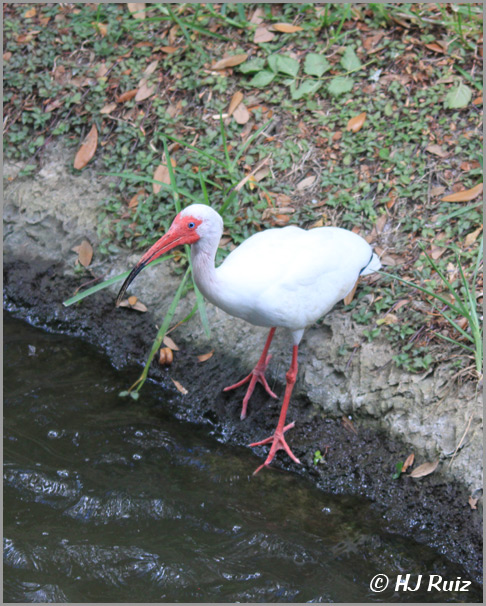
American White Ibis
The American White Ibis is a middle-sized bird with an overall white plumage, bright red-orange down-curved bill and long legs, and black wing tips that are usually only visible in flight. Being sexually dimorphic, males are larger than females. American White Ibises interbreed with Scarlet Ibises where their ranges overlap, and they have been classified as a single species. The breeding range of the American White Ibis spans along the Gulf and Atlantic Coast and also along the coasts of Mexico and Central America. The non-breeding range extends further inland in North America and also includes the Caribbean.
An adult American White Ibis weighs around 2 lb. and has an average length of about 26 in. with a 37 in. wingspan. It has an all-white plumage with thin black wingtips that are usually only visible in flight. The long, downcurved bill and long legs are bright red-orange. The sexes look alike, and it is difficult to determine the sex of an adult American White Ibis by visual observation. However, there is some sexual dimorphism in size — males average significantly larger than females, in terms of flight structure, bill size and weight. The American White Ibis has been found to be most dimorphic in terms of weight and least dimorphic in terms of flight structure. Like other species of ibis, the White Ibis flies with neck and legs outstretched, often in long, loose lines.
The juvenile American White Ibis is structurally like an adult, but it has largely brown plumage and only the rump, underwing and underparts are white. The bill and legs are light orange. As it matures, white feathers begin appearing on the back and it undergoes a gradual molt to obtain the white adult plumage.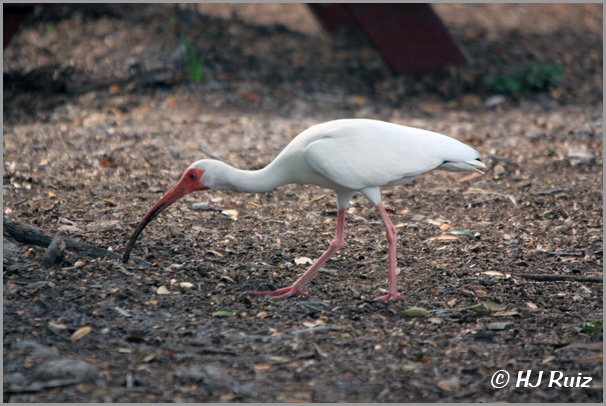
In North America, the White Ibis breeds coastally along the Gulf Coast. It is common across Florida and occurs inland in the state as well. It has also been found to breed along the Atlantic coast, reaching as far north as the Carolinas. The non-breeding range of the White Ibis extends further inland, reaching north to Virginia, and west to eastern Texas. The White Ibis is known to wander, and has been sighted, sometimes in small flocks, in states far out of its usual range. The species is most common in Florida, where over 30,000 have been counted in a single breeding colony. It also occurs throughout the Caribbean, on both coasts of Mexico and Central America, and as far south as Columbia and Venezuela.
Outside the nesting season, the White Ibis’s habitat selection is highly variable although shallow coastal marshes, wetlands, and mangrove swamps are the preferred habitat. The White Ibis is also commonly found in muddy pools, on mudflats and even wet lawns. White Ibis populations that are away from the coast and shoreline, particularly in southern Florida, often reside in other forms of wet habitats such as marshes, ponds and flooded fields.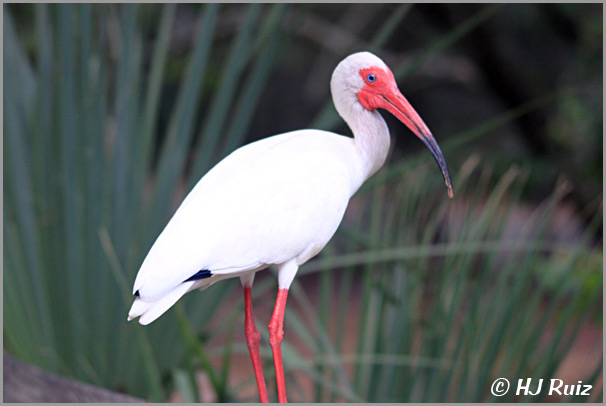
Photographs are © H. J. Ruiz – “My Backyard Visitors” Taken in Tampa and Sarasota, Florida.
Text is available under the Creative Commons Attribution-ShareAlike License; additional terms may apply. See Terms of Use for details.
Wikipedia® is a registered trademark of the Wikimedia Foundation, Inc., a non-profit organization.
Share this:


Read Past Reviews

Book # 69

Quote from the Author
“A good chuckle is healthy, it helps you break the monotony of a serious life.” ~ H.J. Ruiz


You must be logged in to post a comment.