
Shoebill
Shoebill – Spec. Name: Balaeniceps Rex
Also known as Whalehead, is a very large stork-like bird. It derives its name from its massive shoe-shaped bill.
The adult bird is 45–60 in tall, 40–55 in long, 91–125 in across the wings and weighs 8.8-15.5 lbs. The adult is mainly grey while the juveniles are browner. It lives in tropical east Africa in large swamps from Sudan to Zambia.
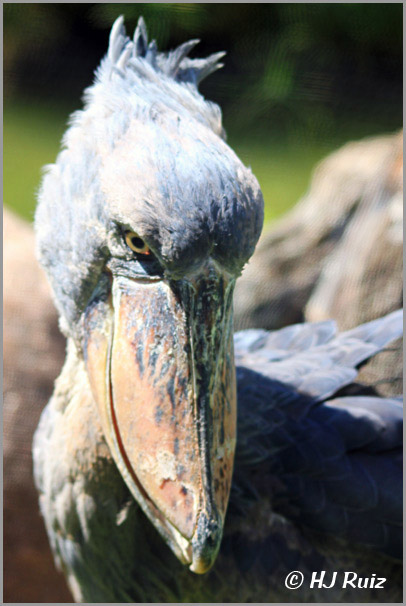
Shoebill
This species was only classified in the 19th century when some skins were brought to Europe. It was not until years later that live specimens reached the scientific community. However, the bird was known to both ancient Egyptians and Arabs. There are Egyptian images depicting the Shoebill, while the Arabs referred to the bird as abu markub, which means one with a shoe, a reference to the bird’s distinctive bill.
Shoebills feed in muddy waters, preying on fish, frogs, reptiles such as baby crocodiles, and small mammals. They nest on the ground and lay 2 eggs.
The population is estimated at between 5,000 and 8,000 individuals, the majority of which live in Sudan. BirdLife International have classified it as Vulnerable with the main threats being habitat destruction, disturbance and hunting.
The Shoebill is one of the bird taxa whose taxonomic treatment is murky. Traditionally allied with the storks (Ciconiiformes), it was retained there in the Sibley-Ahlquist taxonomy which lumped a massive number of unrelated taxa into their “Ciconiiformes”. More recently, the shoebill has been considered to be closer to the pelicans (based on anatomical comparisons; Mayr, 2003) or the herons (based on biochemical evidence; Hagey et al., 2002). A recent DNA study suggests they are part of the Pelecaniformes.
But actually, the dispute has turned out to be mainly one of where to draw the boundary between Ciconiiformes and Pelecaniformes, or whether to draw it at all. Since cormorants and relatives are probably not actually Pelecaniformes, a solution adopted by some modern authors is to merge the “core” Pelecaniformes with the Ciconiiformes. The Shoebill and the Hammerkop (Scopus umbretta) are the “missing links” that connect pelicans and storks, and including the pelican lineage in the Ciconiiformes expresses this more adequately than other treatments do.
So far, two fossil relatives of the shoebill have been described: Goliathia from the early Oligocene of Egypt and Paludavis from the Early Miocene of the same country. It has been suggested that the enigmatic African fossil bird Eremopezus was a relative too, but the evidence for that is very spurious indeed. All that is known of Eremopezus is that it was a very large, probably flightless bird with a flexible foot, allowing it to handle either vegetation or prey.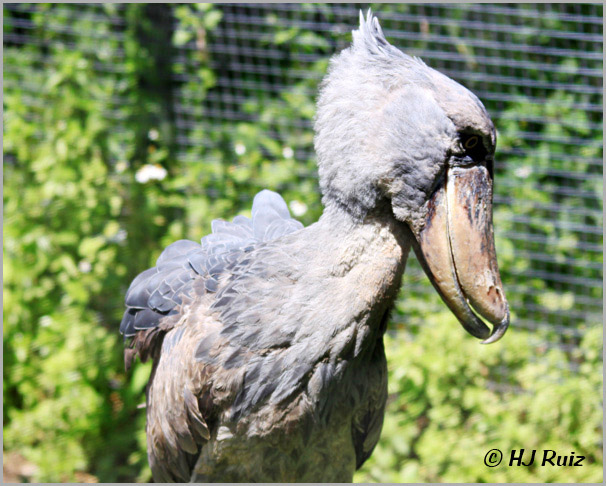
Photographs are © H. J. Ruiz – “My Backyard Visitors”
Text is available under the Creative Commons Attribution-ShareAlike License; additional terms may apply. See Terms of Use for details.
Wikipedia® is a registered trademark of the Wikimedia Foundation, Inc., a non-profit organization.
Share this:

Green Heron
Green Heron – Spec. Name: Butorides Virescens
This is a small heron of North and Central America. It was long considered conspecific with its sister species the Striated Heron (Butorides striata), and together they were called “Green-backed Heron”. Birds of the nominate subspecies (no matter which taxonomic arrangement is preferred) are extremely rare vagrants to western Europe; individuals from the Pacific coast of North America may similarly stray as far as Hawaii.
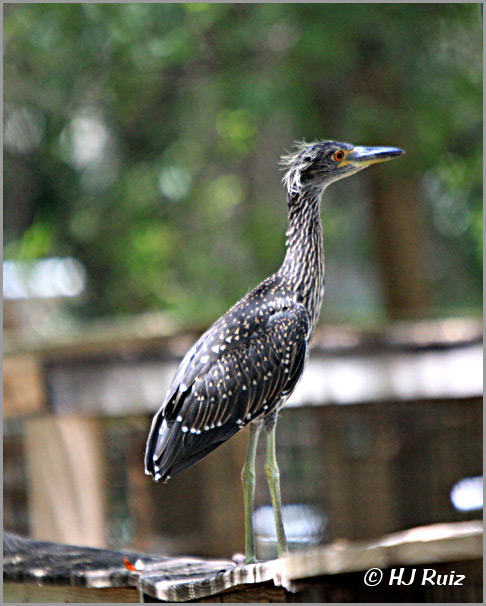
Green Heron (Immature)
The Green Heron is relatively small; adult body length is about 44 cm (17 in). The neck is often pulled in tight against the body. Adults have a glossy, greenish-black cap, a greenish back and wings that are grey-black grading into green or blue, a chestnut neck with a white line down the front, grey underparts and short yellow legs. The bill is dark with a long, sharp point. Female adults tend to be smaller than males, and have duller and lighter plumage, particularly in the breeding season. Juveniles are duller, with the head sides, neck and underparts streaked brown and white, tan-splotched back and wing coverts, and greenish-yellow legs and bill. Hatchlings are covered in down feathers, light grey above, and white on the belly.
The Green Heron’s call is a loud and sudden kyow; it also makes a series of more subdued kukcalls. During courtship, the male gives a raah-rahh call with wide-open bill, makes noisy wingbeats and whoom-whoom-whoom calls in flight, and sometimes calls roo-roo to the female before landing again. While sitting, an aaroo-aaroo courtship call is also given.
Green Herons are seasonally monogamous. The pairs form in the breeding range, after an intense courtship display by the males, who select the nesting sites and fly in front of the female noisily and with puffed-up head and neck plumage. They nest in forest and swamp patches, over water or in plants near water. Nests are a platform of sticks, often in shrubs or trees, sometimes on the ground. Locations in trees are preferred, with some nests built 20 meters off the ground; heights of several meters above ground are more common though. Rarely, large numbers of these birds congregate in heronries for nesting.
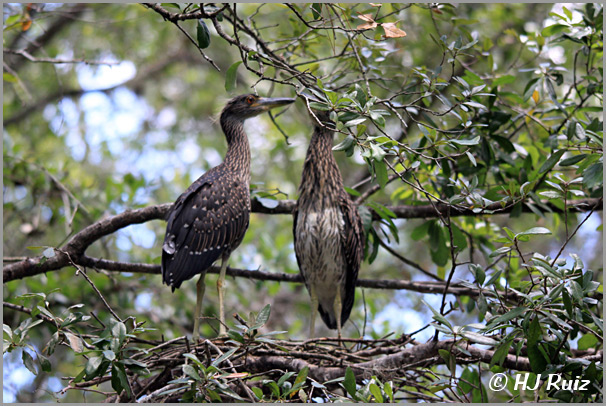
Green Herons at tree nest
Photographs are © H. J. Ruiz – “My Backyard Visitors”
Text is available under the Creative Commons Attribution-ShareAlike License; additional terms may apply. See Terms of Use for details.
Share this:

Saddle-billed Stork
Saddle-billed Stork – Spec. Name: Ephippiorhynchus Senegalensis
This is a large wading bird in the stork family, Ciconiidae. It is a widespread species which is a resident breeder in sub-Saharan Africa from Sudan, Ethiopia and Kenya south to South Africa, and in The Gambia, Senegal, Côte d’Ivoire and Chad in west Africa.

Saddle-billed Stork
This is a close relative of the widespread Asian Black-necked Stork, the only other member of the genus Ephippiorhynchus.
This is a huge bird that regularly attains a height of 150 cm (5 feet) and a 270 cm (9 feet) wingspan. The male is larger and heavier than the female, with a range of 5.1-7.5 kg, the female is usually between 5 and 6.9 kg. It is probably the tallest, if not the heaviest, of the storks. Females are distinctly smaller than the males. The sexes can be readily distinguished by the golden yellow irises of the female and the brown irises of the male.
It is spectacularly plumaged, identical in male and female. The head, neck, back, wings, and tail are iridescent black, with the rest of the body and the primary flight feathers being white. Juveniles are browner grey in plumage. The massive bill is red with a black band and a yellow frontal shield (the “saddle”). The legs and feet are black with pink knees. On the chest is a bare red patch of skin, whose colour darkens during breeding season.
They are silent except for bill-clattering at the nest. Like most storks, these fly with the neck outstretched, not retracted like a heron; in flight, the large heavy bill is kept drooping somewhat below belly height, giving these birds a very unusual appearance to those who see them for the first time. To experienced birdwatchers on the other hand, this makes them easily recognizable even if seen from a distance. It has been suggested that due to the large size and unusual appearance in flight, this species is the basis for the “Big Bird” and Kongamato cryptids.
The Saddle-billed Stork, like most of its relatives, feeds mainly on fish, frogs and crabs, but also on small birds and reptiles . They move in a deliberate and stately manner as they hunt, in a similar way to the larger herons.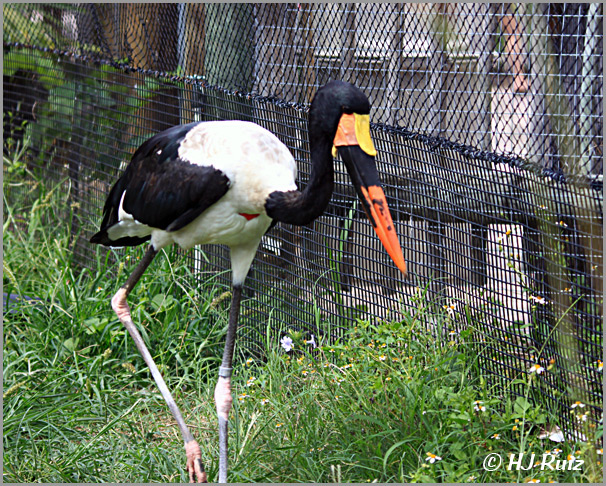
Photographs are © H. J. Ruiz – “My Backyard Visitors”
Text is available under the Creative Commons Attribution-ShareAlike License; additional terms may apply. See Terms of Use for details
Share this:

Pooto Bird Camouflage – Video
This is an amazing bird (Pooto) with a great ability to camouflage when perched on trees. Let’s take a look at the video made by © BBC
Share this:


Read Past Reviews

Book # 69

Quote from the Author
“A good chuckle is healthy, it helps you break the monotony of a serious life.” ~ H.J. Ruiz


You must be logged in to post a comment.