
How Birds Camouflage their nests – Video
I’m sure that you’ll be amazed by what this video made by © BBC has to show. Enjoy!
Share this:

Brown Pelican
Brown Pelican – Spec. Name: Pelecanus Occidentalis
This is the smallest of the eight species of pelican, although it is a large bird in nearly every other regard. It is 106–137 cm (42–54 in) in length, weighs from 2.75 to 5.5 kg (6.1 to 12 lb) and has a wingspan from 1.83 to 2.5 m (6.0 to 8.2 ft).
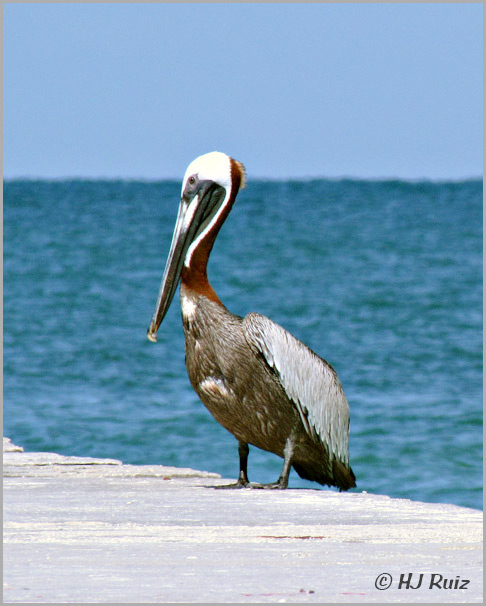
Brown Pelican
The Brown Pelican lives on coasts in the Americas from Washington and Virginia south to northern Peru and the mouth of the Amazon River, as well as the island of Saut d’Eau in Trinidad and Tobago. Some immature birds may stray to inland freshwater lakes. After nesting, North American birds move in flocks further north along the coasts, returning to warmer waters for winter. Their young are hatched in broods of about 3, and eat around 150 lbs. of fish in the 8–10 month period they are cared for.
This bird is distinguished from the American White Pelican by its brown body and its habit of diving for fish from the air, as opposed to co-operative fishing from the surface. It eats mainly fish and amphibians as well as crustaceans. Groups of Brown Pelicans often travel in single file, flying low over the water’s surface.
The nest location varies from a simple scrape on the ground on an island to a bulky stick nest in a low tree. These birds nest in colonies, usually on islands.
Pesticides like DDT and dieldrin threatened the Brown Pelican’s future in the southeast United States and California in the early 1970s. Pesticides also threatened the pelican population in Florida in this period. A research group from the University of Tampa headed by Dr. Ralph Schreiber conducted research in the Tampa Bay/St Petersburg area and found that DDT caused the pelican eggshells to be too thin and incapable of supporting the embryo to maturity. As a result of this research, DDT usage was eliminated in Florida, followed by the rest of the US. Along with the American White Pelican, the Brown Pelican is protected by the Migratory Bird Treaty Act of 1918.
Photographs are © H.J. Ruiz – “My Backyard Visitors” Taken in Bradenton Beach, Florida
Text is available under the Creative Commons Attribution-ShareAlike License; additional terms may apply. See Terms of Use for details.
Share this:

African Spoonbill
African Spoonbill – Spec. Name: Platalea Alba
This is a wading bird of the ibis and spoonbill family Threskiornithidae. This species is a widespread resident across Africa and Madagascar.
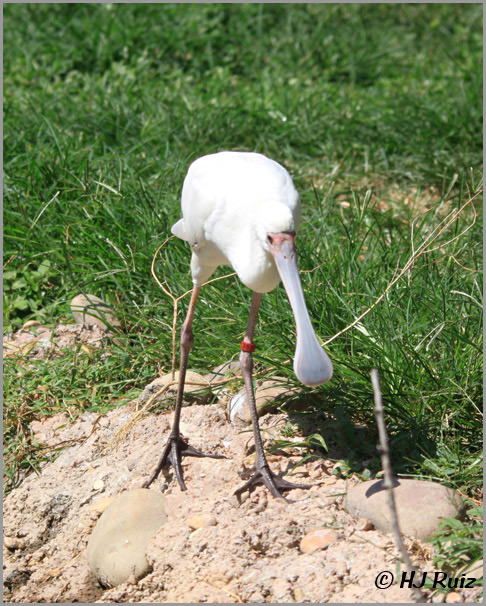
African Spoonbill
It lives in marshy wetlands with some open shallow water, nesting in colonies in trees or reedbeds. It does not usually share colonies with storks or herons. Usually two to four eggs are laid.
The African Spoonbill is almost unmistakable through most of its range. The breeding bird is all white except for its red legs and face and long grey spatulate bill. It has no crest, unlike the Common Spoonbill. Immature birds lack the red face and have a yellow bill. Unlike herons, spoonbills fly with their necks outstretched.
The African Spoonbill is one of the species to which the Agreement on the Conservation of African-Eurasian Migratory Waterbirds (AEWA) applies.
The African Spoonbill’s diet consists mainly of fish and aquatic invertebrates such as crustaceans or shellfishes, insects, larvae, and mollusks.
The African Spoonbill is a shy and alert bird, usually found singly, but can also be encountered in pairs or in groups. It is usually silent, except for an occasional grunt when alarmed. This bird travels by flight.

Photographs are © H.J. Ruiz – “My Backyard Visitors”
Share this:

Yellow-crowned Night Heron
Yellow-crowned Night Heron – Spec. Name: Nyctanassa Violacea
Formerly placed in the genus Nycticorax, also called the American Night Heron or squawk, is a fairly small heron, similar in appearance to the Black-crowned Night Heron. It is found throughout a large part of the Americas, especially (but not exclusively) in warmer coastal regions; an example occurrence is the Petenes mangroves of the Yucatan.
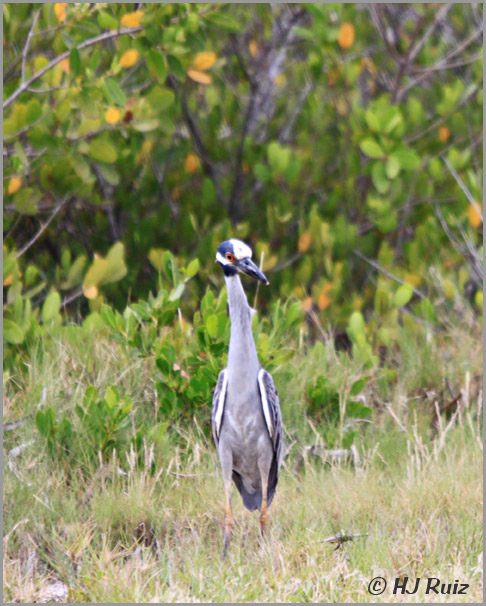
Yellow-crowned Night Heron
Adults are about 61 cm long and weigh 625 g. They have a white crown and back with the remainder of the body grayish, red eyes and short yellow legs. They have a white stripe below the eye. Juveniles resemble young Black-crowned Night-Herons, being mainly brown flecked with white or gray.
These birds stalk their prey or wait in ambush at the water’s edge, mainly at night. They mainly eat crustaceans, mollusks, frogs, aquatic insects and small fish.
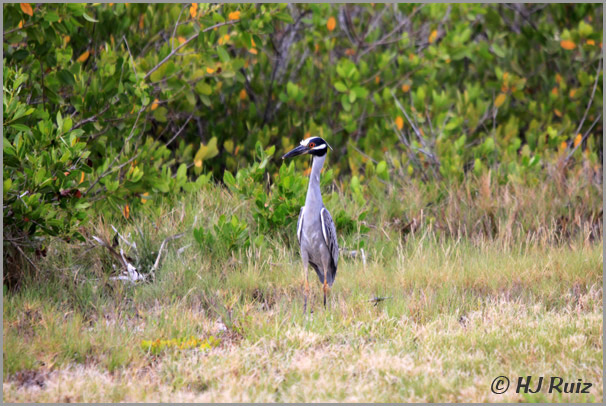
Photographs are © H.J. Ruiz – “My Backyard Visitors” – Taken near a canal in Sarasota, Florida.
Text is available under the Creative Commons Attribution-ShareAlike License; additional terms may apply. See Terms of Use for details.
Share this:


Read Past Reviews

Book # 69

Quote from the Author
“A good chuckle is healthy, it helps you break the monotony of a serious life.” ~ H.J. Ruiz


You must be logged in to post a comment.