Common Moorhen
Common Moorhen, or Common Gallinule – Spec. Name: Gallinula Chloropus
This is a bird in the Rallidae family with an almost worldwide distribution. It lives around well-vegetated marshes, ponds, canals and other wetlands. These species are not found in the polar regions, or many tropical rainforests. But elsewhere the Common Moorhen is likely the most commonly seen rail species to most people, excepting the Eurasian Coot or American Coot in some regions.
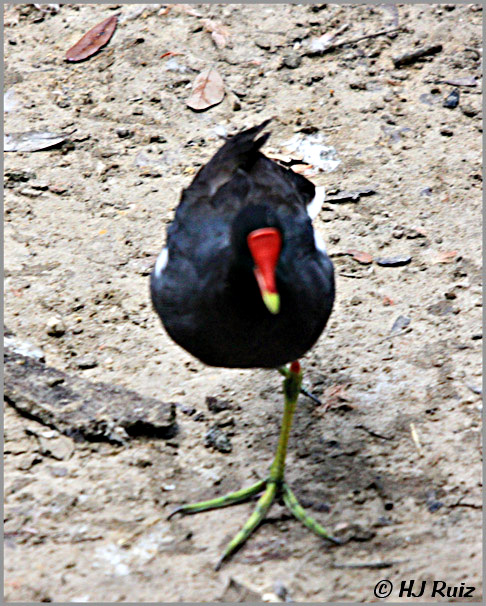
Common Moorhen
The Moorhen is a distinctive species, with dark plumage apart from the white undertail, yellow legs and a red facial shield. The young are browner and lack the red shield. It has a wide range of gargling calls and will emit loud hisses when threatened.
This is a common breeding bird in marsh environments and well-vegetated lakes. Populations in areas where the waters freeze, such as southern Canada, the northern USA and eastern Europe, will migrate to more temperate climes. This species will consume a wide variety of vegetable material and small aquatic creatures. They forage beside or in the water, sometimes upending in the water to feed. It is often secretive, but can become tame in some areas. Despite loss of habitat in parts of its range, the Common Moorhen remains plentiful and widespread.
The nest is a basket built on the ground in dense vegetation. Laying starts in spring, between mid-March and mid-May in N hemisphere temperate regions. About 8 eggs are usually laid per female early in the season; if later in the year they usually lay 5 eggs or less. Nests may be re-used by different females. Incubation lasts about three weeks. Both parents incubate and feed the young. These fledge after 40–50 days, become independent usually a few weeks thereafter, and may raise their first brood the next spring. When threatened, the young may cling to the parent’s body, after which the adult birds fly away to safety, carrying their offspring with them.
On a global scale – all subspecies taken together –, the Common Moorhen is as abundant as its vernacular name implies. It is therefore considered a species of Least Concern by the IUCN.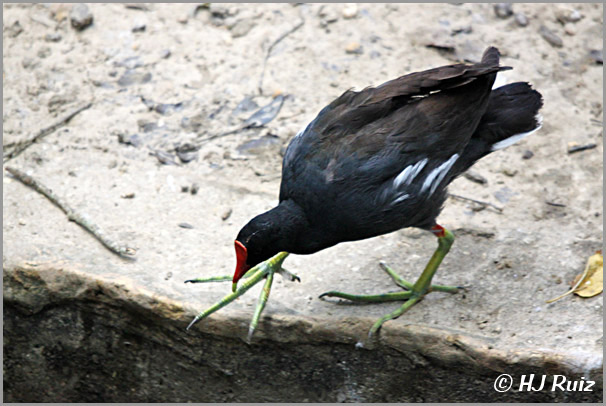
Photographs are © H. J. Ruiz – “My Backyard Visitors”
Text is available under the Creative Commons Attribution-ShareAlike License; additional terms may apply. See Terms of Use for details.
Share this:

American Flamingo
American Flamingo – Spec. Name: Phoenicopterus Ruber
This is a large species of flamingo closely related to the Greater Flamingo and Chilean Flamingo. It was formerly considered conspecific with the Greater Flamingo, but that treatment is now widely viewed (e.g. by the American and British Ornithologists’ Unions) as incorrect due to a lack of evidence.

American Flamingo
It has also been known as the Caribbean Flamingo, but the species’ presence in the Galápagos makes that name problematic. It is the only flamingo which naturally inhabits North America.
Like all flamingos, it lays a single chalky white egg on a mud mound, between May and August; incubation until hatching takes from 28 to 32 days; both parents brood the young for a period of up to 6 years when they reach sexual maturity. Their life expectancy of 40 years is one of the longest in birds.
120–140 cm (47–55 in) in length, the males weigh 2.8 kg (6.2 lb) and females 2.2 kg (4.9 lb) kg. Most of its plumage is pink, giving rise to its earlier name of Rosy Flamingo and differentiating adults from the much paler Greater Flamingo. The wing coverts are red, and the primary and secondary flight feathers are black. The bill is pink and white with a restricted black tip, and the legs are entirely pink. The call is a goose-like honking.
It is one of the species to which the Agreement on the Conservation of African-Eurasian Migratory Waterbirds (AEWA) applies.

Photographs are © H.J. Ruiz – “My Backyard Visitors”
Text is available under the Creative Commons Attribution-ShareAlike License; additional terms may apply. See Terms of Use for details.
Share this:

Wood Duck a.k.a Carolina Duck
Wood Duck or Carolina Duck – Spec.Name: Aix Sponsa
This is a species of duck found in North America. It is one of the most colourful of North American waterfowl.
The Wood Duck is a medium-sized perching duck. A typical adult is from 47 to 54 cm (19 to 21 in) in length with a wingspan of between 66 to 73 cm (26 to 29 in). This is about three-quarters of the length of an adult Mallard. It shares its genes with the Asian Mandarin Duck (Aix galericulata).
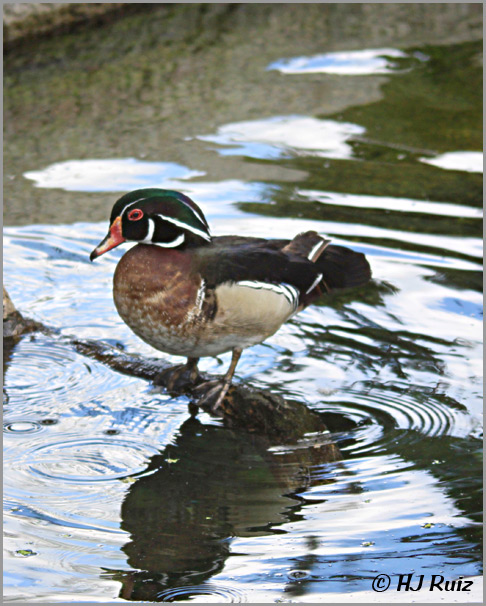
Wood Duck
The adult male has distinctive multicoloured iridescent plumage and red eyes,with a distinctive white flare down the neck. The female, less colourful, has a white eye-ring and a whitish throat. Both adults have crested heads. When swimming, Wood Ducks bob their head back and forth in a jerking motion, which makes them easy to spot.
The male’s call is a rising whistle, “jeeeeee”; the females utter a drawn-out, rising squeal, “oo-eek,” when flushed, and a sharp “cr-r-ek, cr-e-ek” for an alarm call.
Their breeding habitat is wooded swamps, shallow lakes, marshes or ponds, and creeks in eastern North America, the west coast of the United States and western Mexico. They usually nest in cavities in trees close to water, although they will take advantage of nesting boxes in wetland locations if available. Females line their nests with feathers and other soft materials, and the elevation provides some protection from predators. Unlike most other ducks, the Wood Duck has sharp claws for perching in trees and can, in southern regions, produce two broods in a single season—the only North American duck that can do so.
Females typically lay between 7 and 15 white-tan eggs that incubate for an average of 30 days. However, if nesting boxes are placed too close together, females may lay eggs in the nests of their neighbours, which may lead to nests which may contain as many as 40 eggs and unsuccessful incubation, a behaviour known as “nest dumping”
After hatching, the ducklings jump down from the nest tree and make their way to water. The mother calls them to her, but does not help them in any way. The ducklings may jump from heights of up to 88 metres (290 ft) without injury. They prefer nesting over water so the young have a soft landing, but will nest up to 140 m (150 yd) away from the shoreline. The day after they hatch, the young climb to the nest entrance and jump to the ground. The ducklings can swim and find their own food by this time.
These birds feed by dabbling or walking on land. They mainly eat berries, acorns, and seeds, but also insects, making them omnivores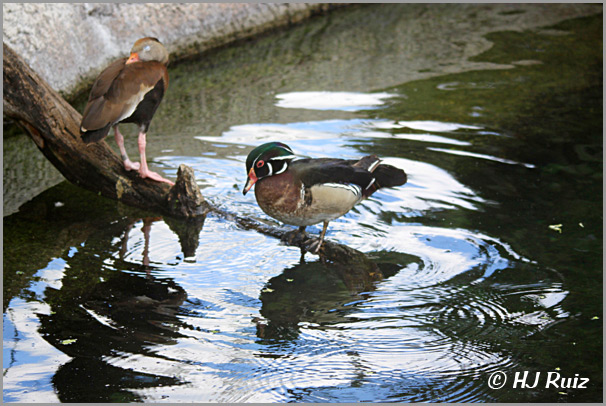
Photographs are © H.J. Ruiz – “My Backyard Visitors”
Text is available under the Creative Commons Attribution-ShareAlike License; additional terms may apply. See Terms of Use for details.
Share this:

Snowy Egret
The Snowy Egret – Spec. Name: Egretta Thula
This is a small white heron. It is the American counterpart to the very similar Old World Little Egret, which has established a foothold in the Bahamas.

Snowy Egret
Adults are typically 61 centimetres (24 in) long and weigh 375 grams (13.2 oz) They have a slim black bill and long black legs with yellow feet. The area of the upper bill, in front of the eyes, is yellow but turns red during the breeding season, when the adults also gain recurved plumes on the back, making for a “shaggy” effect. The juvenile looks similar to the adult, but the base of the bill is paler, and a green or yellow line runs down the back of the legs.
Their breeding habitat is large inland and coastal wetlands from the lower Great Lakesand southwestern United States to South America. The breeding range in eastern North America extends along the Atlantic and Gulf Coasts from Maine to Texas, and inland along major rivers and lakes. They nest in colonies, often with other waders, usually on platforms of sticks in trees or shrubs. Their flat, shallow nests are made of sticks and lined with fine twigs and rushes. Three to four greenish-blue, oval eggs are incubated by both adults. The young leave the nest in 20 to 25 days and hop about on branches near the nest before finally departing.
In warmer locations, some Snowy Egret are permanent residents; northern populations migrate to Central America and the West Indies. They may wander north after the breeding season, very rarely venturing to western Europe—the first bird sighted in Britain wintered in Scotland from 2001–2002.
The birds eat fish, crustaceans, insects and small reptiles. They stalk prey in shallow water, often running or shuffling their feet, flushing prey into view, as well “dip-fishing” by flying with their feet just over the water. Snowy Egrets may also stand still and wait to ambush prey, or hunt for insects stirred up by domestic animals in open fields.
At one time, the beautiful plumes of the Snowy Egret were in great demand by market hunters as decorations for women’s hats. This reduced the population of the species to dangerously low levels.
Now protected in the USA by law, under the Migratory Bird Treaty Act, this bird’s population has rebounded.
Photographs are © H. J. Ruiz – “My Backyard Visitors”
Text is available under the Creative Commons Attribution-ShareAlike License; additional terms may apply. See Terms of Use for details.
Share this:


Read Past Reviews

Book # 69

Quote from the Author
“A good chuckle is healthy, it helps you break the monotony of a serious life.” ~ H.J. Ruiz


You must be logged in to post a comment.