Happy Independence Day!
I wish for all of you to have a beautiful 4th of July Holiday! Enjoy this patriotic day to celebrate our independence and embrace to freedom for all. Never forget that USA is the best country in the world! Hurray!
Please handle firecrackers with safety in mind.

Happy Independence Day!
Share this:

Bahrain Desert Birds -Video
Another amazing video of bird life in exotic and distant places of the world. Great video by BBC. Enjoy!
Share this:

Do you know about Sexual Dimorphism?
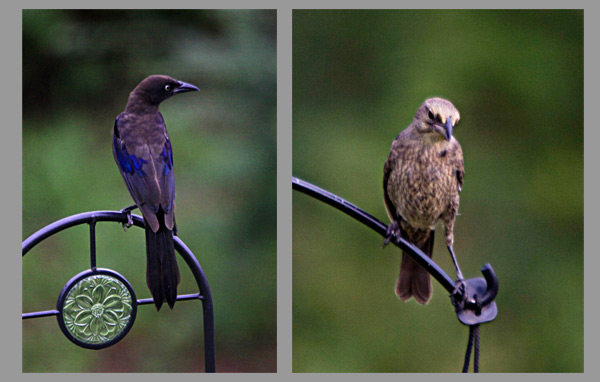
Common Grackle (M - F)
Sexual Dimorphism is a phenotypic difference between males and females of the same species. Examples of such differences include differences in morphology, ornamentation, and behavior.
A common type of dimorphism is ornamentation. Dichromatism is where a sex of a given species is more than one color including that of saturated, vibrant hues.
Exaggerated dimorphic traits are used predominately in the competition over mates. Ornaments are costly to produce or maintain but differ depending on the type of color mechanism involved.
One excellent example of this is in the Common Grackle The male has a very vibrant plumage which it uses to attract females. The male Grackle will use its vibrant plumage to court a mate. Same case with other species such as House Finches, Red-winged Blackbirds, Peafowls and many other birds.
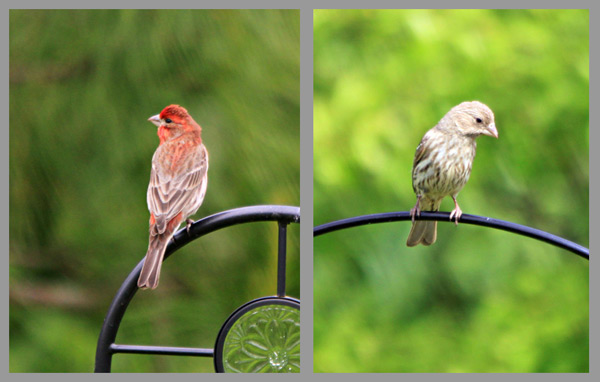
House Finch (M - F)
Sexual dimorphism in mammals and birds
The brains of many birds and mammals, including humans, are significantly different for males and females of the species. Both genes and hormones affect the formation of many animal brains before “birth” (or hatching), and also behaviour of adult individuals. Hormones significantly affect human brain formation, and also brain development at puberty. A 2004 review in Nature Reviews Neuroscienceobserved that “because it is easier to manipulate hormone levels than the expression of sex chromosome genes, the effects of hormones have been studied much more extensively, and are much better understood, than the direct actions in the brain of sex chromosome genes.” It concluded that while “the differentiating effects of gonadal secretions seem to be dominant,” the existing body of research “support the idea that sex differences in neural expression of X and Y genes significantly contribute to sex differences in brain functions and disease.

Red-winged Blackbird (M - F)
Photographs are © H.J. Ruiz – “My Backyard Visitors”
Share this:

Wild Turkey
Wild Turkey – Spec. Name: Meleagris Gallopavo
This bird is native to North America and is the heaviest member of the Galliformes. It is the same species as the domestic turkey, which was domesticated from the South Mexican subspecies of the wild turkey.
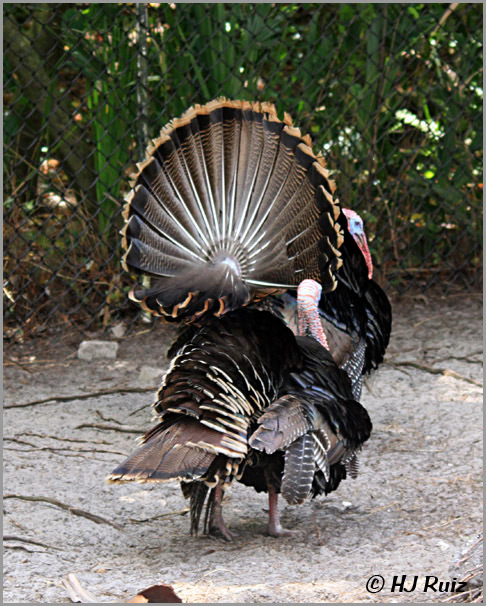
Wild Turkey
Adult wild turkeys have long reddish-yellow to grayish-green legs and a black body. Males, called toms or gobblers, have a large, featherless, reddish head, red throat, and red wattles on the throat and neck. The head has fleshy growths called caruncles. When males are excited, a fleshy flap on the bill expands, and this, the wattles and the bare skin of the head and neck all become engorged with blood, almost concealing the eyes and bill. The long fleshy object over a male’s beak is called as nood. When a male turkey’s excited, its head turns blue; when ready to fight, it turns red. Each foot has three toes, and males have a spur behind each of their lower legs.
Turkeys have a long, dark, fan-shaped tail and glossy bronze wings. As with many other species of the Galliformes, turkeys exhibit strong sexual dimorphism. The male is substantially larger than the female, and his feathers have areas of red, purple, green, copper, bronze, and gold iridescence. Females, called hens, have feathers that are duller overall, in shades of brown and gray. Parasites can dull coloration of both sexes; in males, coloration may serve as a signal of health. The primary wing feathers have white bars. Turkeys have 5000 to 6000 feathers. Tail feathers are of the same length in adults, different lengths in juveniles. Males typically have a “beard”, a tuft of coarse hair (modified feathers) growing from the center of the breast. Beards average 9 inches (230 mm) in length. In some populations, 10 to 20 percent of females have a beard, usually shorter and thinner than that of the male. The adult male normally weighs from 5 to 11 kg (11–24 pounds) and measures 100–125 cm (39–49 in). The adult female is typically much smaller at 3 to 5.4 kg (6.6–12 lbs) and is 76 to 95 cm (30–37 in) long. The wingspan ranges from 1.25 to 1.44 m (49–57 in). The record-sized adult male Wild Turkey, according to the National Wild Turkey Federation, weighed 38 lb (17.2 kg).
Despite their weight, wild turkeys are surprisingly agile fliers and cunning, unlike their domestic counterparts.
Turkeys are very cautious birds and will fly or run at the first sign of danger. Their ideal habitat is an open woodland or savanna, where they may fly beneath the canopy top and find perches. They usually fly close to the ground for no more than a quarter mile (400 m).
Wild turkeys are omnivorous, foraging on the ground or climbing shrubs and small trees to feed. They prefer eating hard mast such as acorns, nuts, and various trees, including hazel, chestnut, hickory, and pinyon pine as well as various seeds, berries such as juniper and bearberry, roots and insects. Turkeys also occasionally consume amphibians and small reptiles such as lizards and snakes.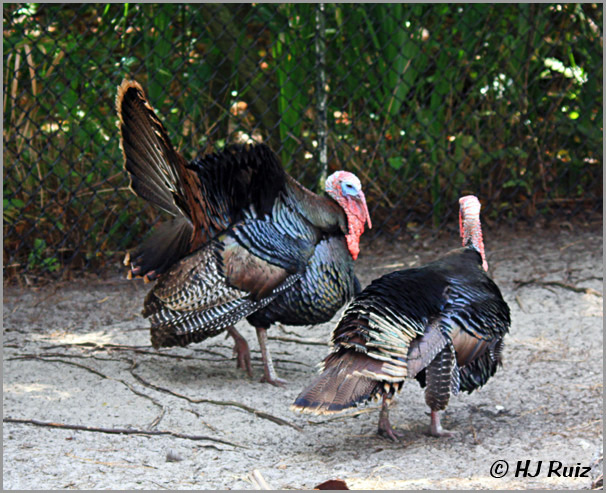
All photographs are © H.J. Ruiz – “My Backyard Visitors”
Text is available under the Creative Commons Attribution-ShareAlike License; additional terms may apply. See Terms of use for details.
Share this:


Read Past Reviews

Book # 69

Quote from the Author
“A good chuckle is healthy, it helps you break the monotony of a serious life.” ~ H.J. Ruiz


You must be logged in to post a comment.