
Double-crested Cormorant
Double-crested Cormorant – Spec. Name: Phalacrocorax Auritus
This is a member of the cormorant family of seabirds. It occurs along inland waterways as well as in coastal areas, and is widely distributed across North America, from the Aleutian Islands in Alaska down to Florida and Mexico.
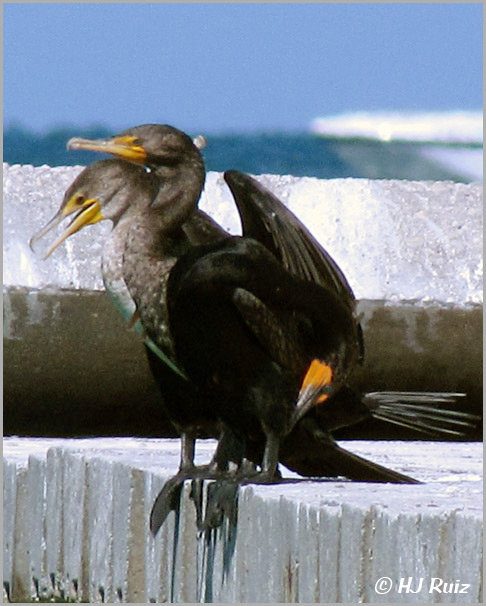
Double-crested Cormorants
The Double-crested Cormorant is a large waterbird with a stocky body, long neck, medium-sized tail, webbed feet and a medium sized hooked bill. It has a body length of between 70–90 cm (28–35 in) long, with a wingspan of between 114–132 cm (45–52 in). Double-crested Cormorants weigh between 1.2–2.5 kg (2.6–5.5 pounds) Males and females do not display sexual dimorphism.
This species has dark-colored plumage with bare super-loral skin and gular skin that is yellow or orange. An adult in breeding plumage will be mostly black with the back and coverts being a dark grayish towards the center. Nuptial crests, for which the species is named, are either white, black or a mix of the two. These are located just above the eyes with the bare skin on the face of a breeding adult being orange. A non-breeding adult will lack the crests and have more yellowish skin around the face. The bill of the adult is dark-colored.
The plumage of juvenile Double-crested Cormorants is more dark grey or brownish. The underparts of a juvenile are lighter than the back with a pale throat and breast that darkens towards the belly. As a bird ages, its plumage will grow darker. The bill of a juvenile will be mostly orange or yellowish.
Food can be found in the sea, freshwater lakes, and rivers. Like all cormorants, the double-crested dives to find its prey. It mainly eats fish, but will sometimes also eat amphibians and crustaceans. Fish are caught by diving under water. Smaller fish may be eaten while the bird is still beneath the surface but bigger prey is often brought to the surface before it is eaten. Cormorants regurgitate pellets containing undigested parts of their meals such as bones.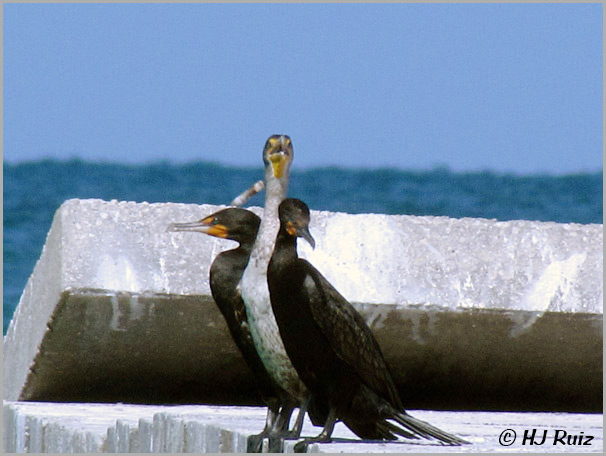
Photographs are © H.J. Ruiz – “My Backyard Visitors”
Text is available under the Creative Commons Attribution-ShareAlike License; additional terms may apply. See Terms of use for details.
Share this:

Roseate Spoonbill
Roseate Spoonbill – Spec. Name: Ajaja Ajaja, (sometimes placed in the larger genus Platalea as Platalea Ajaja)
This is a gregarious wading bird of the ibis and spoonbill family, Threskiornithidae. It is a resident breeder in South America mostly east of the Andes, and in coastal regions of the Caribbean, Central America, Mexico, and the Gulf Coast of the United States.

Roseate Spoonbill
The Roseate Spoonbill is 80 cm (31 in) tall, with a 120–130 cm (47–51 in) wingspan. It has long legs, a long neck, and a long, spatulate bill. Adults have a bare greenish head (“golden buff” when breeding) and a white neck, back, and breast (with a tuft of pink feathers in the center when breeding), and are otherwise a deep pink. The bill is grey. There is no significant sexual dimorphism.
Like the Flamingo, their pink color is diet-derived, consisting of the carotenoid pigment canthaxanthin. Another carotenoid, astaxanthin, can also be found deposited in flight and body feathers. The colors can range from pale pink to bright magenta, depending on age and location.
Unlike herons, spoonbills fly with their necks outstretched. They alternate groups of stiff, shallow wingbeats with glides
The Roseate Spoonbill nests in shrubs or trees, often mangroves, laying 2 to 5 eggs, which are whitish with brown markings. Immature birds have white, feathered heads, and the pink of the plumage is paler. The bill is yellowish or pinkish.
This species feeds in shallow fresh or coastal waters by swinging its bill from side to side as it steadily walks through the water, often in groups. It feeds on crustaceans, aquatic beetles and bugs, frogs and newts and very small fish bigger waders ignore. In the United States a popular and easy place to observe Roseate Spoonbills is “Ding” Darling National Wildlife Refuge in Florida. Roseate Spoonbills sometimes feed near Snowy Egrets, Great Egrets, Tri-colored Herons, and American White Pelicans.
Photographs are © H.J. Ruiz – “My Backyard Visitors”
Text is available under the Creative Commons Attribution-ShareAlike License; additional terms may apply. See Terms of use for details.
Share this:

Black Heron
Black Heron a.k.a. the Black Egret Spec. Name: Egretta Ardesiaca
This is an African heron. It is a medium-sized (42.5–66 cm in height), black-plumaged heron with yellow legs and feet. It is found south of the Sahara Desert, including Madagascar, and prefers shallow open waters, such as the edges of freshwater lakes and ponds. It may also be found in marshes, river edges, rice fields, and seasonally flooded grasslands.

Black Heron
In coastal areas, it may be found feeding along tidal rivers and creeks, alkaline lakes, and tidal flats. Its breeding range is between Senegal and Sudan and to the south. It is found mainly on the eastern half of the continent.
The Black Heron has an interesting hunting method called canopy feeding—it uses its wings like an umbrella, and uses the shade it creates to attract fish. This technique was well documented on episode 5 of the BBC’s The Life of Birds. Some Black Herons feed solitarily, while others feed in groups of up to 50 individuals, 200 being the highest number reported. The Black Heron feeds by day but especially prefers the time around sunset. It roosts communally at night, and coastal flocks roost at high tide. The primary food of the Black Heron is small fish, but it will also eat aquatic insects, crustaceans and amphibians.
The nest of the Black Heron is constructed of twigs placed over water in trees, bushes, and reed beds, forming a solid structure. The heron nests at the beginning of the rainy season, in single or mixed-species colonies that may number in the hundreds. The eggs are dark blue and the clutch is two to four eggs.

Photographs are © H.J. Ruiz – “My Backyard Visitors”
Text is available under the Creative Commons Attribution-ShareAlike License; additional terms may apply. See Terms of use for details.
Share this:

Trumpeter Hornbill
Trumpeter Hornbill – Spec. Name: Bycanistes Bucinato
This is a medium-sized hornbill, with length between 58 to 65 cm, characterized by a large grey casque on the bill, smaller in females.

Trumpeter Hornbill
The eyes are brown or red, with pink surrounding skin. They are similar to Silvery-cheeked Hornbill. Distinguishing features include an all-black back, white belly and white underwing coverts (in flight, wings present white tips), and red facial skin.
The Trumpeter Hornbill is a gregarious bird, usually living in groups of 2 to 5 individuals, although sometimes as many as 50. This hornbill is a locally common resident of the tropical evergreen forests of Burundi, Mozambique, Botswana, Congo, Kenya, the Caprivi strip of Namibia and eastern South Africa, where it feeds on fruits and large insects. Like other hornbills, the females incubate 4 to 5 white eggs, while sealed in the nest compartment.
When and fed in captivity they are tame loving birds that can be taught a variety of tricks, and enjoy companionship with their owner. They require large spacious cages to move about in because of their active nature. Care needs to be taken in their high fruit diet because of their susceptibility to excessive iron storage, which is similar to the excessive iron storage seen in the disease hemochromatosis in humans. They are very intelligent and have a life expectancy of up to 20 years.
Widespread throughout its large range, the Trumpeter Hornbill is evaluated as Least Concern on the IUCN Red List of Threatened Species.
All photographs are © H.J. Ruiz – “My Backyard Visitors”
Text is available under the Creative Commons Attribution-ShareAlike License; additional terms may apply. See Terms of use for details.
Share this:


Read Past Reviews

Book # 69

Quote from the Author
“A good chuckle is healthy, it helps you break the monotony of a serious life.” ~ H.J. Ruiz


You must be logged in to post a comment.