Arrests made for Trafficking in Eagle & Migratory Bird Remains
Arrests made for Illegally Trafficking in Eagle and Migratory Bird Remains
Contact: Robert Johns, 202-234-7181 ext.210, Email click here
Three Montana men were arrested and arraigned following the conclusion of “Operation Rolling Thunder,” a multi-year federal investigation into the illegal trafficking of eagle and migratory bird feathers and remains. If convicted, they face possible penalties of up to five years in prison and $250,000 in fines. All three defendants pled not guilty to the charges.

Bald Eagle
“The laws protecting eagles and migratory birds exist to ensure their long term survival. If the value of sustaining bird populations doesn’t dissuade people from illegal trafficking, then the fear of prosecution is the next best deterrent. We congratulate the law enforcement staff at FWS for providing that deterrent,” said ABC President George Fenwick.
The investigation took place from March 2008 through February 2011, and focused on the unlawful trafficking in protected migratory birds, primarily Bald and Golden Eagles. The federal statutes violated include the Bald and Golden Eagle Protection Act, the Migratory Bird Treaty Act, and the Lacey Act. “Bald and Golden Eagles face many threats in our country, including unlawful killing fueled by the illegal trade in their parts,” said Steve Oberholtzer, Special Agent in Charge for FWS. “These magnificent animals are important to the American public for a variety of reasons, and we will investigate violations of the statutes that protect them to ensure they receive the protection they need to survive. The defendants in this case are charged with killing and dismembering some of the nation’s most treasured raptors for mere monetary gain. “
Photograph © H.J. Ruiz – “My Backyard Visitors
American Bird Conservancy (ABC) is a 501(c)(3) not-for-profit membership organization which conserves native birds and their habitats throughout the Americas by safeguarding the rarest species, conserving and restoring habitats, and reducing threats while building capacity in the bird conservation movement.
Join American Bird Conservancy
Share this:

Sandhill Crane
Sandhill Crane – Spec. Name: Grus Canadensis
This is a large crane of North America and extreme northeastern Siberia. The common name of this bird references habitat like that at the Platte River, on the edge of Nebraska’s Sandhills in the American Midwest.

Sandhill Crane
This is the most important stopover area for the Lesser Sandhill Crane (Grus canadensis canadensis), with up to 450,000 of these birds migrating through annually.
Adults are gray overall; during breeding, the plumage is usually much worn and stained, particularly in the migratory populations, and looks nearly ochre. The Sandhill Crane has a red forehead, white cheeks and a long dark pointed bill. Its long dark legs trail behind in flight, and the long neck is kept straight in flight. Immature birds have reddish brown upperparts and gray underparts. The sexes look alike. Size varies among the different subspecies. This crane frequently gives a loud trumpeting call that suggests a French-style “r” rolled in the throat, and they can be heard from a long distance.
Mated pairs of cranes engage in “unison calling.” The cranes stand close together, calling in a synchronized and complex duet. The female makes two calls for every single call of the male.
The only other large grayish-bodied bird of North America is the Great Blue Heron. This heron is of similar dimensions to the Sandhill Crane and is sometimes mistakenly called a crane, even though it is very different in plumage details and build. Like other herons, it flies with its neck tucked toward the body.
The sandhill crane’s large wingspan, which is 6–8 feet when fully grown, makes this a very skilled soaring bird similar in style to hawks and eagles. Utilizing thermals to obtain lift, they can stay aloft for many hours, requiring only occasional flapping of their wings and consequently expending little energy. With migratory flocks containing hundreds of birds, they can create clear outlines of the normally invisible rising columns of air (thermals) that they ride.
The Sandhill Crane flies south for the winter. In their wintering areas they form flocks of over 10,000 birds. One place to observe this is at Bosque del Apache National Wildlife Refuge, 100 miles south of Albuquerque, New Mexico. There is an annual Sandhill Crane Festival in November.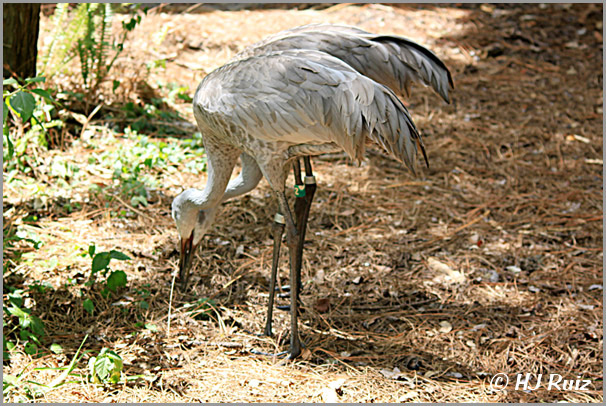
All Photographs are © H.J. Ruiz – “My Backyard Visitors”
Text is available under the Creative Commons Attribution-ShareAlike License; additional terms may apply. See Terms of use for details.
Share this:

Animal Partnerships – Video
It’s amazing and quite interesting how animals establish a convenience partnership to satisfy both parties needs. Presented by courtesy of © BBC & UTube. Enjoy!
Share this:

American Kestrel
American Kestrel – Spec. Name: Falco Sparverius
This is a small falcon, and the only kestrel found in the Americas. It is the most common falcon in North America, and is found in a wide variety of habitats. At 19–21 centimeters (7–8 in) long, it is also the smallest falcon in North America. It exhibits sexual dimorphism in size and plumage, although both genders have a rufous back with noticeable barring. Juveniles are similar in plumage to adults.

American Kestrel
The American Kestrel hunts by hovering in the air with rapid wing beats or perching and scanning the ground for prey. Its diet typically consists of grasshoppers, lizards, mice, and other small birds. It nests in cavities in trees, cliffs, buildings, and other structures. The female lays three to seven eggs, which both sexes help to incubate. It is a common bird to be used in falconry, especially by beginners.
Its breeding range extends from central and western Alaska across northern Canada to Nova Scotia, and south throughout North America, into central Mexico and the Caribbean. It is a local breeder in Central America and is widely distributed throughout South America. Most birds breeding in Canada and the northern United States migrate south in the winter. It is an occasional vagrant to western Europe.
At about the size of a large thrush, the American Kestrel is the smallest falcon in North America.The American Kestrel is sexually dimorphic, although there is some overlap in plumage coloration between the sexes. The bird is 19–21 centimeters (7–8 in) in length with a wingspan of 50–60 centimeters (20–24 in), with the female typically larger than the male. The male weighs 103–120 grams (3.6–4.2 oz), and the female 126–166 grams (4.4–5.9 oz).
Plumage has more variation between the sexes than size. Males have blue-grey wings with black spots and white undersides with black barring. The back is rufous, with barring on the lower half. The belly and flanks are white with black spotting. The tail is also rufous, with a white or rufous tip and a black subterminal band. The back and wings of the female American Kestrel are rufous with dark brown barring. The undersides of the females are creamy to buff with heavy brown streaking. The tail is noticeably different from the male’s, being rufous in color with numerous narrow dark black bars. Juveniles exhibit coloration patterns similar to the adults’. In both sexes, the head is white with a bluish-grey top. There are also two narrow, vertical black facial markings on each side of the head, while other falcons have one. Two black spots (ocelli) can be found on each side of the white or orangish nape. The function of these spots is debated, but the most commonly accepted theory is that they act as “false eyes”, and help to protect the bird from potential attackers. The wings are moderately long, fairly narrow, and taper to a point. While the kestrel is perched, the wingtips are noticeably shorter than the tail tip.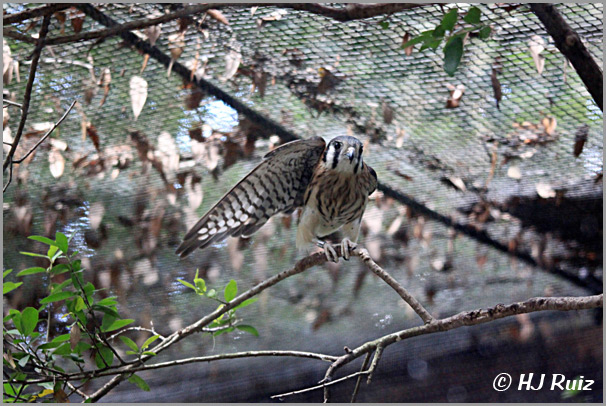
Photographs are © H.J. Ruiz – “My Backyard Visitors”
Text is available under the Creative Commons Attribution-ShareAlike License; additional terms may apply. See Terms of use for details.
Share this:


Read Past Reviews

Book # 69

Quote from the Author
“A good chuckle is healthy, it helps you break the monotony of a serious life.” ~ H.J. Ruiz


You must be logged in to post a comment.