
Pied Imperial Pigeon
Pied Imperial-pigeon – Spec. Name: Ducula Bicolor
This is a relatively large, pied species of pigeon. It is found in forest, woodland, mangrove, plantations and scrub in Southeast Asia, ranging from Myanmar and Thailand south to Java and east to the Philippines and the Bird’s Head Peninsula in New Guinea. It is mainly found on small islands and in coastal regions.

Pied Imperial Pigeon
It remains locally common, and is therefore considered to be of least concern by BirdLife International and IUCN.
Its taxonomy is confusing and remains unsettled. It has sometimes included the Torresian, Yellowish and White Imperial-pigeons as subspecies. The widespread nominate subspecies of the Pied Imperial-pigeon differs from all these by its plain white thighs and undertail coverts (though often with a dark spot at the very tip), and its narrowly dark-tipped bluish bill. For comparison, the other species’ have black-spotted undertail coverts and thighs (spotting mainly near thighs in White Imperial-pigeon), the bill of the Torresian Imperial-pigeon is greenish-yellow, and the bills of the Yellowish and White Imperial-pigeons are bluish at the base and yellowish at the tip. Furthermore, the Yellowish Imperial-pigeon has a distinctive yellowish tinge to its plumage (some Pied Imperial-pigeons may also appear yellowish, but infrequently to the same extend), and the White Imperial-pigeon has silvery-grey remiges. However, the taxon melanura of the Moluccas, which usually is considered a subspecies of the Pied Imperial-pigeon, resembles the Torresian Imperial-pigeon in bill, thighs and undertail coverts, but has a significantly broader black tail-tip. Consequently, some have suggested it should be placed under the Torresian Imperial-pigeon, while others have suggested it should be considered an entirely separate species, D. melanura (for which the name Black Imperial-pigeon has been used – an unfortunate choice, as only the tail has significantly more black than the other members of this group, and the name Black Imperial-pigeon usually has been used for D. melanochroa). Yet others have considered melanura to be invalid, instead believing it only is a morph of D. b. bicolor, as both types can be found on some islands.
Photographs are © H.J. Ruiz – “My Backyard Visitors”
Text is available under the Creative Commons Attribution-ShareAlike License; additional terms may apply. See Terms of use for details.
Share this:

Invitation/Request to my readers
This is an invitation/Request for all my friends, readers of
AVIAN101 – “My Backyard Visitors”
I’d like to ask you a small favor: Press the button below, sign in/up to Flicker web page and upload one or more photos of any species of birds, pick your best shots and then see how popular your pictures will get. I’m counting on your love for birds and photography thus helping me extend this passion to our kids. I have several young friends followers that are becoming avid birders and enjoy seeing the photos on the blog. Please share some of the birder’s spirit and submit your photos. Thank you! At this time I have approximately 100 different species of birds recorded on my blog. I’d like to keep promoting preservation and love for all avians of the world. My blog is non-profit, I promote and defend avians in general.
Submit photos at: 
Share this:

Scarlet Macaw
Scarlet Macaw – Spec.Name: Ara Macao
This is a large, colorful macaw. It is native to humid evergreen forests in the American tropics. Range extends from extreme south-eastern Mexico to Amazonian Peru, Bolivia and Brazil in lowlands up to 500 m (1,640 ft) (at least formerly) up to 1,000 m (3,281 ft). It has suffered from local extinction through habitat destruction and capture for the parrot trade, but locally it remains fairly common. Formerly it ranged north to southern Tamaulipas. It can still be found on the island of Coiba. It is the national bird of Honduras.

Scarlet Macaw
It is about 81 centimetres (32 in) long, of which more than half is the pointed, graduated tail typical of all macaws, though the Scarlet Macaw has a larger percentage of tail than the other large Macaws. The average weight is about 1 kilogram (2.2 lb). The plumage is mostly scarlet, but the rump and tail-covert feathers are light blue, the greater upper wing coverts are yellow, the upper sides of the flight feathers of the wings are dark blue as are the ends of the tail feathers, and the undersides of the wing and tail flight feathers are dark red with metallic gold iridescence. Some individuals may have green in the wings.
Three subspecies present varying widths in their yellow wing band. There is bare white skin around the eye and from there to the bill. Tiny white feathers are contained on the face patch. The upper mandible is mostly pale horn in color and the lower is black. The only difference between ages is that young birds have dark eyes, and adults have light yellow eyes. It is frequently confused with the slightly larger Green-winged Macaw, which has more distinct red lines in the face and no yellow in the wing. Scarlet Macaws make very loud, high & sometimes low-pitched, throaty squawks, squeaks and screams designed to carry many miles to call for their groups.Scarlet Macaws eat mostly fruits, nuts and seeds, including large, hard seeds. A typical sighting is of a single bird or a pair flying above the forest canopy, though in some areas flocks can be seen. They may gather at clay licks. They like nuts and fruits. They also feed on nectar and buds. 
All photographs are © H.J. Ruiz – “My Backyard Visitors”
Text is available under the Creative Commons Attribution-ShareAlike License; additional terms may apply. See Terms of use for details.
Share this:

Greater Flamingo
Greater Flamingo – Spec. Name: Phoenicopterus Roseus
This is the most widespread species of the flamingo family. It is found in parts of Africa, southern Asia (coastal regions of Pakistan and India), and southern Europe (including Spain, Sardinia, Albania, Turkey,Greece,
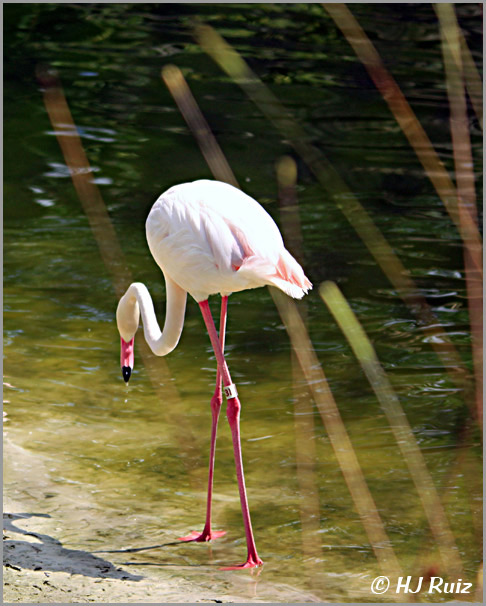
Greater Flamingo
Cyprus, Portugal, and the Camargue region of France). Some populations are short distance migrants, and records north of the breeding range are relatively frequent; however, given the species’ popularity in captivity whether these are truly wild individuals is a matter of some debate. A single bird was seen on North Keeling Island (Cocos (Keeling) Islands) in 1988. Greater Flamingo is the state bird of Gujarat, India.
This is the largest species of flamingo, averaging 110–150 cm (43–60 in) tall and weighing 2–4 kg (4.4–8.8 lbs). The largest male flamingoes have been recorded at up to 187 cm (74 in) tall and 4.5 kg (10 lbs). It is closely related to the American Flamingo and Chilean Flamingo, with which it has sometimes been considered conspecific, but that treatment is now widely seen (e.g., by the American and British Ornithologists’ Union) as incorrect and based on a lack of evidence. Like all flamingos, this species lays a single chalky-white egg on a mud mound. Most of the plumage is pinkish-white, but the wing coverts are red and the primary and secondary flight feathers are black. The bill is pink with a restricted black tip, and the legs are entirely pink. The call is a goose-like honking.
The first recorded zoo hatch was in 1959 at Zoo Basel. In Zoo Basel’s breeding program over 400 birds hatched with an average between 20 and 27 since the year 2000. Due to Basel’s breeding success, most hatched flamingos cannot be kept in the zoo and are given to zoos around the world. Given the history and the large number of birds hatched in Basel since 1959, it can be concluded that most Greater Flamingo zoo colonies around the world are related to the one at Zoo Basel. 
All photographs are © H.J. Ruiz – “My Backyard Visitors”
Text is available under the Creative Commons Attribution-ShareAlike License; additional terms may apply. See Terms of use for details.
Share this:


Read Past Reviews

Book # 69

Quote from the Author
“A good chuckle is healthy, it helps you break the monotony of a serious life.” ~ H.J. Ruiz


You must be logged in to post a comment.