Blue-and-Yellow Macaw
Blue-and-Yellow Macaw a.k.a. Blue-and-Gold Macaw – Spec. Name: Ara ararauna,
This is a member of the group of large Neotropical parrots known as macaws. It breeds in forest (especially varzea, but also in open sections of Terra Firme) and woodland of tropical South America from Trinidad and Venezuela south to Peru, Brazil, Bolivia, and Paraguay.
It extends slightly into Central America, where it is restricted to Panama. It is an endangered species in Trinidad, and is on the verge of being extirpated from Paraguay, but still remains widespread and fairly common in a large part of mainland South America. There is also a breeding population in Miami-Dade County, USA. It is therefore listed as Least Concernby BirdLife International.
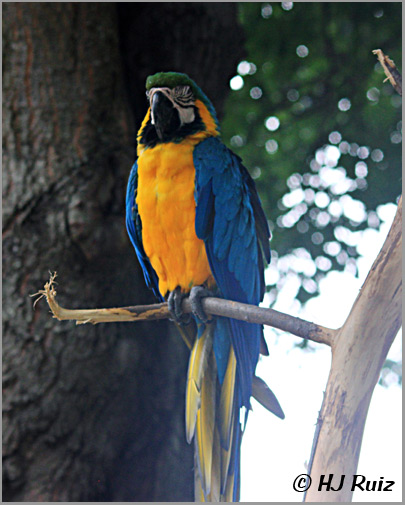
Blue and Yellow Macaw
These birds can reach 76–86 cm (29.9-33.9 inches) long and weigh 900 to 1300 g (2-3 lbs). They are vivid in appearance with blue wings and tail, dark blue chin, golden under parts and a green forehead. Beaks are black, and very strong for crushing nuts. The naked face is white, turning pink in excited birds, and lined with small black feathers.
There is little variation in plumage across the range. Some birds have a more orangey or “butterscotch” underside color, particularly on the breast. This was often seen in Trinidad birds and others of the Caribbean area, and appears to be due to environmental factors.
The Blue-and-yellow Macaw uses its powerful beak for breaking nutshells, and also for climbing up and hanging from trees.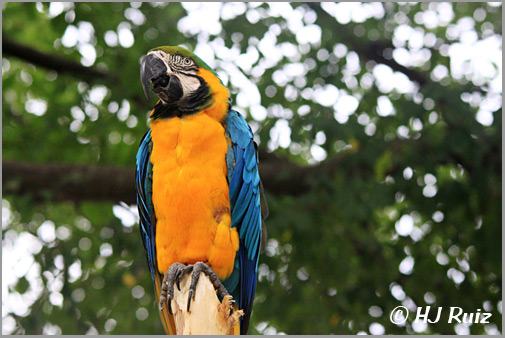
All photographs are © H.J. Ruiz – Avian101
Text is available under the Creative Commons Attribution-ShareAlike License; additional terms may apply. See Terms of use for details.
Share this:

Marabou Stork
Marabou Stork – Spec. Name: Leptoptilos Crumeniferus
This is a large wading bird in the stork family Ciconiidae. It breeds in Africa south of the Sahara, occurring in both wet and arid habitats, often near human habitation, especially waste tips. It is sometimes called the “undertaker bird,” due to its shape from behind: cloak-like wings and back, skinny white legs, and sometimes, a large white mass of “hair.”
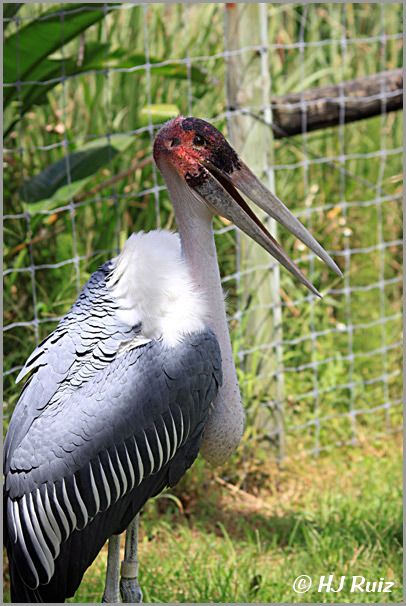
Marabou Stork
A massive bird, large specimens are thought to reach a height of 150 cm (60 in), a weight of over 9 kg (20 lbs) and have a wingspan of at least 3.5 m (10.5 ft). In the last regard, it shares the distinction of having the largest wingspan of any landbird with the Andean Condor. More typically, these birds measure 120–140 cm (43–55 in), 225–285 cm (89–113 in) across the wings, and weigh 4.5–8 kg (10-18 lbs). Unlike most storks, the three Leptoptilos species fly with the neck retracted like a heron.
The Marabou is unmistakable due to its size, bare head and neck, black back, and white underparts. It has a huge bill, a pink gular sac at its throat, a neck ruff, and black legs and wings. The sexes are alike, but the young bird is browner and has a smaller bill. Full maturity is not reached for up to four years.
Like most storks, the Marabou is gregarious and a colonial breeder. In the African dry season (when food is more readily available as the pools shrink) it builds a tree nest in which two or three eggs are laid.
It also resembles other storks in that it is not very vocal, but indulges in bill-rattling courtship displays. The throat sac is also used to make various noises at that time.
The Marabou Stork is a frequent scavenger, and the naked head and neck are adaptations to this, as it is with the vultures with which the stork often feeds. In both cases, a feathered head would become rapidly clotted with blood and other substances when the bird’s head was inside a large corpse, and the bare head is easier to keep clean.
This large and powerful bird eats mainly carrion, scraps and faeces, but will also take fish, frogs, insects, eggs, small mammals and reptiles such as crocodile hatchlings and eggs. It occasionally eats other birds including quelea nestlings, pigeons, doves, pelican and cormorant chicks, and even flamingos. They may sometimes wash food in water to remove soil.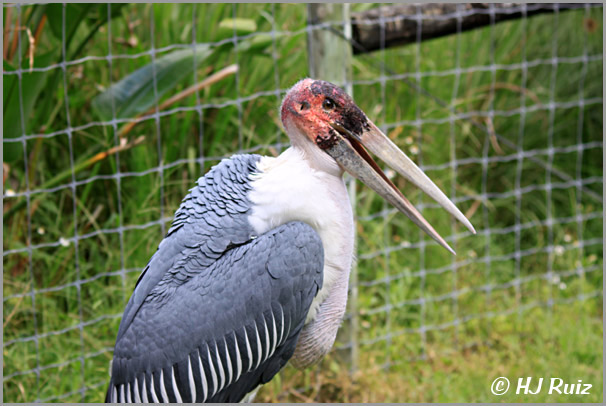
All photographs are © H.J. Ruiz – “My Backyard Visitors”
Text is available under the Creative Commons Attribution-ShareAlike License; additional terms may apply. See Terms of use for details.
Share this:

THE ATLAS OF BIRDS – Review
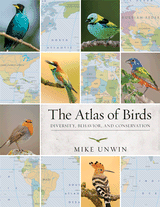
“I’ve been very absorbed into reading lately. I got the latest book written by Mike Unwin: “THE ATLAS OF BIRDS” –Diversity, behavior and conservation.
The Atlas of Birds
Mike has taken a very smart approach to bird’s life and has compiled important data, birds facts and statistics to put avians on a different perspective. A lot of information cleverly organized.I for one was delighted to find a great deal of important data that will help me plan my next trip as well as stats on conservation, best locations where to find spots with more density of birds habitats.This book displays few images but they are carefully picked to be very relevant to the information being conveyed.He’s very accurate when describes birds being direct descendants of dinosaurs that ruled the Earth for millions of years, now they they boast a 10,000 different species surpassing every other vertebrate species! I liked this book because of the fresh up to date no nonsense information, based on reality, numbers and statistics, it has good photos also. I recommend it, you should add it to your home library”
Review made by H.J. Ruiz – Avian101 – “My Backyard Visitors”
Share this:

Humming Birds – Video
Take a look at humming birds feeding in this video made by © BBC.You’ll be amazed!
Share this:


Read Past Reviews

Book # 69

Quote from the Author
“A good chuckle is healthy, it helps you break the monotony of a serious life.” ~ H.J. Ruiz


You must be logged in to post a comment.