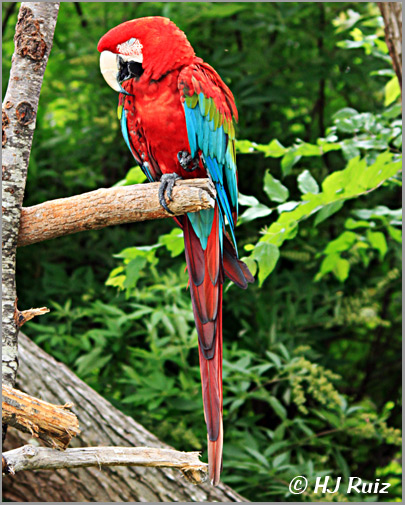
Red and Green Macaw
Red-and-green Macaw, a.k.a. Green-winged Macaw – Spec. Name: Ara chloropterus
This is the largest of the Aragenus, widespread in the forests and woodlands of northern and central South America. However, in common with other macaws, in recent years there has been a marked decline in its numbers due to habitat loss and illegal capture for the parrot trade.
Red and Green Macaw
The Red-and-green Macaw can be readily identified from the Scarlet Macaw as whilst the breast of both birds is bright red, the upper-wing covert feathers of the Red-and-green Macaw are green (as opposed to yellow, or yellow and green in the Scarlet Macaw). In addition, the Red-and-green Macaw has characteristic red lines around the eyes formed by rows of tiny feathers on the otherwise bare white skin patch; this is one of the biggest differences from a Scarlet Macaw to the casual viewer. Iridescent teal feathers are surrounded by red on the tail.
It is second only in size to the Hyacinth Macaw, the largest bird of the macaw family. The wingspan of the Red-and-green Macaw can be up to 49 inches (125 cm), with a total body length of 39 inches (100 cm). A healthy adult will weigh between 1,250 and 1,700 grams (2.7-3.7 lbs).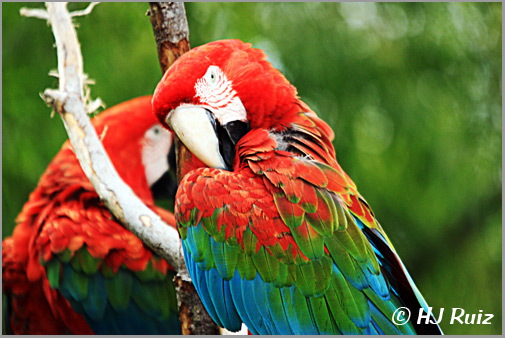
The Red-and-green Macaw has a very powerful beak which can generate a pressure of 2000 psi and can snap a broomstick in half. This powerful beak has evolved to crush or open even the hardest nuts and seeds.
The Red-and-green Macaw generally mates for life. The female typically lays two or three eggs in a nest made in a hole in a tree. The female incubates the eggs for about 28 days, and the chicks fledge from the nest about 90 days after hatching.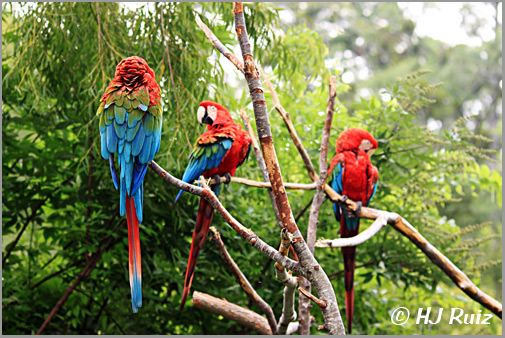
All photographs are © H.J. Ruiz – Avian101
Text is available under the Creative Commons Attribution-ShareAlike License; additional terms may apply. See Terms of use for details.
Share this:

Black Swan
Black Swan – Spec. Name: Cygnus atratus
This is a large waterbird, a species of swan, which breeds mainly in the southeast and southwest regions of Australia. The species was hunted to extinction in New Zealand, but later reintroduced. Within Australia they are nomadic, with erratic migration patterns dependent upon climatic conditions. Black Swans are large birds with mostly black plumage and red bills. They are monogamous breeders that share incubation duties and cygnet rearing between the sexes.

Black Swan
The Black Swan was described scientifically by English naturalist John Latham in 1790. It was formerly placed into a monotypic genus,Chenopis. Black Swans can be found singly, or in loose companies numbering into the hundreds or even thousands. Black Swans are popular birds in zoological gardens and bird collections, and escapees are sometimes seen outside their natural range.
Black Swans are primarily black-feathered birds, with white flight feathers. The bill is bright red, with a pale bar and tip; and legs and feet are greyish-black. Cobs (males) are slightly larger than pens (females), with a longer and straighter bill. Cygnets (immature birds) are a greyish-brown with pale-edged feathers.
A mature Black Swan measures between 110 and 142 centimetres (43 and 56 in) in length and weighs 3.7–9 kilograms (8.2–20 lb). Its wing span is between 1.6 and 2 metres (5.2 and 6.6 ft).The neck is long (relatively the longest neck among the swans) and curved in an “S”-shape.
The Black Swan utters a musical and far reaching bugle-like sound, called either on the water or in flight, as well as a range of softer crooning notes. It can also whistle, especially when disturbed while breeding and nesting.
When swimming, Black Swans hold their necks arched or erect, and often carry their feathers or wings raised in an aggressive display. In flight, a wedge of Black Swans will form as a line or a V, with the individual birds flying strongly with undulating long necks, making whistling sounds with their wings and baying, bugling or trumpeting calls.
The Black Swan is unlike any other Australian bird, although in poor light and at long range it may be confused with a Magpie Goose in flight. However, the Black Swan can be distinguished by its much longer neck and slower wing beat.
The Black Swan is almost exclusively herbivorous, and while there is some regional and seasonal variation, the diet is generally dominated by aquatic and marshland plants. In New South Wales the leaf of reedmace (genus Typha) is the most important food of birds in wetlands, followed by submerged algae and aquatic plants like Vallisneria. In Queensland aquatic plants like Potamogeton and stoneworts and algae are the dominant foods. The exact composition varies with water level, in flood situations where normal foods are out of reach Black Swans will feed on pasture plants on shore. The Black Swan feeds in a similar manner to other swans. When feeding in shallow water it will dip its head and neck under the water, and it is able to keep its head flat against the bottom while keeping its body horizontal. In deeper water the bird up-ends to reach lower. Black Swans are also able to filter feed at the water’s surface.
All photographs are © H.J. Ruiz – Avian101
Text is available under the Creative Commons Attribution-ShareAlike License; additional terms may apply. See Terms of use for details.
Share this:

Chestnut – mandibled Toucan
Chestnut-mandibled Toucan, a.k.a. Swainson’s Toucan – Spec. Name: Ramphastos swainsonii
This is a near-passerine bird which breeds from eastern Honduras to northern Colombia to western Ecuador. This species is replaced from southern Colombia to eastern Peru by the closely related Black-mandibled Toucan, R. ambiguus, with which it is sometimes considered conspecific. The scientific and alternative English names commemorate the English ornithologist and artist William Swainson.

Chestnut - mandibled Toucan
Like other toucans, the Chestnut-mandibled is brightly marked and has a large bill. The male is 56 cm long, while the smaller female is typically 52 cm long. Weight ranges from 599 to 746 grams (1.3-1.6 lbs).
The sexes are alike in appearance, mainly black with maroon hints to the head, upper back and lower breast. The face and upper breast are bright yellow, with narrow white and broader red lines forming a lower border. The upper tail is white and the lower abdomen is red. The legs are blue. The body plumage is similar to that of the smaller Keel-billed Toucan, but the bill pattern is quite different, being diagonally divided into bright yellow and maroon.
Juvenile birds are sooty-black, and have duller plumage, particularly with respect to the bib, red border, and lower mandible. They are fed by the parents for several weeks after leaving the nest.
The call of the Chestnut-mandibled Toucan is a yelping yo-YIP, a-yip, a-yip, or a Dios te dé, Dios te dé (Spanish for “God give you…”). It is given to maintain contact as the flock travels in “follow-my-leader” style through the trees, but also in chorus at the evening roosts.
Small flocks, usually consisting of 3-12 birds, move through the forest with an undulating flight, rarely travelling more than 100 m at a time. This species is primarily an arboreal fruit-eater, but will also take insects, lizards, small birds and frogs. Flocks will follow Keel-billed Toucans to exploit their sources of food.
The Chestnut-mandibled Toucan is a resident breeder in moist lowland forest. The 2-4 white eggs are laid in an unlined cavity high in a decayed section of a living tree, or occasionally in an old woodpecker nest in a dead tree.
Both sexes incubate the eggs for at 14–15 days, and the toucan chicks remain in the nest after hatching. They are blind and naked at birth, and have short bills and specialised pads on their heels to protect them from the rough floor of the nest. They are fed by both parents, and fledge after about 6 weeks.
All photographs are © H.J. Ruiz – Avian101
Text is available under the Creative Commons Attribution-ShareAlike License; additional terms may apply. See Terms of use for details.
Share this:

Helmeted Guineafowl
Helmeted Guineafowl – Spec. Name: Numida meleagris
This is the best known of the guineafowl bird family, Numididae, and the only member of the genusNumida. It breeds in Africa, mainly south of the Sahara, and has been widely introduced into the West Indies, Brazil and southern France.

Helmeted Guineafowl
It breeds in warm, fairly dry and open habitats with scattered shrubs and trees such as savanna or farmland. Males often show aggression towards each other, and will partake in ravenous fighting which will leave other males bloodied and otherwise injured. Attempts at making themselves look fearsome is when their wings raise upwards from their sides and feathers bristle across the length of the body, or they may also rush forwards with a gaping beak. The nest is a well-hidden, generally unlined scrape and a clutch is normally 6-12 eggs which the female incubates for 26–28 days. Nests containing larger numbers of eggs are generally believed to be the result of more than one hen using the nest; eggs are large and an incubating bird could not realistically cover significantly more than a normal clutch. Domestic birds at least, are notable for producing extremely thick-shelled eggs that are reduced to fragments as the chicks hatch, rather than leaving two large sections and small chips from where any chick has removed the end of the egg. It has been noted that domesticated Guineahens are not the best of mothers, and will often abandon their nests. The chicks are cryptically coloured and rapid wing growth enables them to flutter onto low branches barely a week after hatching. These guineafowl live as long as 12 years in the wild.
The Helmeted Guineafowl is a large (53–58 cm) bird with a round body and small head. They weigh about 1.3 kg. The body plumage is gray-black spangled with white. Like other guineafowl, this species has an unfeathered head, in this case decorated with a dull yellow or reddish bony knob, and red and blue patches of skin. The wings are short and rounded, and the tail is also short. Various sub-species are proposed, differences in appearance being mostly a large variation in shape, size and colour of the casque and facial wattles.
This is a gregarious species, forming flocks outside the breeding season typically of about 25 birds that also roost communally. Guineafowl are particularly well-suited to consuming massive quantities of ticks, which might otherwise spread lyme disease. These birds are terrestrial, and prone to run rather than fly when alarmed. Like most gallinaceous birds, they have a short-lived explosive flight and rely on gliding to cover extended distances. Helmeted Guineafowl are great runners, and can walk 10 km and more in a day. They make loud harsh calls when disturbed. Their diet consists of a variety of animal and plant food; seeds, fruits, greens, snails, spiders, worms and insects, frogs, lizards, small snakes and small mammals. Guineafowl are equipped with strong claws and scratch in loose soil for food much like domestic chickens, although they seldom uproot growing plants in so doing. As with all of the numididae, they have no spurs.
Flocks of guineafowl have flourished in recent years in the Southern Suburbs of Cape Town, where they seem to have adapted remarkably well. The flocks move slowly the quieter suburban roads, looking for food on the grassy ‘pavements’ and in gardens where the fence is low enough for some to enter without feeling separated from the flock. They often roost at night on the roofs of bungalows. While residents generally appreciate the local wildlife, it can be a nuisance, obstructing traffic and making a lot of noise in the early morning. Their success is probably due to the large but cautious flock – they can fend off cats, do not enter gardens with dogs, and are visible enough in the quiet roads in which they live to avoid being run over. Although many young guineafowl manage to fall down drains (and are left behind by the flock), it is not enough to restrain their numbers. Adult birds are sometimes caught and eaten by the homeless.
In the early days of the European colonisation of North America, the native Wild Turkey (Meleagris gallopavo) was confused with this species. This led to the English name of the American bird, since Turkey and Guinea were equally far-off and exotic places. The word meleagris, Greek for guineafowl, is also shared in the scientific names of the two species, although for the guineafowl it is the species name, whereas for the turkey, it is the name of the genus and (in an altered state) the family.
All photographs are © H.J. Ruiz – Avian101
Text is available under the Creative Commons Attribution-ShareAlike License; additional terms may apply. See Terms of use for details.
Share this:


Read Past Reviews

Book # 69

Quote from the Author
“A good chuckle is healthy, it helps you break the monotony of a serious life.” ~ H.J. Ruiz


You must be logged in to post a comment.