
Funny Bird – Video
Really funny and very entertaining! 🙂 Recopy from Punjabis
Share this:

Georgia State Bird

State of Georgia flag
I’d like you to learn a bit more about the State of Georgia, where I live with my family. I’m just writing some information that pertains to birds, at the same time, other people should know more about this beautiful State.
Adoption of the Georgia State Bird
In 1928, the school children of Georgia selected the Brown Thrasher (Toxostoma rufum) as the state bird. According toNature Magazine(April, 1932)
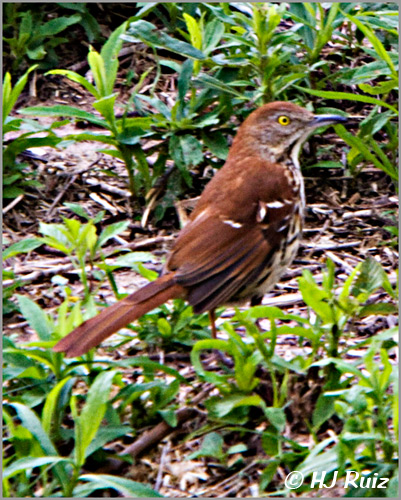
Brown Thrasher
“The Campaign was inaugurated by the Fifth District of the State Federation of Women’s Clubs and was sponsored by the Atlanta Bird Club and kindred groups.”
Proposals were made to the Legislature and bills to adopt the brown thrasher as the state bird were introduced, but no action was taken.
On April 6, 1935, the brown thrasher was declared the state bird of Georgia by proclamation of Governor Eugene Talmadge.
Thirty-five years later, at the urging of the Garden Clubs of Georgia, the Georgia General Assembly passed Joint Resolution No. 128, that designated the brown thrasher the official Georgia State Bird and the Bobwhite Quail the official Georgia State Game Bird. The resolution was approved on March 20, 1970.
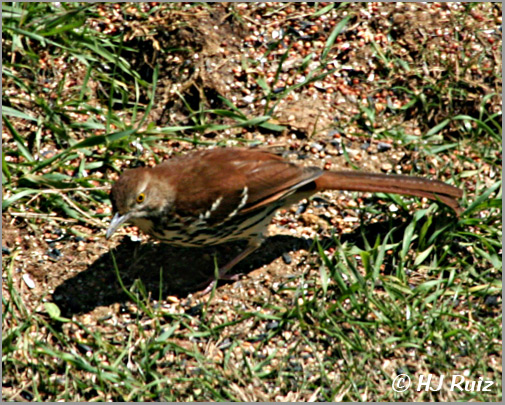
The Georgia Code
The following information is excerpted from the Georgia Code, Title 50, Chapter 3, Section 50-3-50.
TITLE 50 – STATE GOVERNMENT.
CHAPTER 3.
SECTION 50-3-50.
50-3-50. The brown thrasher is designated as the official Georgia state bird.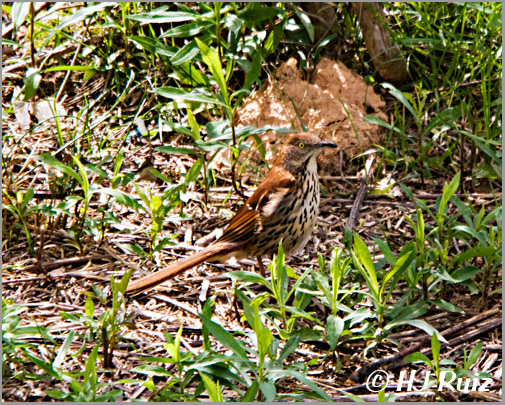
All photographs are © H.J. Ruiz – “My Backyard Visitors”
Share this:

Songbirds fly three times faster than expected
A York University researcher has tracked the migration of songbirds by outfitting them with tiny geolocator backpacks – a world first – revealing that scientists have underestimated their flight performance dramatically.

Photo © Elizabeth Gow
“Never before has anyone been able to track songbirds for their entire migratory trip,” said study author Bridget Stutchbury, a professor of biology in York’s Faculty of Science & Engineering. “We’re excited to achieve this scientific first.” Songbirds, the most common type of bird in our skies, are too small for conventional satellite tracking.
Stutchbury and her team mounted miniaturized geolocators on 14 wood thrushes and 20 purple martins, breeding in Pennsylvania during 2007, tracking the birds’ fall takeoff, migration to South America, and journey back to North America. In the summer of 2008, they retrieved the geolocators from five wood thrushes and two purple martins and reconstructed individual migration routes and wintering locations.
Data from the geolocators indicated that songbirds can fly in excess of 500 km (311 miles) per day. Previous studies estimated their flight performance at roughly 150 km (93 miles) per day.
The study found that songbirds’ overall migration rate was two to six times more rapid in spring than in fall. For example, one purple martin took 43 days to reach Brazil during fall migration, but in spring returned to its breeding colony in only 13 days. Rapid long-distance movement occurred in both species, said Stutchbury.
“We were flabbergasted by the birds’ spring return times. To have a bird leave Brazil on April 12 and be home by the end of the month was just astounding. We always assumed they left sometime in March,” she said.
Researchers also found that prolonged stopovers were common during fall migration. The purple martins, which are members of the swallow family, had a stopover of three to four weeks in the Yucatan before continuing to Brazil. Four wood thrushes spent one to two weeks in the southeastern United States in late October, before crossing the Gulf of Mexico, and two other individuals stopped on the Yucatan Peninsula for two to four weeks before continuing migration.
The geolocators, which are smaller than a dime, detect light, allowing researchers to estimate birds’ latitude and longitude by recording sunrise and sunset times. The devices are mounted on birds’ backs by looping thin straps around their legs. The weight of the geolocator rests at the base of the bird’s spine, so as not to interfere with its balance.
Stutchbury credits researchers with the British Antarctic Survey for miniaturizing the geolocators. “They hadn’t really been thinking of [attaching them to] songbirds, but when I saw the technology, I knew we could do this,” she said.
The study also uncovered evidence that wood thrushes from a single breeding population did not scatter over their tropical wintering grounds. All five wood thrushes wintered in a narrow band in eastern Honduras or Nicaragua.
“This region is clearly important for the overall conservation of wood thrushes, a species that has declined by 30 percent since 1966,” said Stutchbury. “Songbird populations have been declining around the world for 30 or 40 years, so there is a lot of concern about them.”
She emphasized the importance of this research not only to protect at-risk species of songbirds, but also to gauge environmental concerns.
“Tracking birds to their wintering areas is also essential for predicting the impact of tropical habitat loss and climate change,” she said. “Until now, our hands have been tied in many ways, because we didn’t know where the birds were going. They would just disappear and then come back in the spring. It’s wonderful to now have a window into their journey.”
This study was funded in part by the National Geographic Society.
The above story is reprinted (with editorial adaptations by ScienceDaily staff) from materials provided by National Geographic Society
Share this:

Birds & Dinosaurs – Evolutionary Relationship
Microraptor (Greek, μίκρος, mīkros: “small”; Latin, raptor: “one who seizes”) is a genus of small, four-winged dromaeosaurid dinosaurs. Numerous well-preserved fossil specimens have been recovered from Liaoning, China. They date from the early Cretaceous Jiufotang Formation (Aptian stage), 120 million years ago.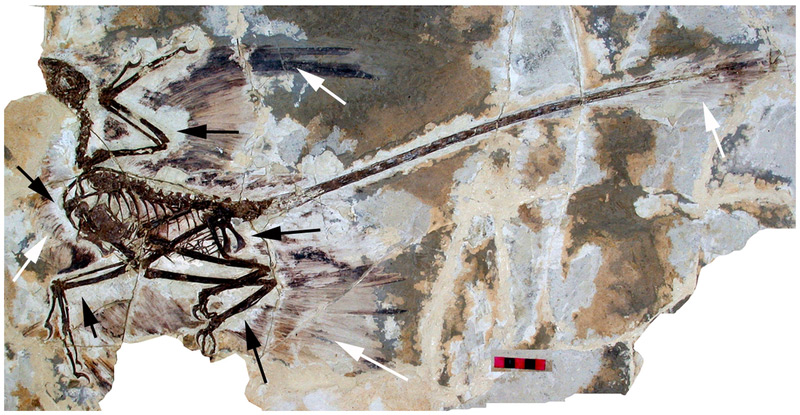
Like Archaeopteryx, Microraptor provides important evidence about the evolutionary relationship between birds and dinosaurs. Microraptorhad long pennaceous feathers that formed aerodynamic surfaces on the arms and tail but also, surprisingly, on the legs. This led paleontologist Xu Xing in 2003 to describe it as a “four-winged dinosaur” and to speculate that it may have glided using all four limbs for lift. Two species have been named, M. zhaoianus and M. gui, though further study has suggested that all of the specimens belong to a single species, which is properly called M. zhaoianus. Cryptovolans pauli, another four-winged dromaeosaur, may also be a species ofMicroraptor or a synonym of M. zhaoianus.

Illustration by © H.J. Ruiz
Microraptor was among the most abundant non-avialan dinosaurs in its ecosystem, and is represented by more fossils than any other dromaeosaurid, with possibly over 300 fossil specimens represented across various museum collections.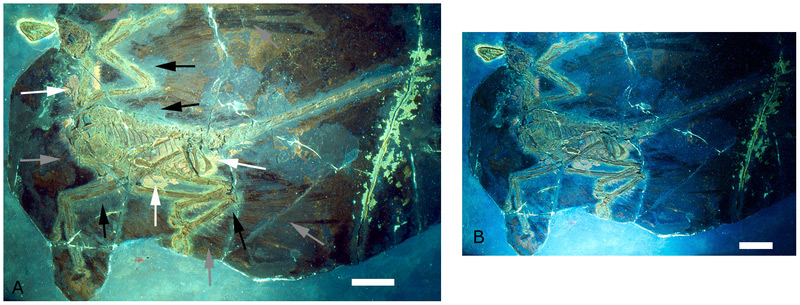
The holotype of Microraptor gui, IVPP V 13352 under UV light. Different filters were employed for parts A and B, hence the difference in color and appearance. A also is labeled to indicate the preserved feathers (grey arrows) and the ‘halo’ around the specimen where they appear to be absent (black arrows) as well as phosphatised tissues (white arrows). Scale bars are 5 cm in both A and B
Text is available under the Creative Commons Attribution-ShareAlike License; additional terms may apply. See Terms of use for details.
Share this:


Read Past Reviews

Book # 69

Quote from the Author
“A good chuckle is healthy, it helps you break the monotony of a serious life.” ~ H.J. Ruiz


You must be logged in to post a comment.