Secretary Bird
Secretary Bird – Spec. Name: Sagittarius serpentarius
This is a large, mostly terrestrial bird of prey. Endemic to Africa, it is usually found in the open grasslands and savannah of the sub-Sahara. Although a member of the order Accipitriformes, which also includes many other diurnal raptors such as kites, buzzards, vultures, and harriers, it is given its own family, Sagittariidae. It appears on the coats of arms of Sudan and South Africa.

Secretary Bird
The Secretary Bird is instantly recognizable as having an eagle-like body on crane-like legs which increases the bird’s height to around 1.3 m (4 ft) tall. This 140 cm (4.5 ft) long bird has an eagle-like head with a hooked bill, but has rounded wings. Body weight averages at about 3.3 kg (7.3 lbs) and the wingspan is over 2 m (6.6 ft). Due to its long legs and long tail, it is both longer and taller than any other diurnal raptor. The neck is not especially long, and can only be lowered down to the inter-tarsal joint, so birds reaching down to the ground or drinking must stoop to do so.
From a distance or in flight it resembles a crane more than a bird of prey. The tail has two elongated central feathers that extend beyond the feet during flight, as well as long flat plumage creating a posterior crest. Secretary Bird flight feathers and thighs are black, while most of the coverts are grey with some being white. Sexes look similar to one another as the species exhibits very little sexual dimorphism, although the male has longer head plumes and tail feathers. Adults have a featherless red face as opposed to the yellow facial skin of the young.
Secretary Birds are endemic to Sub-Saharan Africa and are non-migratory, though they may follow food sources. Their range extends from Senegal to Somalia and south to the Cape of Good Hope. These birds are also found at a variety of elevations, from the coastal plains to the highlands. Secretary Birds prefer open grasslands and savannas rather than forests and dense shrubbery which may impede their cursorial existence. While the birds roost on the local Acacia trees at night, they spend much of the day on the ground, returning to roosting sites just before dark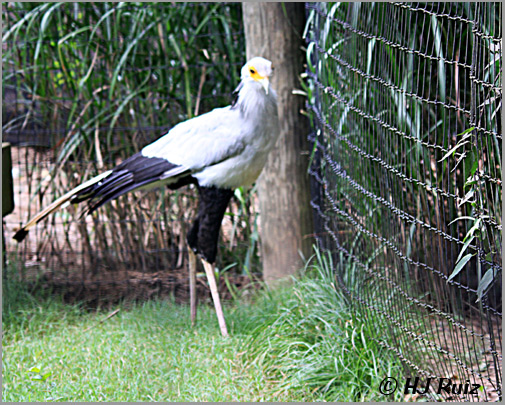
The Secretary Bird is largely terrestrial, hunting its prey on foot, and other than the caracara (such as Caracara plancus), is the only bird of prey to do so habitually. Adults hunt in pairs and sometimes as loose familial flocks, stalking through the habitat with long strides. Prey consists of insects, small mammals, lizards, snakes, young birds, bird eggs, and sometimes dead animals killed in grass or bush fires. It also waits near fires, eating anything it can that is trying to escape. Larger herbivores are not hunted, although there are some reports of Secretary Birds killing young gazelles.
Young are fed liquefied and regurgitated insects directly by the male or female parent and are eventually weaned to small mammals and reptile fragments regurgitated onto the nest itself. The above foodstuffs are originally stored in the crop of the adults.
Secretary Birds have two distinct feeding strategies that are both executed on land. They can either catch their prey by chasing it and striking with the bill, or stamping on the prey until it is rendered stunned or unconscious enough to swallow. Studies of this latter strategy have helped reconstruct the possible feeding mechanisms employed by the dinosaur-like ‘terror birds’ that lived between sixty and five million years ago.
In hunting and feeding on small animals and arthropods on the ground and in tall grass or scrub, Secretary Birds occupy an ecological niche similar to that occupied by peafowl in South and Southeast Asia, roadrunners in North and Central America and seriemas in South America.
All photographs are © H.J. Ruiz – Avian101
Text is available under the Creative Commons Attribution-ShareAlike License; additional terms may apply. See Terms of use for details.
Share this:

Bird Anatomy – Part 2
Today I bring you Part 2 of the series Bird Anatomy, I hope that will help you satisfy some of the curiosity that you had about some anatomic names of birds.
PART 2
Skeleton
The bird skeleton is highly adapted for flight. It is extremely lightweight but strong enough to withstand the stresses of taking off, flying, and landing. One key adaptation is the fusing of bones into single ossifications, such as the pygostyle. Because of this, birds usually have a smaller number of bones than other terrestrial vertebrates. Birds also lack teeth or even a true jaw, instead having evolved a beak, which is far more lightweight. The beaks of many baby birds have a projection called an egg tooth, which facilitates their exit from the amniotic egg.
Birds have many bones that are hollow (pneumatized) with criss-crossing struts or trusses for structural strength. The number of hollow bones varies among species, though large gliding and soaring birds tend to have the most. Respiratory air sacs often form air pockets within the semi-hollow bones of the bird’s skeleton. Some flightless birds like penguins and ostriches have only solid bones, further evidencing the link between flight and the adaptation of hollow bones.
Birds also have more cervical (neck) vertebrae than many other animals; most have a highly flexible neck consisting of 13-25 vertebrae. Birds are the only vertebrate animals to have a fused collarbone (the furcula or wishbone) or a keeled sternum or breastbone. The keel of the sternum serves as an attachment site for the muscles used for flight, or similarly for swimming in penguins. Again, flightless birds, such as ostriches, which do not have highly developed pectoral muscles, lack a pronounced keel on the sternum. It is noted that swimming birds have a wide sternum, while walking birds had a long or high sternum while flying birds have the width and height nearly equal.
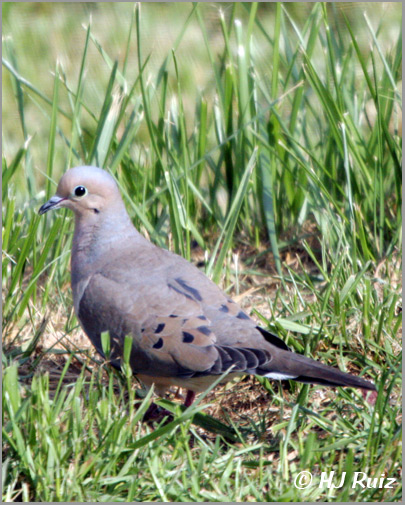
Mourning Dove
Birds have uncinate processes on the ribs. These are hooked extensions of bone which help to strengthen the rib cage by overlapping with the rib behind them. This feature is also found in the tuatara Sphenodon. They also have a greatly elongate tetradiate pelvis as in some reptiles. The hindlimb has an intra-tarsal joint found also in some reptiles. There is extensive fusion of the trunk vertebrae as well as fusion with the pectoral girdle. They have a diapsid skull as in reptiles with a pre-lachrymal fossa (present in some reptiles). The skull has a single occipital condyle.
The skull consists of five major bones: the frontal (top of head), parietal (back of head), premaxillary and nasal (top beak), and the mandible (bottom beak). The skull of a normal bird usually weighs about 1% of the birds total body weight.
The vertebral column consists of vertebrae, and is divided into three sections: cervical (11-25) (neck), Synsacrum (fused vertebrae of the back, also fused to the hips (pelvis)), and pygostyle (tail).
The chest consists of the furcula (wishbone) and coracoid (collar bone), which two bones, together with the scapula (see below), form the pectoral girdle. The side of the chest is formed by the ribs, which meet at the sternum (mid-line of the chest).
The shoulder consists of the scapula (shoulder blade), coracoid (see The Chest), and humerus (upper arm). The humerus joins the radius and ulna (forearm) to form the elbow. The carpus and metacarpus form the “wrist” and “hand” of the bird, and the digits (fingers) are fused together. The bones in the wing are extremely light so that the bird can fly more easily.
The hips consist of the pelvis which includes three major bones: Illium (top of the hip), Ischium (sides of hip), and Pubis (front of the hip). These are fused into one (the innominate bone). Innominate bones are evolutionary significant in that they allow birds to lay eggs. They meet at the acetabulum (the hip socket) and articulate with the femur, which is the first bone of the hind limb.
The upper leg consists of the femur. At the knee-joint, the femur connects to the tibia-tarsus (shin) and fibula (side of lower leg). The tarsus-metatarsus forms the upper part of the foot, digits make up the toes. The leg bones of birds are the heaviest, contributing to a low center of gravity. This aids in flight. A bird’s skeleton comprises only about 5% of its total body weight. Birds feet are classified as anisodactyl, zygodactyl, pterodactyl, syndactyl or pamprodactyl.
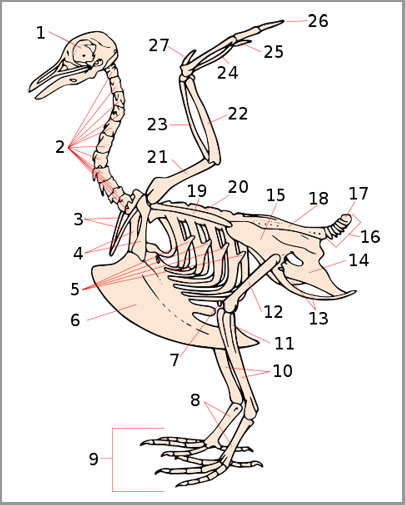
Skeleton drawing based on a dove © Biodidac
1. Skull
2. Cervical vertebrae
3. Furcula
4. Coracoid
5. Uncinate processes of ribs
6. Keel
7. Patella
8. Tarsus-metatarsus
9. Digits
10. Tibia
11. Fibula
12. Femur
13. Ischium
14. Pubis
15. Illium
16. Caudal vertebrae
17. Pygostyle
18. Synsacrum
19. Scapula
20. Lumbar vertebrae
21. Humerus
22. Ulna
23. Radius
24. Carpus
25. Metacarpus
26. Digits
27. Alula
Photograph © H.J. Ruiz – Avian 101
Text is available under the Creative Commons Attribution-ShareAlike License; additional terms may apply. See Terms of use for details.
Share this:

Owning Budgies by Marianne Marlow – Guest
Firstly I would like to say that it’s an honour to be asked to write a guest post and I am happy to do so. I love Avian 101 it always has such colourful photography!
My name is Marianne. I live in London, England, and look after nine budgies. I wouldn’t say I own them, they more own me. The Fiends names are Monty, Snowy, Roswell, Jerry, Sky, Blueboy, Hector, Lilek and Abbie. They have their own personal human to take care of their feathery needs. I feed them, put out their baths, clean their cages, put them to bed, and make sure that they have plenty of toys!

Playful bunch
As budgies have the mentality of a three year old child, it’s like looking after a bunch of naughty children. They aren’t really mean to each other but I do have to occasionally step in to break up squabbles and tell them off. Telling them off usually means that I show my finger and thumb as a “beak” to make an aggressive budgie back off, but it rarely comes to this. Discipline is really important for a group of budgies in a front room as it stops submissive budgies being bullied and picked on by the more dominant ones. It’s really important to be consistent and to tell the budgies “No fighting, no biting, no pulling on tail feathers”. That way they can all lead happy little lives together.
This whole budgie obsession started off in 2009. My sister in law took in a couple of budgies temporarily, but she had cats so she couldn’t keep them. She gave the budgies to the RSPCA, I realised that I really wanted to take them but it was too late. Then it brought back memories of my Dad having a budgie when I was young. His name was Cheeky and I remember him being blue. I remember my Dad saying that Cheeky loved Top of the Pops and that he used to bounce up and down on his perch to the music.

Abbie playing upside down
Unfortunately, my Dad had to give Cheeky away as he found out that he was allergic to birds and they sparked off his asthma. My parents told me that Cheeky had flown back to Australia, something that haunts me to this day. If they had told me the truth, that he went to live with the people upstairs, then I could have visited him!
Anyway, I digress. I really wanted budgies so in November 2009, after some research, we went to a good pet shop where we got Monty and Eric. Eric was a Dominant Pied Sky Blue and Monty a Normal Sky Blue. We chose them because they seemed like great friends. Even though they were in a cage with lots of other budgies we could tell that they had lots of personality. Wherever Eric went, Monty would follow like he was looking after him.
Devastatingly little Eric didn’t live very long. We woke up one morning to find that he had died during the night. After a period of mourning we put plans into motion to get a couple more budgies, Roswell and Snowy. Roswell is a Normal Grey and Snowy an Opaline Grey Cinnamon Pied. It turns out that three is a crowd. Despite Roswell being interested in Monty, Monty became great friends with Snowy. Roswell felt left out, becoming jealous and antisocial. He frequently pinged the bars in frustration, and would occasionally jump directly between Monty and Snowy to get their attention.

Monty in a bowl
After some time trying to figure out what to do about Roswell’s behaviour, we brought in another little fellow – Jerry! Jerry is a Normal Green budgie, as close to looking like the budgies of Australia as it gets.
I was admitted to hospital in January 2011 with breathing problems. It seems that I have an extreme reaction to bird dander and dried bird droppings. Although not common, it is a well known condition called Bird Fancier’s Lung (Hypersensitivity pneumonitis). The reason why there are not more of these cases in the world is because people do not have the exposure to birds that they once did. It is an extremely serious condition comparable to smoking 80 a day. I had to stay in hospital for five nights with oxygen and strong drugs.
When I was released we decided that it was time to adopt a strict daily cleaning regime. We also purchased an air purifier and powerful vacuum cleaner with a Hepa Filter. My daily regime involves using newspapers on top of the budgie cages. My husband thought of doing this as it is easier and more hygienic. In the evening I pull the papers off and bundle them into a bag which is put outside. I clean all of the toys and playgrounds that the budgies have used during the day, plus their food bowls. Perches are inspected to make sure there are no droppings. The outside and inside of each of the three cages are wiped down free of dust and debris. Newspapers are also laid down where droppings typically gather. These are also removed, every other day.
My latest addition is Abbie. She is our ninth little “Ringwraith” and came to us in July 2011. Her owner called her Albie, but we changed it to Abbie as it sounds more feminine. She’s a pretty little four year old, so it’s a shame to have a man’s name. Abbie (Dominant Pied Violet) was originally with another budgie but apparently he escaped. Her owner didn’t want her to be on her own but didn’t have time for another budgie. She has settled in here really well, she gets fed by Hector and Jerry and loves hanging upside down. We also find, that being a hen she has an unfortunate habit of nibbling things. She is a little vandal that has stripped plastic from wire clothes airers. She has also bitten the wood on our budgie screens and tried to break the plastic locks on the cages.

Lileks getting extra attention by owner
We have introduced Abbie to vegetables which she has taken to really quickly. I am happy about this as I like my birds to have a varied diet. I feed them carrot, courgette, mange tout, corn, spinach, parsley, basil, dill and many other things. There are lots of foods that budgies can have but also some that you should never feed them. Chocolate, avocado, alcohol, caffeine are all big no-no’s. Owners should also be wary of many house-plants, as the leaves can be fatal to budgies. Perfumes and cleaning products can also give off strong fumes which are not good for budgies air sacs.
My budgies are a lively bunch, singing from morning until night. They are allowed out in my front room all day long. We even built special screens for the windows, made from wood and aviary mesh. We can therefore freely open the windows when the budgies are out so that we can get what is laughingly considered fresh air in London. As far as we are aware, these are the only screens of this type in the entire world.
They have a big swing, hoops, wire racks on the wall, playgrounds and have fresh leaves pegged up daily. Their preferred bathing method is either a wet plate of Basil or a glass, see-through shallow bowl, with some colourful plastic balls in it.
I would like to be able to get my birds a huge cage that they can all roost in at night. At the moment they have three large cages, but none of them are big enough for all the birds to sleep in. The problem is that there is not enough room for them to stretch their wings at the same time, without squabbling and fighting.
I really enjoy sharing my day with budgies even though they can be a lot of work to look after. They all have their own individual personalities, like little snowflakes. I am not sure that people realise how different each one can be, with their funny little ways and noises. For example Abbie and Roswell enjoy hanging upside-down. Monty likes to sit in a bowl and eat seed and oats. Blueboy pings the cage bars at night if he thinks there is too much noise. Snowy likes to sing to his Green ping-pong ball. Lilek is slightly obsessed with my feet, although he’s growing out of that thankfully.
Giving homes to budgies is addictive. I now have nine budgies, even after finding out that I am dangerously allergic to them. I have promised my family that I will no longer add to my flock. I admit that I shouldn’t have so many budgies, but at the time I was completely ignorant of Bird Fancier’s Lung. Sure, it had not helped my fathers asthma but I considered giving up Cheeky was an overreaction to being told he was allergic to birds. However, five of my current birds are re-homed from people that couldn’t look after them and wanted someone else to take them. I believe that I have done the right thing, which is not always the same as the sensible thing or the easy thing.

OMG this is a banquet!
This article and photographs are © Marianne Marlow, my friend from the UK, visit her blog at:
http://featheredfiends.wordpress.com/
Share this:

Chilean Pintail
Chilean Pintail a.k.a. Brown Pintail – Spec. Name: Anas georgica spinicauda
This is a subspecies of the Yellow-billed Pintail (Anas georgica), a duck in the dabbling duck subfamily Anatinae. Its local names are Pato jergón grande, Pato maicero and Pato piquidorado in Spanish, and Marreca-parda or Marreca-danadain Portuguese.

Chilean Pintail
Chilean Pintails are about 65 cm long. Males weigh 740-830 g and the females 660-770 g. The head and neck are brown with fine black mottling; the throat and foreneck paler. The body is mainly buff-brown with dark centres to the feathers, the birds appearing as spotted on the breast, and paler on the underparts. The feathers of the upperparts are brown-black with buff edges. The wings are grey-brown with buff-tipped greater coverts and glossy black secondaries with buff tips. The speculum is glossy black edged with buff. Females are similar to males though slightly duller in appearance. Juveniles are similar to the adults, but greyer, and with streaking on the breast and underparts. Chilean Pintails are generally paler than Niceforo’s Pintail, and both greyer and distinctly larger than the South Georgia Pintail.
The Chilean Pintail is one of three subspecies of the Yellow-billed Pintail, and by far the most numerous and widespread. It is found throughout much of South America from extreme southern Colombia southwards to Tierra del Fuego, as well as in the Falkland Islands. The two other subspecies are the smaller South Georgia Pintail which is limited to the subantarctic island of South Georgia and which is sometimes considered a separate species, and the extinct Niceforo’s Pintail, which occurred formerly in central Colombia.
Chilean Pintails inhabit freshwater lakes, rivers, marshes, lagoons and flooded meadows up to 4600 m above sea level in the puna zone of the Andes. Populations in the northern parts of the range are mainly sedentary; those further south migrate for the austral winter as far north as southern Brazil.
All photographs are © H.J. Ruiz – Avian101
Text is available under the Creative Commons Attribution-ShareAlike License; additional terms may apply. See Terms of use for details.
Share this:


Read Past Reviews

Book # 69

Quote from the Author
“A good chuckle is healthy, it helps you break the monotony of a serious life.” ~ H.J. Ruiz


You must be logged in to post a comment.