Introducing Rainbow Lorikeets to my Grandson
Not very long ago I introduced my grandson Tyler to his first contact with birds. It happened at the Birmingham Zoo in Alabama. We let Tyler touch and play with the multicolor Lorikeets. Tyler is familiar with birds when he see them at my backyard but from afar, however, this time at the Zoo he was intrigued when he saw them close and with a chance for a touch. At first he hesitated of the contact but a minute later he was familiarized and wanted more.
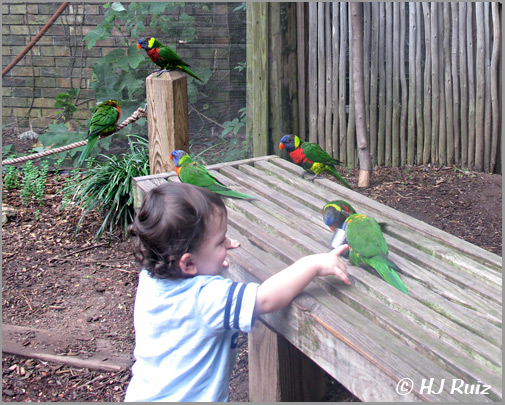
Tyler touching the Lorikeet
Lorikeets are extremely friendly I may say, because while I was shooting pictures of Tyler and the Lorikeets, one of them landed on my shoulder and began to nibble on my ear, it was funny and made me laugh because I did not expect it and it tickled me. He wouldn’t let go.of my ear! 🙂
My wife enjoyed this moment very much, so did Tyler being only 16 months old.
We planned this trip as a trial to see if Tyler would be ok to have long drives without getting bored or too uncomfortable. He did the trip with no problem at all. I’ll be making plans to travel to further points, until he gets used to. We always like to travel by road to visit new places and do photography. Tyler lives with us now.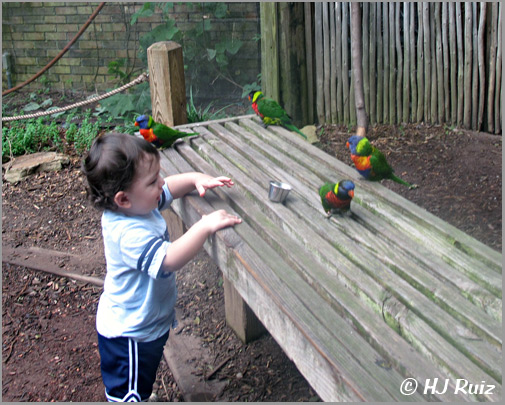
That day Tyler had a great deal of fun looking at all the animals and seeing other children walking the grounds with their relatives. I saw several large groups of school children and their teachers and chaperons. I’m not sure if is mandatory for all School Curriculums but it would be a great benefit for all kids to visit a Zoo. It would be an unforgettable experience for them, to be aware of the existence of many kinds of animals in Nature. Later in life, when kids grow up, I’m sure they will remember the experience and have more respect for animals and care for them. (I lived that experience!)
We certainly had a great day in Alabama, my wife and I were very happy that the trip was a success, we returned home with a smile on our faces and Tyler was happy camper! Hurray! 🙂
Now I have more about Rainbow Lorikeets:
Rainbow Lorikeet – Spec. Name: Trichoglossus haematodus
This is a species of Australasian parrot found in Australia, eastern Indonesia(Maluku and Western New Guinea), Papua New Guinea, New Caledonia, Solomon Islands and Vanuatu. In Australia, it is common along the eastern seaboard, from Queensland to South Australia and northwest Tasmania. Its habitat is rainforest, coastal bush and woodland areas. Several taxa traditionally listed as subspecies of the Rainbow Lorikeet are increasingly treated as separate species (see Taxonomy).
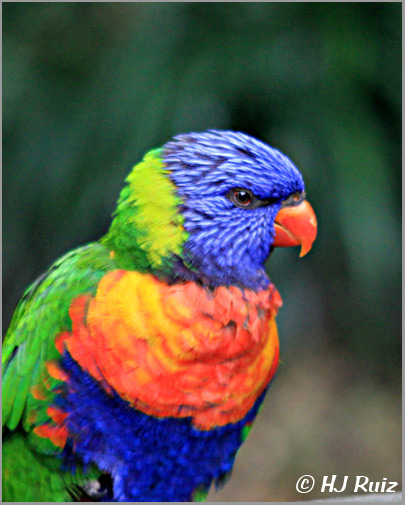
Rainbow Lorikeet
Rainbow Lorikeets have been introduced to Perth – Western Australia, Auckland – New Zealand and Hong Kong – China
The Rainbow Lorikeet is a medium sized parrot, with the length ranging from 25–30 cm (9.8-11.8 in) in size, and has a wingspan of about 17 cm (6.7 in). The weight varies from 75–157 g (2.6–5.5 oz). The plumage of the nominate race, as with all subspecies, is very bright. The head is deep blue with a greenish-yellow nuchal collar, and the rest of the upperparts (wings, back and tail) are deep green. The chest is red with blue-black barring. The belly is deep green, and the thighs and rump are yellow with deep green barring. In flight a yellow wing-bar contrasts clearly with the red underwing coverts. There is little to visually distinguish between the sexes. Juveniles have a black beak which gradually brightens to orange in the adults. The markings of the best known subspecies T. h. moluccanus resemble those of the nominate race, but with a blue belly and a more orange breast with little or no blue-black barring. 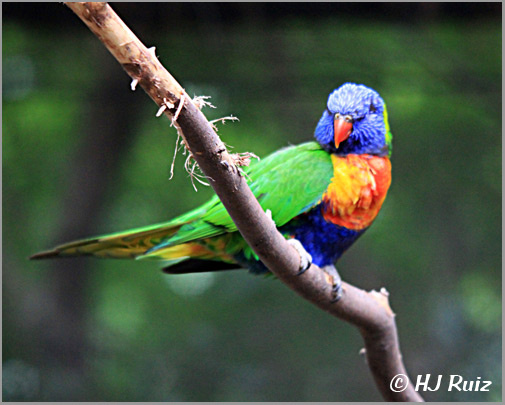 Other subspecies largely resemble either the nominate race or T. h. moluccanus, or are intermediate between them. Two exceptions are T. h. flavicans and T. h. rosenbergii. In the rather variable T. h. flavicans the green of some individuals is dull, almost olivaceous, but in others the green hue approaches that typical of the Rainbow Lorikeet. T. h. rosenbergii is highly distinctive and several features separates it from all other subspecies: Its wing-bars are deep orange (not contrasting clearly with the red underwing coverts in flight), the entire nape is yellow bordered by a narrow red band and the dark blue barring to the red chest is very broad.
Rainbow Lorikeets feed mainly on fruit, pollen and nectar, and possess a tongue adapted especially for their particular diet. The end of the tongue is equipped with a papillate appendage adapted to collecting nectar from flowers.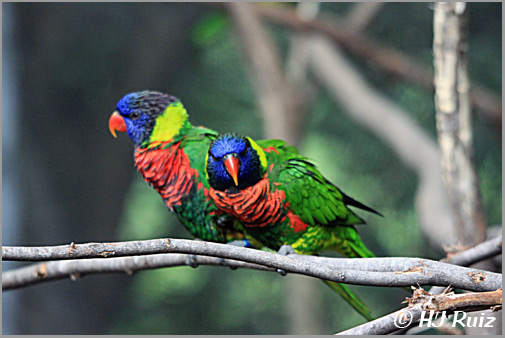
All photographs are © H.J. Ruiz – Avian101
Text is available under the Creative Commons Attribution-ShareAlike License; additional terms may apply. See Terms of use for details.
Share this:

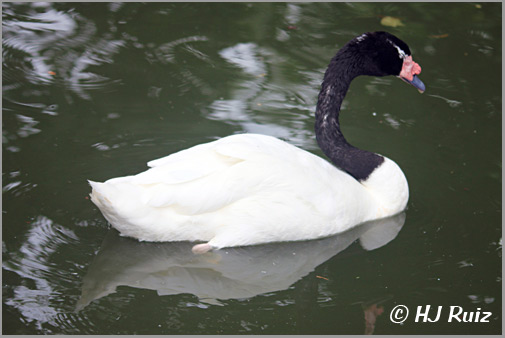
Black-necked Swan
Black-necked Swan – Spec. Name: Cygnus melancoryphus
This is the largest waterfowl native to South America. Males are 115–140 cm (45–55 in) and 4.5-6.7 kg (10-14.8 lbs); females are 102–124 cm (40–49 in) and 3.5-4.4 kg (7.7–9.7 lbs). The wingspan is about 177 cm (70 in). The body plumage is white with a black neck, head and greyish. It has a red knob near the base of the bill and white stripe behind eye. The sexes are similar, with the female slightly smaller. The cygnet has a light grey plumage with black bill and feet. The Black-necked Swan was formerly placed in monotypic genus, Sthenelides.
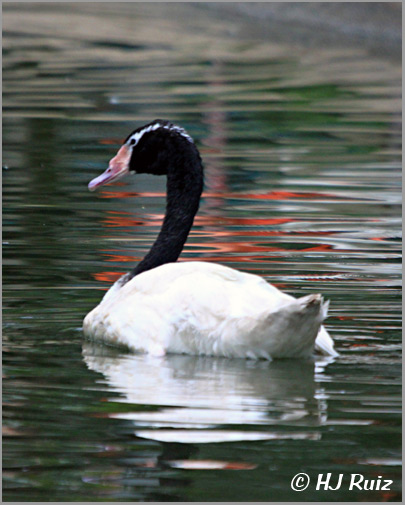
Black-necked Swan
The smallest member in its genus, it is found in freshwater marshes, lagoon and lake shores in southern South America. The Black-necked Swan breeds in Zona Sur, Patagonia, Tierra del Fuego and on the Falkland Islands. In the austral winter, this species migrates northwards to Paraguay and southern Brazil. The wetlands created by the Great Chilean Earthquake like Carlos Anwandter Nature Sanctuary in Cruces River have become important population centers for the Black-necked Swan.
In 2004 and 2005 thousands of Black-necked Swans in the Carlos Anwandter Nature Sanctuary in Chile died or migrated away following major contamination by Valdivia Pulp Mill located on the Cruces River which feeds the wetlands. By August 2005 the birds in the Sanctuary had been “wiped out”; only four birds could be observed from a population formerly estimated at 5,000 birds. Autopsies on dead swans attributed the deaths to high levels of iron and other metals polluting the water.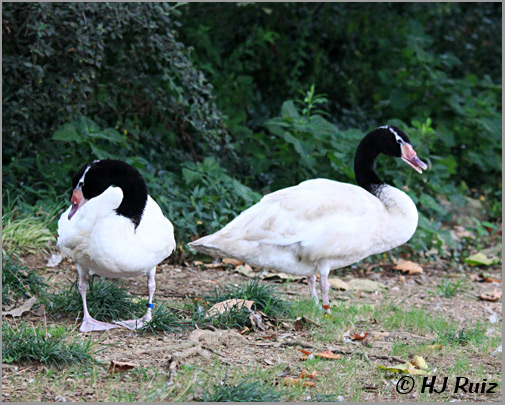
The Black-necked Swan, like its nearest relatives the Black and Mute Swan is relatively silent. Also, unlike most wildfowl, both parents regularly carry the cygnets on their backs. The female lays four to six eggs in a nest of vegetation mound. The diet consists mainly of vegetation, insects and fish spawn.
Widespread and common throughout its habitat, the Black-necked Swan is evaluated as Least Concern on the IUCN Red List of Threatened Species. It is listed on Appendix II of CITES.
 All photographs are © H.J. Ruiz – Avian101
Text is available under the Creative Commons Attribution-ShareAlike License; additional terms may apply. See Terms of use for details.
Share this:

Fishing with birds! – Video
See how fishermen use trained Cormorants to catch fish at the Li river in the Guangxi province of China.© BBC
Share this:

Researchers unravel the magic of flocks of Starlings
Do fish swimming in schools or birds flying in flocks have a collective spirit that enables them to move as one? Are they animals with highly developed cognition, a complex instinct or a telepathic gift? A recent study conducted by the research group led by Prof. Charlotte Hemelrijk of the University of Groningen points in another direction. Mathematical models of self-organization show that complicated collective behaviour can be the consequence of a few simple behavioural rules.

# 1 - European Starling
In an article in the online journal PLoS ONE, Hemelrijk and scientific programmer Hanno Hildenbrandt use the StarDisplay computer model to describe the causes of the miraculous variety of shapes in flocks of starlings.
Schools of fish
Previously, Hemelrijk and her collaborators used a comparable computer model to investigate schools of fish. Observations in nature showed that these are always elongated. “Our models showed that the elongated shape of schools of fish were the automatic result of self-organization,” Hemelrijk says. In addition to the usual grouping and coordination, no extra rules are needed to achieve this. A fish swimming behind another one will slow down to avoid bumping into the one ahead of it and its former neighbours then move inwards to fill the gap that has opened up. This results in an elongated school.
Fantastic variation

# 2
Flocks of starlings, however, produce a much richer variety of shapes. Video footage of flocks of starlings flying around in search of a place to roost show fantastic variation all over the world. Round, broad, elongated, flocks that shift shape from funnels to hourglasses, thickening, thinning; these are all existing variations. People have wondered for ages how all these different shapes are able to be created. In the 1930s, British ornithologist Edmund Selous — also fascinated by flocks — even attributed the tremendous variety to telepathy.
Principles
“We wanted to find out whether self-organization could provide an adequate explanation,” Hemelrijk states. The new StarDisplay model was once again based on a limited number of principles: birds are attracted to each other, they move in the same direction and they try to avoid bumping into one another. In addition, the model contains mathematical functions describing the flying behaviour using simplified aerodynamics. The simulated starlings experience a lifting force, drag and gravity, and bank when turning.
The program was used to simulate how flocks of starlings circle above a roosting place. Whenever starlings in the model left the area above the sleeping site they were made to turn back.
Port, starboard
The turning probably happens differently in birds and in fish. According to the models and empirical research conducted by Hemelrijk’s group, individual fish on the outside of a turning group are able to accelerate slightly, while those on the inside slow down. This enables fish to maintain their original spot in the group and keeps the school elongated. Birds in a flock, however, turn individually, as is shown in observations of circling rock pigeons published by American biologists Harold Pomeroy and Frank Heppner in 1992. This means that the positions of birds relative to one another change after making a 90-degree turn. Birds that were flying abreast are now flying one behind the other. And if yet another turn is made, the birds that were flying starboard are now suddenly flying portside.
Little variation in speed
This way of turning is one of the major factors leading to the variation in shapes. A flock that is flat and wide becomes long and narrow after a 90-degree turn. “StarDisplay shows us that this way of turning is a consequence of the fact that birds do not vary their speed very much,” Hemelrijk says. “If we figure more variation in speed into our model, the shapes become more elongated in the direction of the movement. In that case, the result that we had earlier for fish — where shapes remain elongated — also holds true for birds.”
Other factors
“In the PLoS ONE article we can only discuss a few of the causes of the variation in shapes of flocks of starlings,” Hemelrijk explains. In addition to the speed which can hardly be varied, other factors are the large number of individuals in the flock, the small number of partners — just seven — that each bird interacts with, making curves and banking in curves.
Invaluable
What has not been modelled is feeding behaviour and behaviour related to avoiding predatory birds. Air as medium, with factors such as wind and turbulence, has not been included in the model either. Hemelrijk: “Despite these restrictions, the model has given us quite a few hypotheses to test. This is invaluable, as researching such behaviour in the wild is extremely difficult without a good model to base yourself on.”
Photograph # 1 © H.J. Ruiz – Avian101
Photograph # 2 © Arpad / Fotolia
The above story is reprinted (with editorial adaptations by ScienceDaily staff) from materials provided by University of Groningen.
Share this:


Read Past Reviews

Book # 69

Quote from the Author
“A good chuckle is healthy, it helps you break the monotony of a serious life.” ~ H.J. Ruiz


You must be logged in to post a comment.