
Spotted Owl
Spotted Owl – Spec.Name: Strix occidentalis
This is a species of true owl. It is a resident species of forests in western North America, where it nests in tree holes, old bird of prey nests, or rock crevices. Nests can be between 13 and 66 yards (12 to 60 meters) high and usually contain two eggs (though some will contain as many as four). It is a strictly nocturnal owl, which feeds on small mammals and birds, which has only been discovered recently.
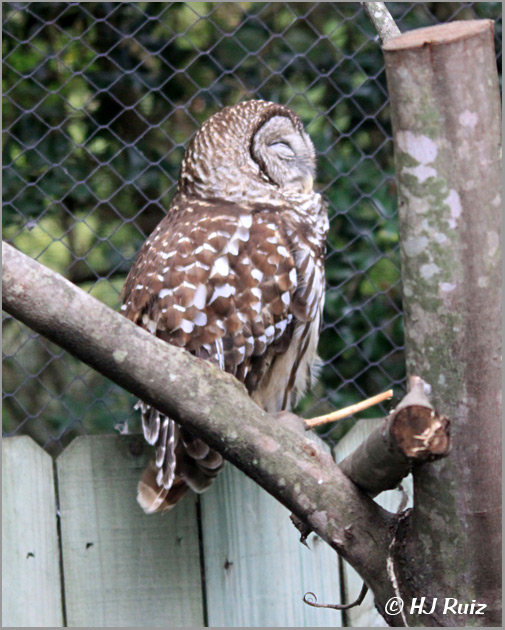
Spotted Owl
This owl has a length of 43 cm (17 inches), a wingspan of 114 cm (45 inches), and a weight of around 600 g (21 ounces). Its eggs are a little over 2 inches (50 mm) long, and are white and smooth with a slightly grainy texture. The female sits on the eggs and cares for the young, while the male provides food for them. Juvenile Spotted Owls have an average survival rate of 11%, with an average birth rate of .58 owls per pair.
The three sub-species of Strix occidentalis are Strix occidentalis caurina (Northern Spotted Owl), Strix occidentalis occidentalis (California Spotted Owl), and Strix occidentalis lucida (often referred to as the Mexican Spotted Owl). The Gila Wilderness is home to the largest population of the Mexican sub-species.
The Spotted Owl is similar in appearance to the Barred Owl but has cross-shaped markings on the underparts, whereas the Barred Owl is alternately barred on the breast and streaked on the belly. Barred Owls are larger and grayer than Spotted Owls. In recent years the California and Northern subspecies of Spotted Owl have been displaced by Barred Owls, which are more aggressive, have a broader diet and occur in more varied habitats. Though the two species may hybridize in areas where displacement is occurring, they are quite genetically distinct, for example, differing 13.9% in certain gene sequences.
Spotted owls are nocturnal, sit-and-wait predators. They often hunt from a perch and swoop or pounce on prey. They also grab arboreal prey from tree boles and limbs. They do occasionally hunt during the day and will hawk prey such as insects or bats.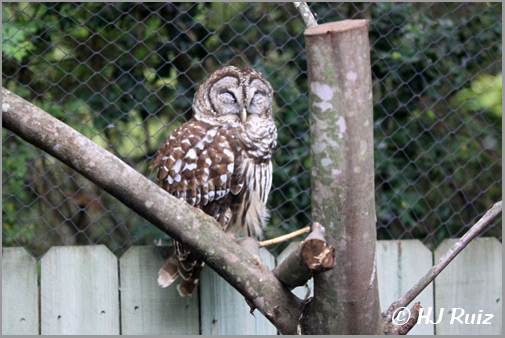
All photographs are © H.J. Ruiz – Avian101
Text is available under the Creative Commons Attribution-ShareAlike License; additional terms may apply. See Terms of use for details.
Share this:

Great White Pelican
Great White Pelican a.k.a. Eastern White Pelican – Spec. Pelecanus onocrotalus
This is a bird in the pelican family. It breeds from same: Southeastern Europe through Asia and in Africa in swamps and shallow lakes. Great White Pelicans are large birds with mass of 10 kg (22 lbs), 160 cm (63 in) long and with a 280 cm (110 inch) wingspan. It differs from the Dalmatian Pelican, the only larger species of pelican, by its pure white, rather than grey-white, plumage, a bare pink facial patch around the eye and pinkish legs. Males are larger than females, and have a long beak that grows in a downwards arc, as opposed to the shorter, straighter beak of the female. Immature birds are grey and have dark flight feathers. In flight, it is an elegant soaring bird, with the head held close to and aligned with the body by a downward bend in the neck. In breeding condition the male has pinkish skin on is face and the female has orangery skin.

Great White Pelican
The Great White Pelican is well adapted for aquatic life. The short strong legs and webbed feet propel it in water and aid the rather awkward takeoff from the water surface. Once aloft, the long-winged pelicans are powerful fliers, however, and often travel in spectacular V-formation groups. The pelican’s pouch is simply a scoop. As the pelican pushes its bill underwater, the lower bill bows out, creating a large pouch which fills with water and fish. As the bird lifts its head, the pouch contracts, forcing out the water but retaining the fish. A group of 6 to 8 great white pelicans will gather in a horseshoe formation in the water to feed together. They dip their bills in unison, creating a circle of open pouches, ready to trap every fish in the area. Large numbers of these pelicans breed together in colonies. The female lays 2 to 4 eggs. Nest location varies with some populations making stick nests in trees and others, such as those in Africa, nesting exclusively in scrapes on the ground lined with grass, sticks, feathers and other material. The young are cared for by both parents.
Well scattered groups occur from the eastern Mediterranean through to Vietnam and south to South Africa. Sedentary populations are found year-round in Africa, south of the Sahara Desert although these are patchy, occurring mainly in coastal, estuarine areas and around very large inland water bodies. Migratory populations are found from Eastern Europe to Kazakstan during the breeding season and from northeast Africa through Iraq to north India in the winter. More than 50% of Great White Pelicans breed in the Danube Delta in Romania.
The diet of the Great White Pelican consists mainly of fish. Each pelican needs about 1.4 kg of fish every day. This corresponds to around 28 million kilograms of fish every year consumed at the largest colony of Great White Pelicans, on Tanzania’s Lake Rukwa, with almost 75000 birds. Pelicans are not restricted to fish, however, and are often opportunistic foragers. In some situations they eat chicks of other birds, such as the well documented case off the southwest coast of South Africa. Here breeding Pelicans from the Dassen Island colony predate chicks up to 2 kg from the Cape Gannet colony on Malgas Island. Great White Pelicans also eat crustaceans, tadpoles and even turtles. They readily accept handouts from humans, and a number of unusual items have been recorded in their diet. During periods of starvation, pelicans also eat seagulls and ducklings. The gulls are held under water and drowned before being eaten headfirst. Pelicans will also rob other birds of their prey.
All photographs are © H.J. Ruiz – Avian101
Text is available under the Creative Commons Attribution-ShareAlike License; additional terms may apply. See Terms of use for details.
Share this:

Emerald Starling
Emerald Starling, a.k.a. Iris Glossy-starling – Spec. Name: Coccycolius iris
This is a small starling with a metallic green crown, upper body, wings and tail. The ear-coverts and underparts are metallic purple. Both sexes are similar. Its placement in a monotypic genus Coccycolius is disputed; some unite it with many other glossy-starlings in Lamprotornis.

Emerald Starling
One of the smallest species among starlings, the Iris Glossy-starling is distributed in West Africa. It inhabits lowlands and savanna of Côte d’Ivoire, Guinea and Sierra Leone.
The Iris Glossy-starling feeds on figs, Haronga berries and other fruit, seeds, ants and small insects such as ants. The cup-shaped nest is built in a tree cavity.
It is classified as “data deficient” by the IUCN. This means that it is unlikely to be seriously threatened with extinction, but that its status in the wild is in need of assessment. In the Iris Gloss-starling’s case, it appears that the species is plentiful enough for the time being, but that it seems that a considerable and possibly unsustainable number of birds being caught for the cage bird trade (BirdLife International 2004). The “data deficient” status has been upheld since 2000 (BirdLife International 2007), indicative of the prolonged wars and unrest in its range which have this far prevented comprehensive field studies.
All photographs are © H.J. Ruiz – Avian101
Text is available under the Creative Commons Attribution-ShareAlike License; additional terms may apply. See Terms of use for details.
Share this:

Silvery-cheeked Hornbill
Silvery-cheeked Hornbill – Spec. Name: Bycanistes brevis
This is a large bird at 75 to 80 centimeters (30 to 31 in) in length with a very large creamy casque on the beak. The female has a smaller casque and reddish skin around the eyes.

Silvery-cheeked Hornbill
The head is silver-grey and the rest of the plumage is iridescent black, except for the white rump, lower back, thighs, vent and tip of the outer tail-feathers. Silvery-cheeked Hornbills are residents of the tall evergreen forests of East Africa from Ethiopia to South Africa. In Zimbabwe it is threatened by habitat destruction and its presence in South Africa is marginal, but it remains locally fairly common, especially in the northern and central parts of its range. Usually they live in pairs and sometimes roost in flocks of hundreds of individuals. This hornbill feeds on fruits, insects, small birds, rodents, small reptiles and centipedes. 
They breed in spring (September and October; at least in part of its range) and lay clutches of 1 to 3 white eggs, incubated for 40 days. The young remain with both parents for circa 80 days.
Silvery-cheeked Hornbills food consists mostly of fruits, also some insects and bird eggs.
All photographs are © H.J. Ruiz – Avian101
Text is in part available under the Creative Commons Attribution-ShareAlike License; additional terms may apply. See Terms of use for details.
Share this:


Read Past Reviews

Book # 69

Quote from the Author
“A good chuckle is healthy, it helps you break the monotony of a serious life.” ~ H.J. Ruiz


You must be logged in to post a comment.