It’s No Sweat for Birds to Beat the Heat if they have Larger Bills
It’s a habit of mine to observe behavior of birds that come to my backyard. One thing that I took notice of is that many of the birds are constantly keeping their mouth open. Especially now that we’re still having a heat wave that never ends 😦 This summer has been very hot and dry in our area of Georgia. So I happened to be doing some research about bird’s behaviors and found the following article where most of my questions were answered. I hope it’s as interesting for you as it was for me.
–0000000000–
Birds use their bills largely to forage and eat, and these behaviors strongly influence the shape and size of a bird’s bill. But the bill can play an important role in regulating the bird’s body temperature by acting as a radiator for excess heat. A team of scientists have found that because of this, high summer temperatures have been a strong influence in determining bill size in some birds, particularly species of sparrows that favor salt marshes.The team’s findings are published in the scientific journal Ecography,

Common Grackle
July 20.Scientists at the Smithsonian Migratory Bird Center at the Smithsonian’s Conservation Biology Institute and colleagues examined five species of sparrow that inhabit salt marshes on the East, West and Gulf coasts of North America. While these marshes are very similar in makeup and structure, the main difference among them is summer temperatures. Focusing on 10 species and subspecies of tidal salt marsh sparrow, the team measured 1,380 specimens and found that the variation in the sparrows’ bill size was strongly related to the variation in the daily high summer temperatures of their salt marsh breeding habitats — the higher the average summer temperature, the larger the bill. Birds pump blood into tissue inside the bill at high temperatures and the body’s heat is released into the air. Because larger bills have a greater surface area than smaller bills, they serve as more effective thermoregulatory organs under hot conditions. On average, the study found the bills of sparrows in marshes with high summer temperatures to be up to 90 percent larger than those of the same species in cooler marshes.
“It is known that blood flow is increased in poorly insulated extremities in some animals, like a seal’s flippers, a rabbit’s ears and the wattles of a turkey helping hot animals to cool down. The bill of a bird can function in much the same way allowing birds to dump heat,” said Russ Greenberg, director of the Smithsonian Migratory Bird Center and lead author of the research. “Being able to cool down and not loose excess body moisture is particularly important since these birds live in an environment with direct sun and limited access to fresh water.”
The scientific theory known as Allen’s Rule states that warm-blooded species from colder climates usually have shorter limbs or appendages than the equivalent animals from warmer climates. The team’s new findings are a new example of Allen’s Rule that confirms the importance of physiological constraints on the evolution of vertebrate morphologies, even in bird bills.

Northern Mockingbird
The research team is working with physiologists from Brock University in Canada, employing thermal imaging to develop a more detail picture of how song sparrows that live in dunes and marshes along the Atlantic coast use their bills to stay cool.
Partial text and all photographs are © H.J. Ruiz – Avian101
The above story is reprinted (with editorial adaptations by ScienceDaily staff) from materials provided by Smithsonian,
Share this:

Nene
Nene,a.k.a. Nēnē and Hawaiian Goose – Spec. Name:, Branta sandvicensis
This is a species of goose endemic to the Hawaiian Islands. The official bird of the state of Hawaiʻi, the Nene is exclusively found in the wild on the islands of Maui, Kauaʻi and Hawaiʻi. The Hawaiian nameNēnēcomes from its soft call.

Nene
The Nene evolved from the Canada Goose (Branta canadensis), which most likely migrated to the Hawaiian islands 500,000 years ago, shortly after the island of Hawaiʻi was formed. This ancestor is the progenitor of the Nene as well as the prehistoric Giant Hawaiʻi Goose and Nēnē-nui (Branta hylobadistes). The Nēnē-nui was larger than the Nene, varied from flightless to flighted depending on the individual, and inhabited the island of Maui. Similar fossil geese found on Oʻahu and Kauaʻi may be of the same species. The Giant Hawaiʻi Goose was restricted to the island of Hawaiʻi and measured 1.2 metres (3.9 ft) in length with a mass of 8.6 kilograms (19 lb), making it more than four times larger than the Nene. It is believed that the herbivorous Giant Hawaiʻi Goose occupied the same ecological niche as the goose-like ducks known as moa-nalo, which were not present on the Big Island. Based on mitochondrial DNA found in fossils, all Hawaiian geese, living and dead, are closely related to the Giant Canada Goose (B. c. maxima) and Dusky Canada Goose (B. c. occidentalis).
The Nene is a medium-sized goose at 41 centimetres (16 in) tall. They are said to be able to fly because their wingspan is long and strong. Females have a mass of 1.525–2.56 kilograms (3.36–5.6 lb), while males average 1.695–3.05 kilograms (3.74–6.7 lb), 11% larger than females. Adult males have a black head and hindneck, buff cheeks and heavily furrowed neck. The neck has black and white diagonal stripes. Aside from being smaller, the female Nene is similar to the male in colouration. The adult’s bill, legs and feet are black. It has soft feathers under its chin. Goslings resemble the male, but are a duller brown and with less demarcation between the colours of the head and neck, and striping and barring effects are much reduced. The bill, legs and feet are the same as for the adult. Its strong toes are padded and have reduced webbing, an adaptation that allows it to swiftly traverse rough terrain such as lava plains.
The breeding season of the Nene, from August to April, is longer than that of any other goose; most eggs are laid between November and January. Unlike most other waterfowl, the Nene mates on land. Nests are built by females on a site of their choosing, in which one to five eggs are laid (average is three on Maui and Hawaiʻi, four on Kauaʻi). Females incubate the eggs for 29 to 32 days, while the male acts as a sentry. Goslings are precocial, able to feed on their own; they remain with their parents until the following breeding season.
The Nene is an herbivore that will either graze or browse, depending on the availability of vegetation. Food items include the leaves, seeds, fruit, and flowers of grasses and shrubs.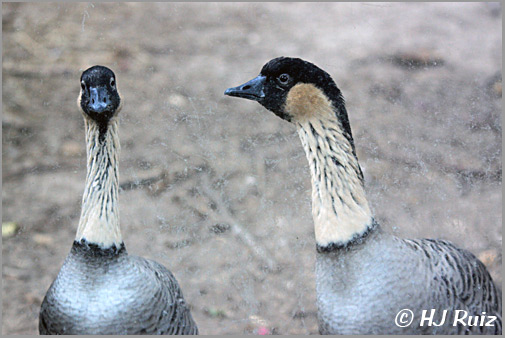
All photographs are © H.J. Ruiz
Text is available under the Creative Commons Attribution-ShareAlike License; additional terms may apply. See Terms of use for details.
Share this:

In the eye of Irene
I know that the news headlines are all related to hurricane “Irene” causing tremendous damage along the east coast of US. The torrential rains causing floods, tragedy of deaths and disruptions in millions of people’s lives. I felt that I had something to say too!
We have family in North Carolina, Virginia, Maryland, Florida, New York and Mainly in New Jersey. By phone and email we’ve been in touch and thankfully all are well. Most just tell you the most common problems: flooded basement, leaking roof, broken gutters, no way to go anywhere with flooded roads. For other it was harder because they had to evacuate. One young nephew was ready to go on vacation to Punta Cana, DR!. Guess what? All flights were canceled! 😦 He had planned that vacation for so long, bummer!
In the general instance I feel sad for those people who lost a dear member of their family, also for the ones that got their homes destroyed. I’m sorry!
I’d like to poke Irene in the bleep eye!
Looking at the many reports in form of TV, video or photos on the web, I stumbled into one that I think is more related to my blog. It gave me a sense of hope in the middle of natural disasters and a clear evidence of compassion even at difficult times such as hurricane “Irene” pounding Manhattan.

Soaked wet pigeon being protected by the finest in an empty Manhattan
Share this:

Peregrine Falcon dives at 180mph – Video
Check this fast flying falcon reaching high velocity dive chasing a lure from skydivers. © BBC
Share this:


Read Past Reviews

Book # 69

Quote from the Author
“A good chuckle is healthy, it helps you break the monotony of a serious life.” ~ H.J. Ruiz


You must be logged in to post a comment.