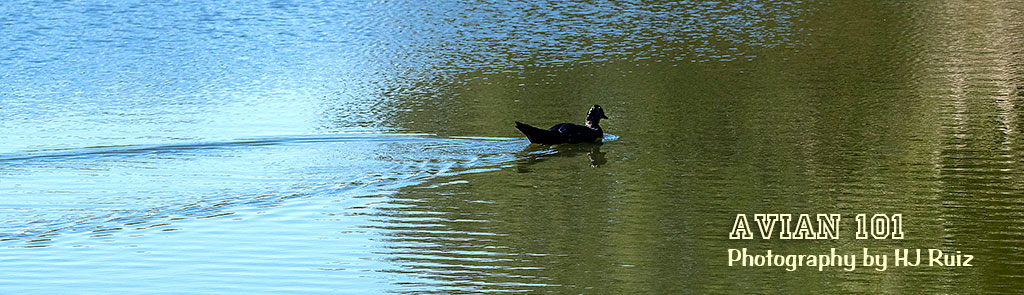
King Bird of Paradise – Video
It’s a fascinating video of such beautiful birds. See how new technology helps study their behavior and mating rituals. Enjoy! Video from uTube – osprey2899
Share this:

Great Tits sing low to be Loved or…
“I know, you got a kick out of this article’s title. Didn’t you?”
Barry White knew it, and male Great Tits know it too: to be successful with the ladies you have to sing as low as possible. But to be heard above city noise, you need to sing high notes. Leiden biologist Wouter Halfwerk studies the role of pitch in communication between city birds.

Great tit. (Credit: © Bruno T / Fotolia)
The results of his research have been published in PNAS.
Fertility
Halfwerk and his colleagues from the Behavioural Biology research group at the Institute of Biology in Leiden discovered that male Great Tits sing at much lower pitch when the females of the species are at their most fertile. The male that achieves the lowest notes is most successful with the females. Female Great Tits actually cheat on their mate if he does not manage to sing low enough.
City noise
Male Great Tits, as well as other male birds found in the city, are faced with a dilemma: how can they make sure they are heard above the noise of people and traffic? Results from earlier research suggest that they can achieve this by singing their songs at higher pitch. Measurements taken by the Institute of Biology Leiden show that this is an effective approach for being heard better, but the downside is that females find these songs less impressive. Females have a definite preference for lower notes.
Need to distinguish themselves
The researchers predict that city birds will therefore switch to other acoustic characteristics to distinguish themselves from competing males. The research results show that bird species that rely on low notes to attract partners, suffer most from the effects of city noise. This explains why these species breed less in areas close to mail roads than species that inhabit more peaceful locations.
The above story is reprinted (with editorial adaptations by ScienceDaily staff) from materials provided by Leiden, Universiteit.
Share this:

Cinereous Vulture
Cinereous Vulture a.k.a Black Vulture, Monk Vulture, or Eurasian Black Vulture – Spec. Name: Aegypius monachus
This is a member of the family Accipitridae, which also includes many other diurnal raptors such as kites, buzzards and harriers.
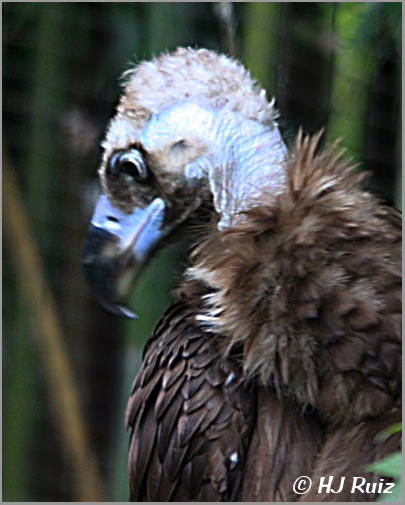
Cinereous Vulture
This bird is an Old World vulture, and is only distantly related to the New World vultures, which are in a separate family, Cathartidae, of the same order. It is therefore not directly related to the American Black Vulture despite the similar name and coloration.
It breeds across southern Europe and Asia from Portugal to Korea, but is endangered throughout its European range. It is resident except in those parts of its range where hard winters cause limited movement.
The Cinereous Vulture is believed to be the largest bird of prey in the world. The Himalayan Griffon Vulture is slightly longer overall but is believed to be marginally surpassed in weight and wingspan by the Cinereous. The condors, slightly larger, are now generally considered unrelated to the true raptors. This huge bird is 98–120 cm (39–47 in) long with a 250–310 cm (107–122 in) wingspan and a weight of 7–14 kg (15.5-31 lbs), and is thus one of the world’s heaviest flying birds.
It breeds in high mountains and large forests, nesting in trees or occasionally on cliff ledges. It has all dark blackish-brown plumage, and even at a distance can be distinguished from the Griffon Vulture by its evenly broad “barn door” wings. It has the typical vulture unfeathered bald head (actually covered in fine down), and dark markings around the eye give it a menacing skull-like appearance. The beak is brown, with a blue-grey cere, and the legs and feet are grey.
It is on average larger than mostly sympatric Griffon Vulture. Among the vultures in its range, the Eurasian Black Vulture is best equipped to tear open tough carcass skins, using its powerful bill. It is dominant over other vultures at carcasses. It can fly at a very high altitude. It has a specialized haemoglobin alphaD subunit of high oxygen affinity which makes it possible to take up oxygen efficiently despite the low partial pressure in the upper troposphere.
Important Note
The Cinereous Vulture has declined over most of its range in the last 200 years due to poisoning by eating poisoned bait put out to kill dogs and other predators, and to higher hygiene standards reducing the amount of available carrion; it is currently listed as near threatened. The decline has been the greatest in the western half of the range, with extinction in many European countries (France, Italy, Austria, Poland, Slovakia, Romania) and northwest Africa (Morocco, Algeria). More recently, protection and deliberate feeding schemes have allowed some local recoveries in numbers, particularly in Spain, where numbers increased to about 1,000 pairs by 1992 after an earlier decline to 200 pairs in 1970. This colony have now spread its breeding grounds to Portugal ref 7. Elsewhere in Europe, very small but increasing numbers breed in Bulgaria and Greece, and a re-introduction scheme is under way in France. Trends in the small populations in Ukraine (Crimea) and European Russia, and in Asian populations, are not well recorded. In the former USSR, it is still threatened by illegal capture for zoos, and in Tibet by rodenticides.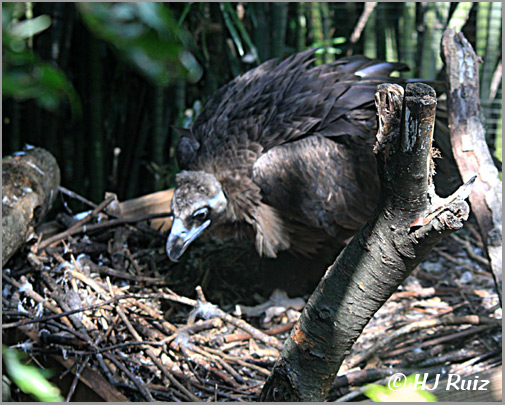
All photographs are © H.J. Ruiz – Avian101
Text is available under the Creative Commons Attribution-ShareAlike License; additional terms may apply. See Terms of use for details.
Share this:

Sulphur-crested Cockatoo
Sulphur-crested Cockatoo – Spec, Name: Cacatua galerita
This is a relatively large white cockatoo found in wooded habitats in Australia and New Guinea. They can be locally very numerous, leading to them sometimes being considered pests. They are well known in aviculture, although they can be demanding pets.
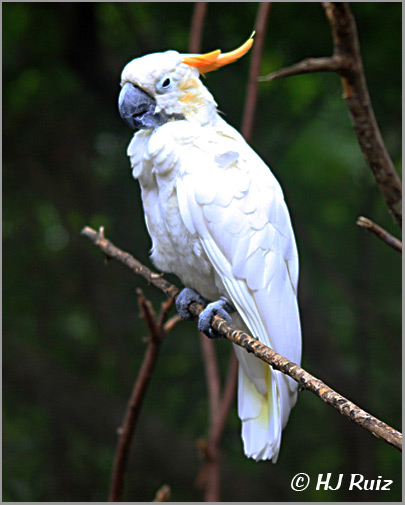
Sulphur-crested Cockatoo
It has a total length of 45–55 cm (18–22 in), with the Australian subspecies larger than subspecies from New Guinea and nearby islands. The plumage is overall white, while the underwing and -tail are tinged yellow. The expressive crest is yellow. The bill is black, the legs are grey, and the eye-ring is whitish. Males typically have almost black eyes, whereas the females have a more red or brown eye, but this require optimum viewing conditions to be seen. The differences between the subspecies are subtle. C. g. fitzroyi is similar to the nominate race but lacks the yellow on the ear tufts and slightly blueish skin around the eye. C. g. eleonora is similar to C. g. fitzroyi but is smaller and has broader feathers in the crest, and C. g. triton is similar to C. g. eleonora except it has a smaller bill.
It is similar in appearance to the three species of corellas found in Australia. However, corellas are smaller, lack the prominent yellow crest and have pale bills. In captivity, the Sulphur-crested Cockatoo is easily confused with the smaller Yellow-crested Cockatoo or the Blue-eyed Cockatoo with a differently shaped crest and a darker blue eye-ring.
Their distinctive raucous call can be very loud; it is adapted to travel through the forest environments in which they live, including tropical and subtropical rainforests. These birds are naturally curious, as well as very intelligent. They have adapted very well to European settlement in Australia and live in many urban areas.
These birds are very long-lived, and can live upwards of 70 years in captivity, although they only live to about 20–40 years in the wild. They have been known to engage ingeophagy, the process of eating clay to detoxify their food. These birds produce a very fine powder to waterproof themselves instead of oil as many other creatures do.
The Sulphur-crested Cockatoo is a seasonal breeder in Australia, little is known about its breeding behaviour in New Guinea. In southern Australia the breeding season is from August to January, whereas in northern Australia the season is from May to September. The nest is a bed of wood chips in a hollow in a tree. Like many other parrots it competes with others of its species and with other species on nesting sites. Two to three eggs are laid and incubation lasts between 25–27 days. Both parents incubate the eggs and raise the nestlings. The nestling period is between 9 to 12 weeks, and the young fledgelings remain with their parents for a number of months after fledging.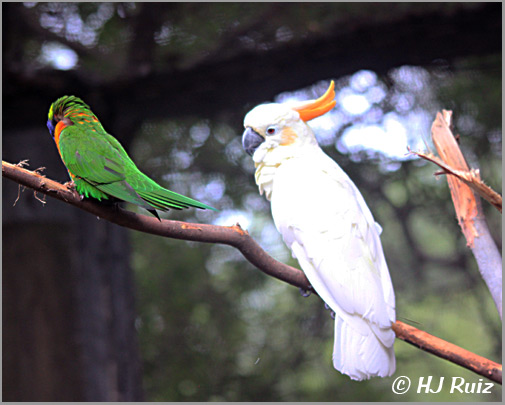
All photographs are © H.J. Ruiz – Avian101
Text is available under the Creative Commons Attribution-ShareAlike License; additional terms may apply. See Terms of use for details.
Share this:


Read Past Reviews

Book # 69

Quote from the Author
“A good chuckle is healthy, it helps you break the monotony of a serious life.” ~ H.J. Ruiz


You must be logged in to post a comment.