
Canada Goose
Canada Goose – Spec. Name: Branta canadensis
This is a wild goose belonging to the genus Branta, which is native to arctic and temperate regions of North America, having a black head and neck, white patches on the face, and a brownish-gray body.
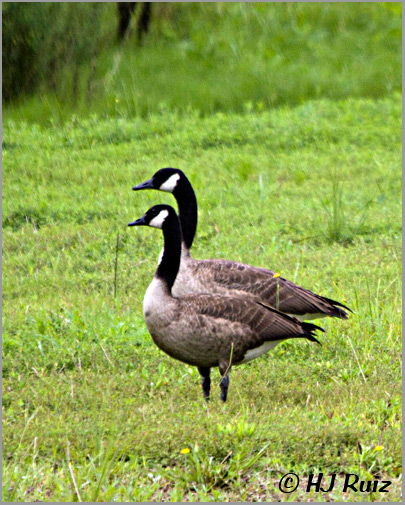
Canada Geese
The black head and neck with white “chinstrap” distinguish the Canada Goose from all other goose species, with the exception of the Barnacle Goose, but the latter has a black breast, and also grey, rather than brownish, body plumage. There are seven subspecies of this bird, of varying sizes and plumage details, but all are recognizable as Canada Geese. Some of the smaller races can be hard to distinguish from the newly-separated Cackling Goose.
This species is 76–110 centimetres (30–43 in) long with a 127–180 centimetres (50–71 in) wingspan. The male usually weighs 3.2–6.5 kilograms (7.1–14 lb), and can be very aggressive in defending territory. The female looks virtually identical but is slightly lighter at 2.5–5.5 kilograms (5.5–12 lb), generally 10% smaller than its male counterpart, and has a different honk. An exceptionally large male of the race B. c. maxima, the “giant Canada goose” (which rarely exceed 8 kilograms (18 lb)), weighed 10.9 kilograms (24 lb) and had a wingspan of 2.24 metres (7.3 ft). This specimen is the largest wild goose ever recorded of any species. The life span in the wild of geese that survive to adulthood ranges 10–24 years.
Like most geese, the Canada Goose is naturally migratory with the wintering range being most of the United States. The calls overhead from large groups of Canada Geese flying in V-shaped formation signal the transitions into spring and autumn. In some areas, migration routes have changed due to changes in habitat and food sources. In mild climates from California to the Great Lakes, some of the population has become non-migratory due to adequate winter food supply and a lack of former predators.
Canada Geese are primarily herbivores, although they sometimes eat small insects and fish. Their diet includes green vegetation and grains. The Canada Goose eats a variety of grasses when on land. It feeds by grasping a blade of grass with the bill, then tearing it with a jerk of the head. The Canada Goose also eats grains such as wheat, beans, rice, and corn when they are available. In the water, it feeds from silt at the bottom of the body of water. It also feeds on aquatic plants, such as seaweeds. In urban cities, they are also known to pick food out of garbage bins.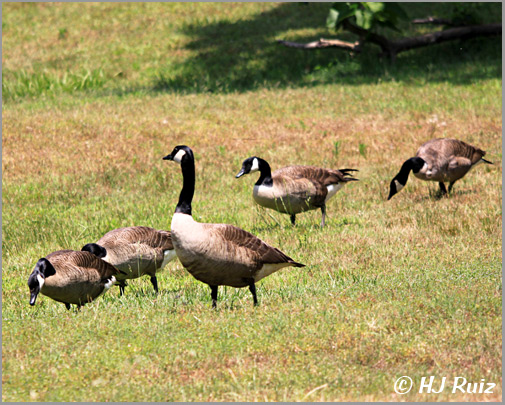
All photographs are © H.J. Ruiz – Avian101
Text is available under the Creative Commons Attribution-ShareAlike License; additional terms may apply. See Terms of use for details.
Share this:

Crested Screamer
Southern Screamer a.k.a the Crested Screamer – Spec. Name: Chauna torquata
This bird belongs to the order Anseriformes. It is found in southeastern Peru, northern Bolivia, Paraguay, southern Brazil, Uruguay and northern Argentina. Its diet consists of plants stems, seeds, leaves, and, rarely, small animals. The Southern Screamer averages 83–95 cm (33–37 in) long and weighs 4–4.5 kg (8.8–9.9 lb). It lives in tropical and sub-tropical swamps, estuaries and watersides.

Crested Screamer
The Southern Screamer establishes monogamous relationships that last its lifetime, estimated to be 15 years. Courtship involves loud calling by both sexes, which can be heard up to two miles away. For the nest the couple makes a big platform of reeds, straws, and other aquatic plants in an inaccessible place near water. The female lays between two and seven white eggs. The couple share incubation, which takes 43 to 46 days. Chicks leave the nest as soon as they hatch, but the parents care for them for several weeks. The fledging period takes 8 to 14 weeks.
The Southern Screamer is a good swimmer, having partially webbed feet, but prefers to move on the ground. The bony spurs on its wings are used for protection against rival screamers and other enemies. Although it is non-migratory, it is an excellent flier. It lives in large flocks, feeding on the ground in grasslands and cultivated fields until nesting season, when birds pair off.
All phptpgraphs are © H.J. Ruiz – Avian101
Text is available under the Creative Commons Attribution-ShareAlike License; additional terms may apply. See Terms of use for details.
Share this:

Hummingbird Guard Duty – Guest Karen Chandler
A Photo Series
A juvenile male hummingbird has claimed a feeder just outside my porch door. I like to observe his behavior as he guards his territory, feeds, and rests. For this series of photos, I wanted to show the variety of positions he takes as he perches on a shepherd’s hook just above his feeder. He does not mind my presence, even though my tripod is six feet from his perch. He is, however, curious each time I touch or stand close to his feeder. He swoops close to me and another bird usually follows him for a second near miss of my head!
Although hummingbirds seem to be in constant motion, they actually spend most of their time perched on a tree limb or other object. The little subject of my photos preens his feathers and tests the air for insects, in addition to watching the activity in his territory. He definitely has a determined personality, choosing to challenge any bird or bee that gets too close. All photos: Canon 60D. Manual, metering mode: center-weighted average, RAW format. I tried various settings, but most of the photos were: ISO 640, 200mm, f/5.6, 1/640. All photos were developed and cropped in Lightroom3.
Photo # 1: Here he is facing the open expanse of the yard,providing a good view of pretty feathers.

Photo # 1
Photo # 2: Facing the porch, he looks to his left where other feeders are placed and activity is high.

Photo # 2
Photo # 3: To his right, the neighbor’s back yard has an open area for fast flying. The chase usually ends up in that direction!

Photo # 3
Photo # 4: Occasionally taking a look straight up is necessary. The competition could be anywhere.

Photo # 4
Photo # 5: This head position allows him to monitor a window feeder, where he occasionally partakes.

Photo # 5
Photo # 6: He has to keep an eye on me too – just in case!

Photo # 6
Photo # 7: Snack time is on his mind when nothing else is happening. You never know when a tiny insect might be passing by!

Photo # 7
Photo # 8: Ok – too close for comfort! Fluffed feathers, flapping beak, and angry chirps precede the chase. Then back to home base for the guard duty that never ends!

Photo # 8
Text and Photos are © Karen Chandler – Her Blog : Visioning
Share this:

Visiting Phinizy Swamp Nature Park, Ga.
Phinizy Swamp Nature Park, along with the Phinizy Swamp Wildlife Management Area, has been designated an “Important Bird Area” by the Audubon Society.
Based on this information, I drove there to visit the site (31/2 hours drive one way for me) The Nature Park is located not very far from the city of Augusta and very close to the border with South Carolina.
All swamps of Georgia have a certain rough beauty that fascinate me. Let me describe them: It is a tangle of many kinds of plants, bushes, trees, aquatic plants, moss etc. All are mixed together at random but when looking at the landscape is perfect as is! Is a paradox. Despite the complexity and disarray, all components harmonize into a beautiful natural site.
One thing I notice and didn’t like was the lack of maintenance the trails had many spots with garbage left by visitors. Funny thing is that I saw garbage bins at different places along trails. I guess some visitors don’t care much about cleaning. I also saw several fallen trees across the trails that don’t look that fell recently. Part of trails have a boardwalk, here too I saw sections of the boardwalk broken down and out of alignment.
The park has several small fishing ponds, they look fine. I was expecting to see hundreds of birds but I felt disappointed not to find many!
One of the main bodies of water is fenced I believe is called the Beaver Dam reservoir. This fence goes all around the pond and that makes it hard for photographers to get a good shot at the wading birds foraging at the marshes.
I hiked around looking for anything that move, after a while I saw a few warblers but had no chance to take even one shot because they hide quickly in the dense foliage. I could hear the loud pecking of the woodpecker but I couldn’t see one! I think that maybe is the wrong time of the season. I’m sure that the swamp is the perfect habitat for many types of birds. I wasn’t lucky to find many birds. Shot some pictures of egrets, that’s it!
My opinion is that this swamp is beautiful but not such a great place for birding. At least the day I went!

All photographs are © H.J. Ruiz – Avian101
Share this:


Read Past Reviews

Book # 69

Quote from the Author
“A good chuckle is healthy, it helps you break the monotony of a serious life.” ~ H.J. Ruiz


You must be logged in to post a comment.