
Budgerigar a.k.a. Parakeet
Budgerigar a.k.a. Parakeet or Shell Parakeet – Spec.Name: Melopsittacus undulatus
They are informally nicknamed the budgie, is a small, long-tailed, seed-eating parrot, and the only species in the Australian genus Melopsittacus. Wild budgerigars are found throughout the drier parts of Australia, where the species has survived harsh inland conditions for the last five million years. Naturally green and yellow with black, scalloped markings on the nape, back, and wings, breeders have created a rainbow of blues,
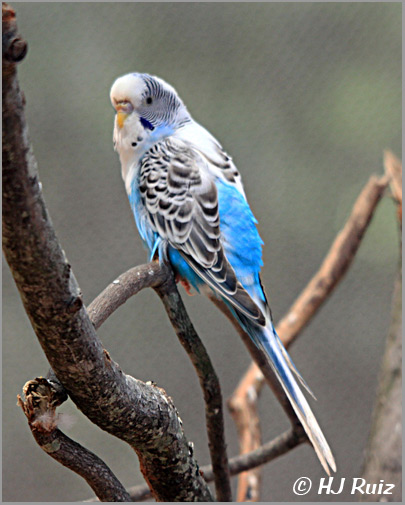
Budgerigar or Parakeet
whites, and yellows, grays, and even forms with small crests. Budgerigars are popular pets around the world due to their small size, low cost, ability to mimic human speech and playful nature.
The budgerigar is closely related to the lories and the fig parrots.] Although budgerigars are often, especially in American English, called parakeets, this term refers to any of a number of small parrots with long, flat tails.
Budgerigars in their natural-habitats of Australia average 18 cm (7 in) long, weigh 30–40 grams (1.1–1.4 oz), and display a light green body colour (abdomen and rumps), while their mantle (back and wing coverts) display pitch-black mantle markings (blackish in fledgelings and immatures) edged in clear yellow undulations. The forehead and face is yellow in adults but with blackish stripes down to the cere (nose) in young individuals until they change into their adult plumage around 3–4 months of age. They display small, purple patches (called cheek patches) and a series of three black spots across each sides of their throats (called throat-spots). The two outermost throat-spots are situated at the base of each cheek-patch. The tail is cobalt (dark-blue); outside tail feathers display central yellow flashes. Their wings have greenish-black flight feathers and black coverts with yellow fringes along with central yellow flashes, which only becomes visible in flight or when the wings are outstretched. Bills are olive grey and legs blueish-grey, with zygodactyl toes.
Like many birds, budgerigars have tetrachromatic color vision, but all four classes of cone cells operating simultaneously requires the full spectrum provided by sunlight. Additionally, budgerigars are known to see in the ultra-violet spectrum, which brightens their feathers to attract mates. The throat-spots in budgerigars reflect UV and can be used to distinguish individual birds.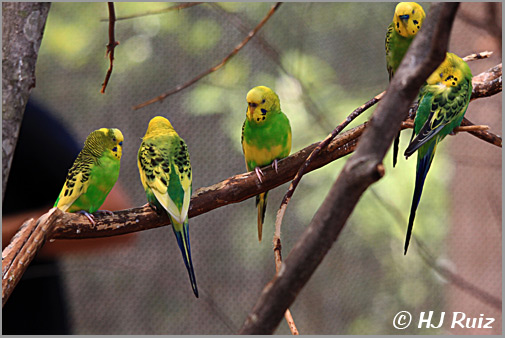
All photographs are © H.J. Ruiz – Avian101
Text is available under the Creative Commons Attribution-ShareAlike License; additional terms may apply. See Terms of use for details.
Share this:

Blue-bellied Roller
Blue-bellied Roller – Spec. Name: Coracias cyanogaster
This is a member of the roller family of birds which breeds across Africa in a narrow belt from Senegal to northeast Zaire. It is resident, apart from some local seasonal movements, in mature moist savannah dominated by Isoberlinia trees.

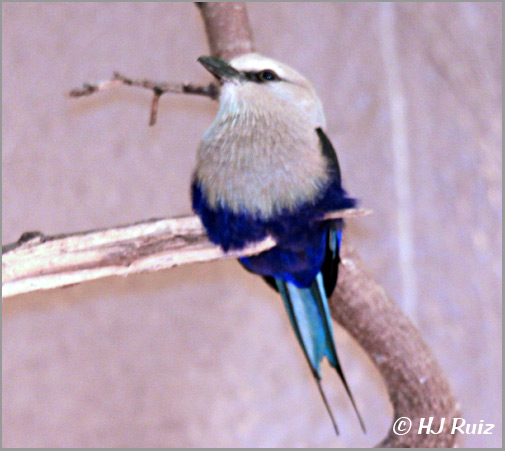
Blue-bellied Roller
The Blue-bellied Roller is a large bird, nearly the size of a Jackdaw at 28-30 cm. It has a dark green back, white head, neck and breast, with the rest of the plumage mainly blue. Adults have 6cm tail streamers. Sexes are similar, but the juvenile is a drabber version of the adult.
Blue-bellied Roller is striking in its strong direct flight, with the brilliant blues of the wings contrasting with the dark back and white head, and the tail streamers trailing behind.
This is a common bird of warm open country with some trees. These rollers often perch prominently on trees, posts or overhead wires, like giant shrikes, whilst watching for the grasshoppers and other large insects on which they feed.
The display of this bird is a lapwing-like display, with the twists and turns that give this species its English name. It nests in a hole in a tree cavity.
The call of Blue-bellied Roller is a harsh clicking ga-ga-ga sound.
Widespread and common throughout its large range, the Blue-bellied Roller is evaluated as Least Concern on the IUCN Red List of Threatened Species.
All photographs are © H.J. Ruiz – Avian101
Text is available under the Creative Commons Attribution-ShareAlike License; additional terms may apply. See Terms of use for details.
Share this:

Milking the Pigeons
When I was a kid I heard an expression among my friends that was used as a metaphoric comparison for taking long time or difficulty to do something in a short period of time. I believe is a Sephardic expression. For example: I lend money to a friend with the promise to return it in a very short time. Another friend makes a sarcastic comment “It would be faster to milk the pigeons!” Meaning: Yeah right! He’ll never pay you back!
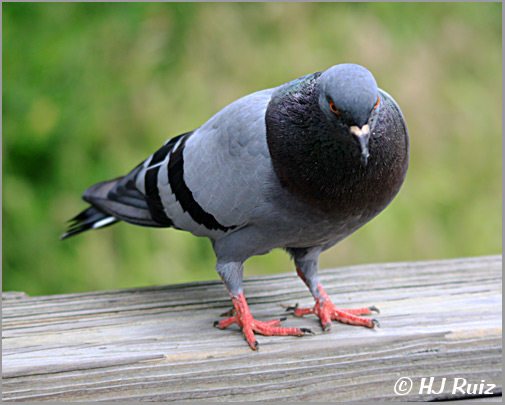
Rock Pigeon
It did imply that pigeons have milk!
Then I read this article:
“Production of crop milk, a secretion from the crops of parent birds, is rare among birds and, apart from pigeons, is only found in flamingos and male emperor penguins. Essential for the growth and development of the young pigeon squab, pigeon ‘milk’ is produced by both parents from fluid-filled cells lining the crop that are rich in fat and protein.
Research published in BioMed Central’s open access journal BMC Genomics uses new technology to study the genes and proteins involved in pigeon ‘milk’ production and shows that pigeon ‘milk’ contains antioxidants and immune-enhancing proteins.
Researchers from CSIRO Livestock Industries and Deakin University, Australia, compared the global gene expression profiles of the crops of four ‘lactating’ and four ‘non-lactating’ female pigeons. As the pigeon genome has not yet been sequenced, they used a chicken microarray to find the genes involved. Genes predominantly over-expressed in ‘lactating’ birds were those involved in stimulating cell growth, producing antioxidants and in immune response. They also found genes associated with triglyceride fat production, suggesting the fat in the ‘milk’ is derived from the pigeon’s liver.
Lead author, Meagan Gillespie, says, “It is possible that if antioxidant and immune proteins are present in pigeon ‘milk’, they are directly enhancing the immune system of the developing squab as well as protecting the parental crop tissue.” She continues, “This study has provided a snap-shot view of some of the processes occurring when ‘lactation’ in the pigeon crop is well established. Due to the unusual nature of ‘lactation’ in the pigeon it would be interesting to investigate the early stages of the differentiation and development of the crop in preparation for ‘milk’ production to further ascertain gene expression patterns that characterize crop development and ‘lactation’ in the pigeon.”
She concludes, “This mechanism is an interesting example of the evolution of a system with analogies to mammalian lactation, as pigeon ‘milk’ fulfills a similar function to mammalian milk.”
Photograph is © H.J. Ruiz -Avian101
The above story is reprinted with editorial adaptations by ScienceDaily staff and additional text by H,J. Ruiz from materials provided by BioMed Central
Share this:

Eastern Towhee Portrait – Video
This beautiful video of Eastern Towhees shot by Lang Elliott is another display of his great talent foe videography.
Share this:


Read Past Reviews

Book # 69

Quote from the Author
“A good chuckle is healthy, it helps you break the monotony of a serious life.” ~ H.J. Ruiz


You must be logged in to post a comment.