Invitation
Invitation
It’s with great delight that I invite you to visit my new website : http://www.avian101.com
For a while I’ve been toying with the idea to design a website that could work in conjunction with my current Blog.
Welcome to Avian101 Website by H.J. Ruiz
Finally is ready! I want this site to be a complement to the blog but more inclined to Photography being the main subjects as always, birds!
I’d like people to be able to read my blog and then spend some time looking at photographs with a larger display of photos from my new galleries. The site is designed to be simple and get to the point for easy browsing. My sincere hope is that my web site will reach out to visitors that love birds but also love to see their images. I will also include brief information about locations or hot spots for birding that I’ve visited. And pictorial samples of other parts of the world.
Come with me and explore this new website!
Bookmark my new site on your browser and feel free to voice your opinion about the content. Day by day I will add interesting photos and new galleries to keep my friends interested.
Let’s have fun birding or taking pictures, I am! It’s a lot of work for me but I’m enjoying every minute of it! How about you?
My thanks to you in advance, help me make this new site a good place to get together!
H.J. Ruiz
Share this:

Red-crested Cardinal
Red-crested Cardinal – Spec. Name: Paroaria coronata
This is a bird species in the tanager family (Thraupidae). It was formerly placed in the Emberizidae, and notwithstanding its common name, it is not very closely related to the true cardinals (family Cardinalidae).

Red-crested Cardinal
It is found in northern Argentina, Bolivia, southern Brazil, Paraguay and Uruguay. Its natural habitats are subtropical or tropical dry shrub land heavily degraded former forest. Among other regions, it is found in southern part of the Pantanal.
It has also been introduced to Hawaii and Puerto Rico. In Brazil, it has been introduced to various places outside its historical range, as in the Tietê Ecological Park in São Paulo, alongside with its very similar-looking close relative, the Red-cowled Cardinal (P. dominicana).
The Yellow-billed Cardinal (P. capitata) could also be easily confused with the Red-crested Cardinal; both the Red-cowled and Yellow-billed have a very short crest that is not visible except in excited birds, and in the case of the latter also a black throat, darker upperparts and a bright yellow bill.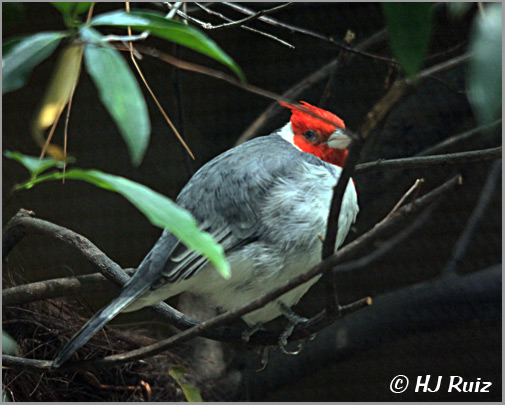
All photographs are © H.J. Ruiz – Avian101
Share this:

Marbled Teal
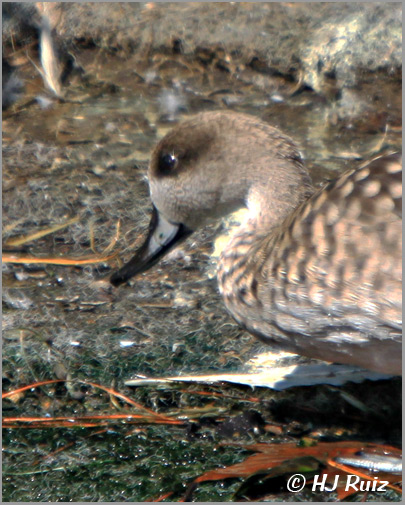
Marbled Teal a.k.a. Marbled Duck – Spec. Name: Marmaronetta angustirostris
This is a medium-sized duck. It used to be included among the dabbling ducks, but is now classed as a diving duck.This duck formerly bred in large numbers in the Mediterranean region, but is now restricted to a few sites in southern Spain, northwest Africa and in Israel.
Marbled Teal
In the east it survives in the Mesopotamian marshland in southern Iraq and in Iran (Shadegan Marshes – the world’s most important site), as well as isolated pockets in Turkey, Armenia, Azerbaijan, Iraq and further to the east in western India and western China. Its breeding habitat is lowland where they lay their eggs in long grass or in high trees. They may lay 7 to 10 cream eggs. They are common in private collections but are a nervous and flighty bird. In some areas birds disperse from the breeding grounds, and have been encountered in the winter period in the Sahel zone, south of the Sahara.
The Marbled Duck is approximately 39–42 centimetres (15–17 in) long. Adults are a pale sandy-brown colour, diffusely blotched off-white, with a dark eye-patch and shaggy head. Juveniles are similar but with more off-white blotches. In flight, the wings look pale without a marked pattern, and no speculum on the secondaries. These are gregarious birds, at times even when nesting. Outside the breeding season flocks are often small, although large wintering flocks have been reported in some areas. The largest winter concentration known is in Khuzestan, Iran.
In 2011, a group of Iraqi ornithologists counted a single flock of the rare marbled teal on the lakes of the Iraqi marshes, numbering at least 40,000 birds. These birds feed mainly in shallow water by dabbling or up-ending, occasionally diving. Little is known of their diet.
This bird is considered vulnerable due to a reduction in population caused by habitat destruction and hunting. It is one of the species to which the Agreement on the Conservation of African-Eurasian Migratory Waterbirds (AEWA) applies. The scientific name, Marmaronetta angustirostris, comes from the Greek marmaros, marbled and netta, a duck, and Latin angustus, narrow or small and rostris.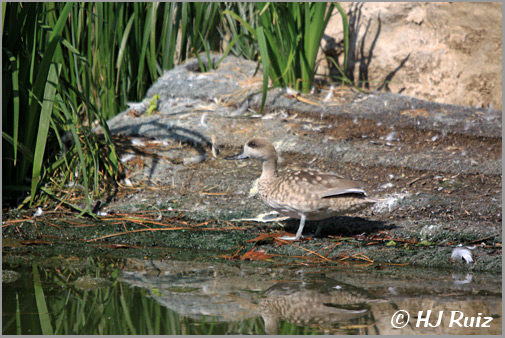
All photos are © H.J. Ruiz – Avian101
Text is available under the Creative Commons Attribution-ShareAlike License; additional terms may apply. See Terms of use for details.
Share this:

The Good Guys!
One bird that you commonly see in my backyard is the Northern Mockingbird. It’s funny to see one very often walking along the railing of my deck, from one corner to the other. I picture it in my mind as a soldier on guard duty on the lookout for enemies. 🙂
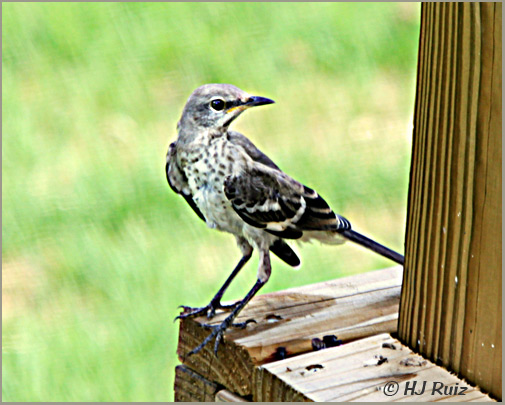
Young Northern Mockingbird
Almost daily you can see one Mockingbird doing what I described previously.
These birds are brave! I’ve seen them chasing crows away and even hawks. They’re are very protective of their territory at times acting fearlessly and aggressively against larger intruders.
Through several seasons I believe I’ve seen several generations of Mockingbirds hatched from nests around my house. I’ve observed their behavior, they have a tendency to act as guardians of our feeders. They do not bother any of the birds that nest locally like finches, cardinals, field sparrows, tufted titmice, brow-headed nuthatches or red-headed woodpeckers. It’s a different story with cowbirds, blackbirds, blue jays and bluebirds.
For a while I thought that they were aggressive by nature but I was wrong, most of them are defending their own or other birds from bigger birds that bully their way around.
I think Mockingbirds are the good guys!

All photos are © H.J. Ruiz – Avian101
Share this:


Read Past Reviews

Book # 69

Quote from the Author
“A good chuckle is healthy, it helps you break the monotony of a serious life.” ~ H.J. Ruiz


You must be logged in to post a comment.