
Sunbittern
Sunbittern – Spec. Name: Eurypyga helias
This is a bittern-like bird of tropical regions of the Americas, and the sole member of the family Eurypygidae (sometimes spelled Eurypigidae) and genus Eurypyga.
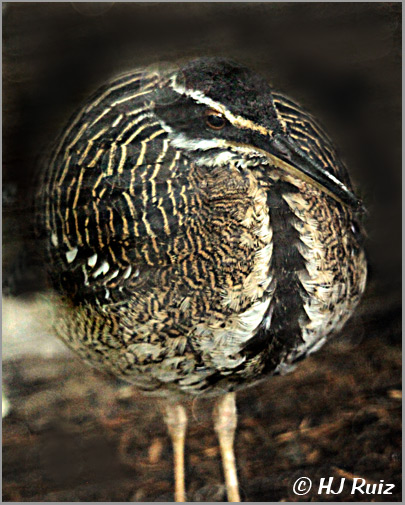
Sunbittern
The bird has a generally subdued coloration, with fine linear patterns of black, grey and brown. Its remiges however have vividly-colored middle webs, which with wings fully spread show bright eyespots in red, yellow, and black. These are shown to other sunbitterns in courtship and threat displays, or used to startle potential predators. Like some other birds, the Sunbittern has powder down.
They build open nests in trees, and lay two eggs with blotched markings. The young are precocial, but remain in the nest for several weeks after hatching
The Sunbittern’s range extends from Guatemala to Brazil. The species may also be present in southern Mexico: it has been traditionally reported from the Atlantic slope of Chiapas, but no specimens are known and there have been no recent records.
The Sunbittern is normally found foraging on the ground and scratching for insects.
The Sunbittern is usually placed in the Gruiformes, but this was always considered preliminary. Altogether, the bird is most similar to another enigmatic bird that was provisionally placed in the Gruiformes, the Kagu (Rhynochetos jubatus).[4] Molecular studies seem to confirm that the Kagu and Sunbittern are each other’s closest living relatives.] They are probably not Gruiformes (though the proposed Metaves are just as weakly supported). Altogether, the two species seem to form a minor Gondwanan lineage which could also include the extinct adzebills and/or the mesites, and is of unclear relation to the Gruiformes proper. Notably, the Kagu and mesites also have powder down.
A DNA study by Hackett et al. (2008) concluded strongly, as well as Fain & Houde (2004) and other researchers, that the Sunbittern and the Kagu form a clade, but puts these two as a sister group of the swifts, nightjars and hummingbirds.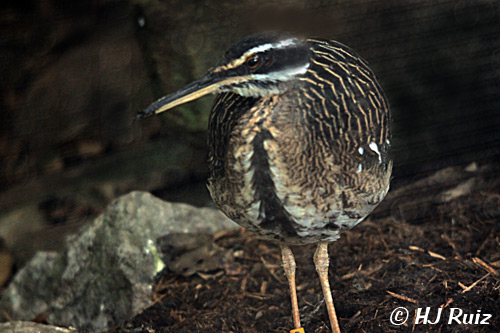
All photos are © H.J. Ruiz – Avian101
Text is available under the Creative Commons Attribution-ShareAlike License; additional terms may apply. See Terms of use for details.
Share this:

Peruvian Thick-knee
Peruvian Thick-knee – Spec. Name: Burhinus superciliaris
This is a species of bird in the Burhinidae family. It is found in Chile, Ecuador, and Peru. Its natural habitats are subtropical or tropical dry shrubland, subtropical or tropical seasonally wet or flooded lowland grassland, and pastureland. Ironically, it is known for its very thin legs. It feeds on small insects and grains.

Peruvian Thick-knee
Photograph is © H.J. Ruiz – Avian 101
Share this:

BIRDS of North America and Greenland – Book review
BIRDS of North America and Greenland,
Written and beautifully illustrated by Norman Arlott, published by Princeton Press.

Birds of North America and Greenland
“This book is small in size (perfect for my backpack) however the size might deceive you for the tremendous amount of information content!, Precise, brief, yet just appropriated information about almost any bird that you might bump into during your lifetime. The pictorials are clear and well detailed, colors have been carefully picked to match the bird’s natural plumage colors. This guide covers a large amount of species. Formatted to have all bird’s information on the left page and the illustrations on the right, positioned in numerical order to be easily located.
It’s not a scientific book or study about birds but one thing it is, a useful small guide!
I’ve used this guide already!”
Review made by H.J. Ruiz – Avian 101

Sample
Share this:

Picnic for Lucy
Last Friday was my wife’s birthday, instead of staying home we decided to go outdoors and we picked the location for our picnic to be High Falls near Jackson, Ga. because it’s only 2 hours drive and we have been there before, we like that beautiful area. We couldn’t ask for better weather to have a picnic, it was perfect!. 
We got there early and after driving around the site a bit parked the car. I picked a good spot to try shooting video so I set up my camera and 120-400 mm zoom mounted on my sturdy tripod and shot a couple of minutes of video. The tripod was standing on grass but near a part that is paved. My plan was to shoot video of a Great Blue Heron by a cascade, but this time for a longer period of time. I was approximately 3 feet away from the tripod when I head a sound behind me! My tripod was on the ground and the camera and lens had hit the pavement hard! 😦
I just couldn’t believe it. It must have been the wind, once in a while you could feel gusts of wind but I never thought it would tip a tripod over!
The result of this disaster: The Canon 500D T1i had a direct impact and had a cracked bottom corner, the shock had affected the circuitry and now is not shooting, the display works but if I want to use the shutter the screen black out and warns me of high temperature in the circuitry and shuts off all functions. It’s useless!
The collar ring support for my Sigma 400 mm zoom lens broke in two pieces but the lens is okay, the lens shade is scratched but I don’t care. I have ordered a new collar ring support already. The camera is shot so I’m thinking of buying a Canon 7D.
I haven’t lost or damaged any of my camera equipment ever! When this incident occurred I felt hurt!
I think one solution to avoid this problem to occur again would be to hang some weight under the center of my tripod when using my big lens.
I wouldn’t let this ruin our day! It was a good thing that I always carry a backup camera in my bag. This time a had the Canon SX30 IS so I felt I had some consolation after all!
I shot a bunch of pictures to several birds and had some great shots of the Great Blue Heron! 🙂
Some time in the afternoon we got to the end of our picnic. Tyler had a great time and a great deal of exercise.
We returned home very satisfied and happy to have spent a beautiful day outdoors. Happy birthday Lucy!


 All photos are © H.J. Ruiz – Avian101
Share this:


Read Past Reviews

Book # 69

Quote from the Author
“A good chuckle is healthy, it helps you break the monotony of a serious life.” ~ H.J. Ruiz


You must be logged in to post a comment.