
Buff-banded Rail
Buff-banded Rail – Spec. Name: Gallirallus philippensis
This is a distinctively coloured, highly dispersive, medium-sized rail of the family Rallidae.This species comprises several subspecies found throughout much of Australasia and the south-west Pacific region, including the Philippines (where it is known as Tikling),
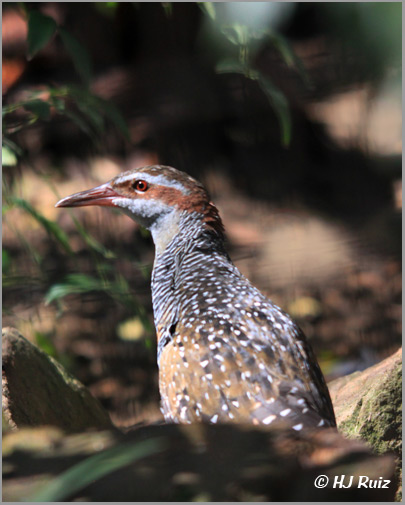
Buff-banded Rail
New Guinea, Australia, New Zealand (where it is known as the Banded Rail or Moho-pereru in Māori) – and numerous smaller islands, covering a range of latitudes from the tropics to the Subantarctic.
It is a largely terrestrial bird the size of a small mummy domestic chicken, with mainly brown upperparts, finely banded black and white underparts, a white eyebrow, chestnut band running from the bill round the nape, with a buff band on the breast. It utilises a range of moist or wetland habitats with low, dense vegetation for cover. It is usually quite shy but may become very tame and bold in some circumstances, such as in island resorts within the Great Barrier Reef region.
The Buff-banded Rail is an omnivorous scavenger which feeds on a range of terrestrial invertebrates and small vertebrates, seeds, fallen fruit and other vegetable matter, as well as carrion and refuse. Its nest is usually situated in dense grassy or reddy vegetation close to water, with a clutch size of 3-4. Although some island populations may be threatened, or even exterminated, by introduced predators, the species as a whole appears to be safe and its conservation status is considered to be of Least Concern.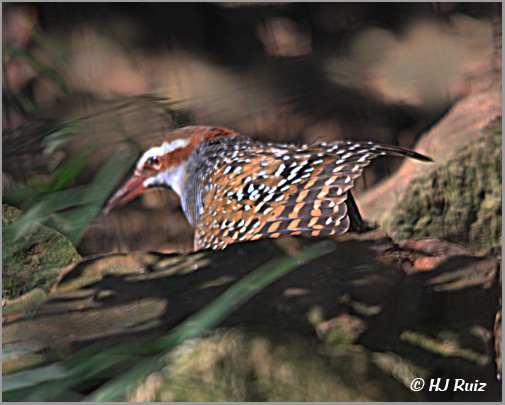
All photographs are © H.J. Ruiz – Avian101
Text is available under the Creative Commons Attribution-ShareAlike License; additional terms may apply. See Terms of use for details.
Share this:

Reddish Egret
Reddish Egret – Spec. Name: Egretta rufescens
This is a small heron. It is a resident breeder in Central America, The Bahamas, the Caribbean, the Gulf Coast of the United States, and Mexico. There is post-breeding dispersal to well north of the nesting range. In the past, this bird was a victim of the plume trade.
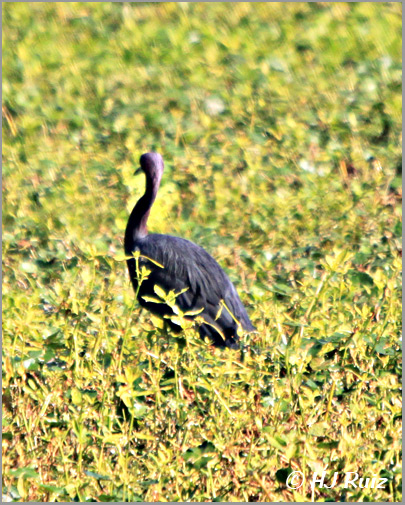
Reddish Egret
According to the Texas Parks and Wildlife Department (TPWD), there are only 1,500 to 2,000 nesting pairs of Reddish Egrets in the United States – and most of these are in Texas. They are classified as “threatened” in Texas and receive special protection.
This species reaches 68–82 cm (27–32 in) in length, with a 116–124 cm (46–49 in) wingspan. It is a medium-sized, long-legged, long-necked heron with a long pointed pinkish bill with a black tip. The legs and feet are bluish-black. The sexes are similar, but there are two color morphs. The adult dark morph has a slate blue body and reddish head and neck with shaggy plumes. The adult white morph has completely white body plumage. Young birds have a brown body, head, and neck. During mating, the males plumage stands out in a ruff on its head, neck and back.
The Reddish Egret is considered one of the most active herons, and is often seen on the move. It stalks its prey visually in shallow water far more actively than other herons and egrets, frequently running energetically and using the shadow of its wings to reduce glare on the water once it is in position to spear a fish; the result is a fascinating, graceful dance. It eats fish, frogs, crustaceans, and insects. The bird’s usual cry is a low, guttural croak.
Note from H.J. Ruiz:
The Reddish Egret displayed on this essay was photographed at Phinizy Swamp Nature Pk. near Augusta in Georgia. Indication that the species in question are migrating further North from the Gulf Coast of USA.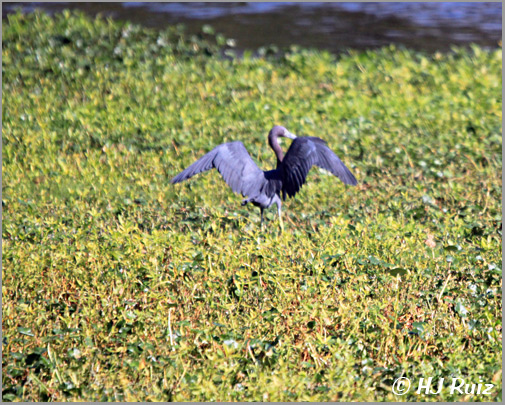
All photographs and part text are © H.J. Ruiz – Avian 101
Text is available under the Creative Commons Attribution-ShareAlike License; additional terms may apply. See Terms of use for details.
Share this:

Great Blue Heron – Video
This video you are about to see was the last seconds of recording before the tripod fell and the camera broke and went out of order. the location is High Falls State Park in Georgia. The bird is a Great Blue Heron.Video © H.J. Ruiz – Avian101
Share this:

Victoria Crowned Pigeon
Victoria Crowned Pigeon – Spec. Name: Goura victoria
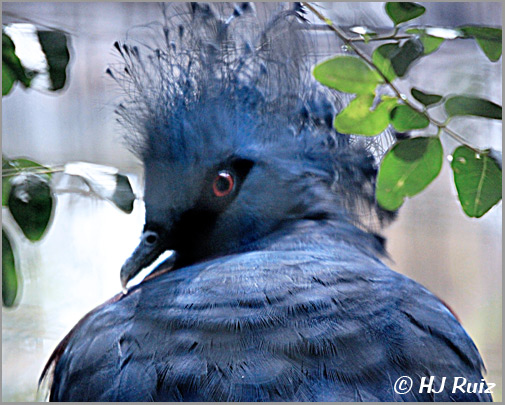
Victoria Crowned Pigeon
This is a large, bluish-grey pigeon with elegant blue lace-like crests, maroon breast and red iris. The bird may be easily recognized by the unique white tips on its crests. Both sexes are similar. It is on average 74 cm (29 in) long and weighs 2,384 grams (5.3 lbs). It is marginally larger than the other crowned pigeons on average and likely the largest species of pigeon of earth.
One of three superficially similar species of crowned pigeons (the others being the Western Crowned Pigeon and the Southern Crowned Pigeon), the Victoria Crowned Pigeon is distributed in the lowland and swamp forests of northern New Guinea and surrounding islands. Its diet consists mainly of fruits, figs, seeds and invertebrates. The female usually lays a single white egg.
The name commemorates the British monarch, Queen Victoria of the United Kingdom.
There are two subspecies of the Victoria Crowned Pigeon, Goura victoria victoria, the nominate race is the smaller of the two supspecies and can be found in Yapen, Biak & Supiori. Goura victoria beccarii is found on the mainland of New Guinea
Due to continuing habitat loss, being tame and easily hunted for its plumes and meat, the Victoria Crowned Pigeon is evaluated as Vulnerable on the IUCN Red List of Threatened Species.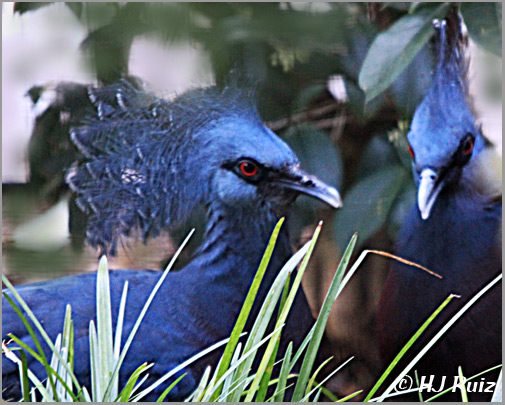
All photographs are © H.J. Ruiz – Avian101
Text is available under the Creative Commons Attribution-ShareAlike License; additional terms may apply. See Terms of use for details.
Share this:


Read Past Reviews

Book # 69

Quote from the Author
“A good chuckle is healthy, it helps you break the monotony of a serious life.” ~ H.J. Ruiz


You must be logged in to post a comment.