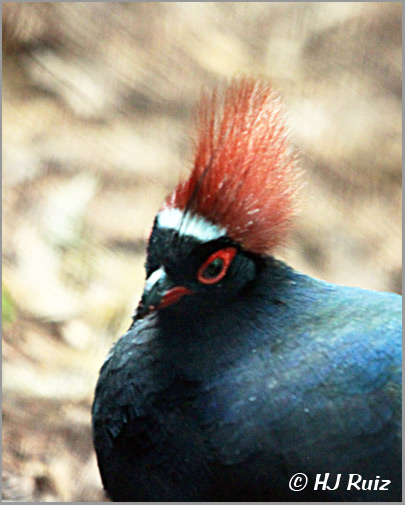
Crested Partridge
Crested Partridge – Rollulus rouloul
This bird is a.k.a. the Crested Wood Partridge, Roul-roul, Red-crowned Wood Partridge or Green Wood Partridgewhich is a gamebird in the pheasant family Phasianidae of the order Galliformes, gallinaceous birds. It is the only member of the genus Rollulus.
Crested Partridge
This small partridge is a resident breeder in lowland rainforests in south Burma, south Thailand, Malaysia, Sumatra and Borneo. Its nest is a ground scrape lined with leaves, which is concealed under a heap of leaf litter. Five or six white eggs are incubated for 18 days.
Unusually for a galliform species, the young are fed bill-to-bill by both parents instead of pecking from the ground, and although precocial, they roost in the nest while small.
Crested Partridge is a rotund short-tailed bird, 25cm in length, with the male marginally larger than the female. Both sexes have a scarlet patch of bare skin around the eye and red legs without a spur or hind toe.
The male is metallic green above with glossy dark blue underparts and a brownish wing panel. The head is adorned with a tall red crest, a white forehead spot and black frontal bristles. The female has pea-green body plumage apart from the brown wing coverts. She has a slate-grey head with the bristles but no spot or crest. The bill is all-dark. Young birds are duller versions of the adult of the same sex. The song is a mournful whistled si-ul.
The Crested Partridge is usually seen singly or in pairs as it uses its feet to probe the forest floor for fruit, seeds and invertebrates. When disturbed, it prefers to run but if necessary it flies a short distance on its rounded wings.
There is some concern about the effect of habitat destruction on this bird, especially with regard to logging.
However, it seems to be somewhat more adaptable than other southeast Asian pheasants. The Crested Wood Partridge is evaluated as Near Threatened on the IUCN Red List of Threatened Species. It is listed on Appendix III of CITES.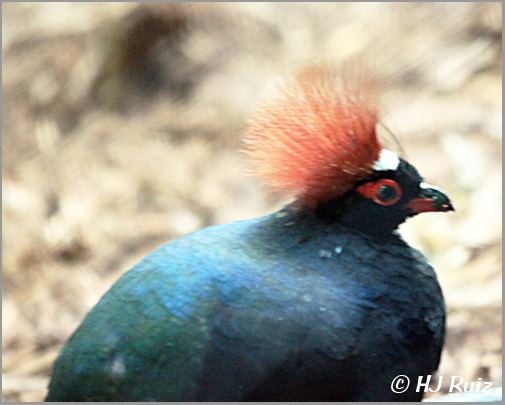
All photographs are © H.J. Ruiz – Avian 101
Text is available under the Creative Commons Attribution-ShareAlike License; additional terms may apply. See Terms of use for details.
Share this:

Weeds Are Vital to the Existence of Farmland Species
Weeds, which are widely deemed as a nuisance plant, are vital to the existence of many farmland species according to a new University of Hull study published in the journal Biological Conservation.
Since many weeds produce flowers and seed, they are an integral part of our ecosystem and together with other crop and non-crop seeds found on farms, they provide food for over 330 species of insects, birds and animals.
Scientists at the Universities of Hull and Bristol examined the distribution of berries and soil-surface seeds collected over an entire year. They built up the first picture of its kind showing which farmland habitats are the most important seed producers and how the seed resources change in different seasons.
Whilst considerable research has linked agricultural intensification with dramatic declines of seed-feeding birds, surprisingly little is known about the wider importance of seeds for other farmland animals, especially insects. Moreover, understanding the dynamics of farmland seed food resources for species of conservation concern is of considerable research interest.
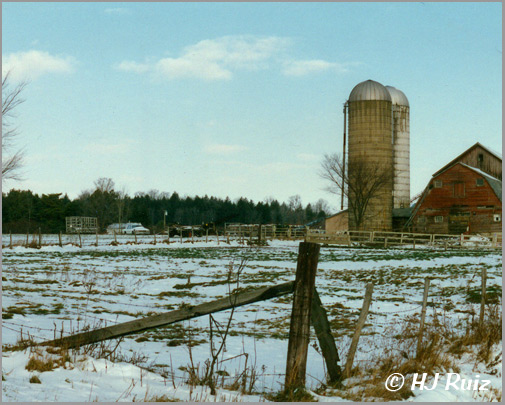
Farmland in Winter
The team of researchers created complex ‘food-webs’ which linked all farmland insects, birds and mammals which are known to feed on the seeds recorded on a typical organic farm. They used the food-web to identify the key seed-producing plants favoured by most animals. This enabled them to model the impacts of increasing farm management on seed resources and food-web interactions.
Dr Darren Evans, a lecturer in Conservation Biology at the University of Hull and who led the research said: “We understand a lot about farmland birds and mammals, but little about the plants and insects that underpin them. In this study, we discovered not only the importance of weed and non-crop species for many farmland animals but that the vast majority of seed-feeding animals on farms are insects, which are often overlooked by conservationists.”
The team of researchers converted seed counts into mass and energy estimates; they found that shed seeds and berries available on a single organic farm have can produce a staggering 560 gigajoules of energy.
Dr Evans added: “We show that an increase in farm management intensity can lead to a decline of up to 19% in overall seed biomass and energy, which is presumably why agricultural intensification causes many farmland birds to suffer a ‘hunger-gap’ in mid-winter. Non-farmed habitats such as woodlands and hedgerows are important for seed resources, but we also show that some farmed areas are too.”
The team predicted that increased farming intensity can have large cascading effects throughout an entire ecosystem, which can indirectly affect animals associated with the seeds.
The scientists conclude that farmers can maintain or enhance biodiversity by appropriately managing uncultivated, semi-natural habitats such as hedgerows and woodlands but that even small changes to cropped areas, such as allowing some weed species to grow, could have a huge impact on the quantity and variety of seeds available on the farm and the animals that feed on them. They suggest that rather than focussing limited conservation resources on a small number of charismatic species such as birds, an alternative approach is to understand and manage the complex network of species interactions on farms and to explore ways of incorporating this into policy.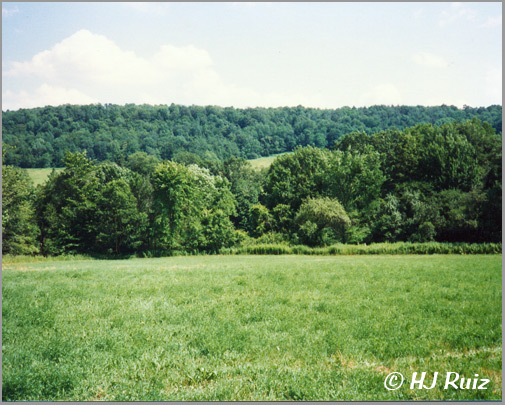
All photographs are © H.J. Ruiz – Avian101
The above story is reprinted (with editorial adaptations by ScienceDaily staff) from materials provided by University of Hull
Share this:

Violet-backed Starling
Violet-backed Starling – Spec. Name: Cinnyricinclus leucogaster
This is a sub-Saharan African bird that belongs to the Sturnidae bird family group which includes birds such as Starlings, Mynans, Oxpeckers.
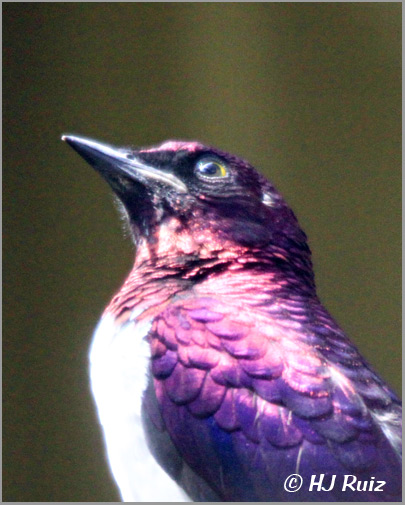
Violet-backed Starling
The Violet-backed Starling has a height of approximately 18 cms and weighs around 45 gms. The head is colored purple while the bill is colored black. The Violet-backed Starling has white breast down to the under-tail, a purple colored throat, black legs and a purple coloured back. The eyes are brown.
The Violet-backed Starling is strongly sexually dimorphic.
This bird forages for food on the ground, also attacks its prey aerially and feeds while flying or takes the prey to a safe place and then proceeds to eat.
This bird eats insects such as butterflies, bees, wasps, locusts and ants.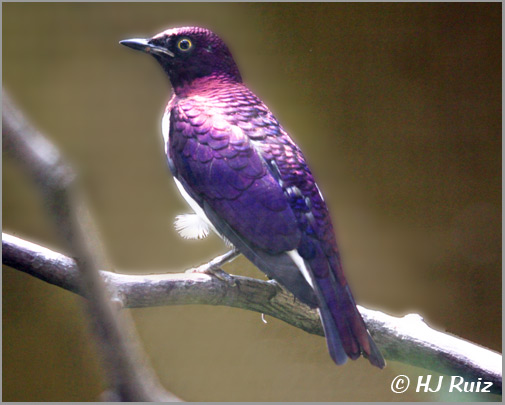
All photographs and text are © H.J. Ruiz – Avian 101
Share this:

Spectacled Owl
Spectacled Owl – Spec. Name: Pulsatrix perspicillata
This is a large tropical owl. It is a resident breeder from southern Mexico and Trinidad south to southern Brazil, Paraguay and northwestern Argentina. There are six subspecies.
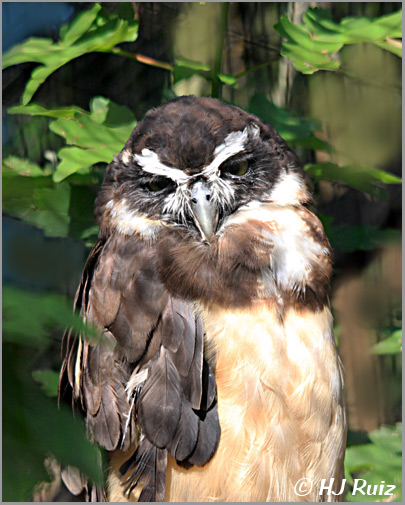
Spectacled Owl
The Spectacled Owl is 46 cm (18 in.) long and weighs 850 g (1.9 lbs). It is unmistakable with brown upperparts, head and upper breast, white facial markings and buff underparts. The eyes are yellow and the beak is pale. The juvenile is even more distinctive than the adult, being completely white apart from a chocolate brown facial disc.
The Spectacled Owl is a nocturnal species of mature forests. It nests in an unlined tree cavity, laying two white eggs. It preys on mammals, even the much larger three-toed sloth, large insects, and birds, including smaller owls. The call is a deep hooting BOO Boo boo boo boo becoming softer and faster.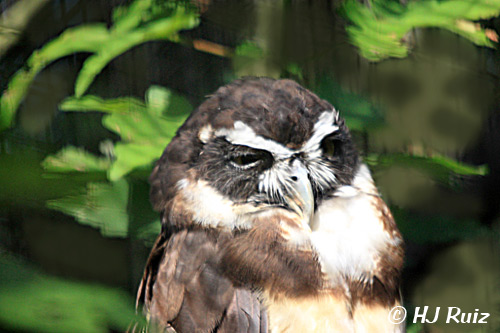
All photographs are © H.J. Ruiz – Avian 101
Text is available under the Creative Commons Attribution-ShareAlike License; additional terms may apply. See Terms of use for details.
Share this:


Read Past Reviews

Book # 69

Quote from the Author
“A good chuckle is healthy, it helps you break the monotony of a serious life.” ~ H.J. Ruiz


You must be logged in to post a comment.