
Red-billed Hornbill
Red-billed Hornbill – Spec. Name: Tockus erythrorhynchus
This is a relatively small species of hornbill found in savanna and woodland of sub-Saharan Africa. It is sometimes split into five species, the Northern Red-billed Hornbill (T. erythrorhynchus), Western Red-billed Hornbill (T. kempi), Tanzania Red-billed Hornbill (T. ruahae), Southern Red-billed Hornbill (T. rufirostris) and Damara Red-billed Hornbill (T. damarensis), but at present most authorities considered them all to be subspecies of a single species.
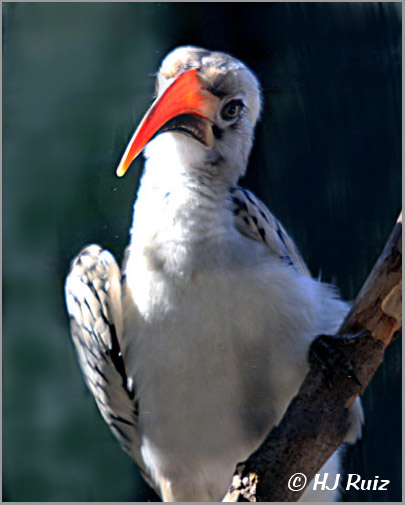
Red-billed Hornbill
This conspicuous bird has mainly whitish underparts and head, and grey upperparts. It has a long tail and a long and curved red bill which lacks a casque. Sexes are similar, but the female has a smaller bill. It is a large bird, at 42 cm long, but is one of the smaller hornbills. It advertises its presence with its noisy accelerating tok-tok-tok-toktoktok call.
During incubation, the female lays three to six white eggs in a tree hole, which is blocked off with a plaster of mud, droppings and fruit pulp. 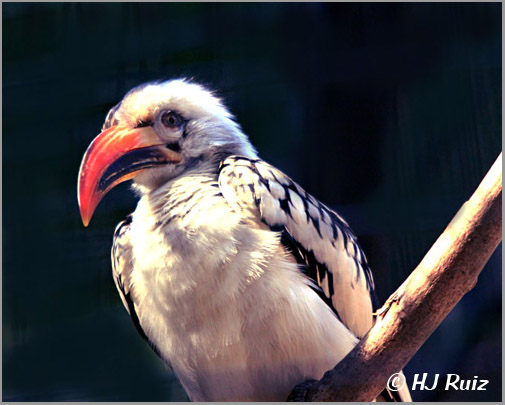 There is only one narrow aperture, just big enough for the male to transfer food to the mother and the chicks. When the chicks and the female are too big to fit in the nest, the mother breaks out and rebuilds the wall, then both parents feed the chicks.
This species is omnivorous, taking insects, fruit and seeds. It feeds mainly on the ground and will form flocks outside the breeding season.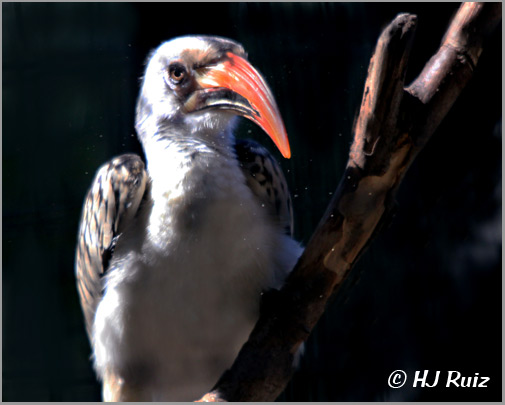
All photographs are © H.J. Ruiz – Avian 101
Text is available under the Creative Commons Attribution-ShareAlike License; additional terms may apply. See Terms of use for details.
Share this:

Testing my new camera! What a day!
I did some shooting in my backyard with my Canon 60D that I bought to replace my broken Canon 500D T1i. Why didn’t I go somewhere else? Because I had a sore throat and had some pain to talk or swallow. My grandson Tyler has a chest cold and I think he’s so good that he’s sharing it with me. 🙂
Anyway, I was getting familiar with the new camera so I decided to just walk around the house looking for subjects and use the camera. Originally I set the camera with a Canon 18-55 mm IS lens and I saw some insects flying around the flowers. With the short lens I had to get closer to the subjects to get good focus and depth, and what did I get?
I got stung by one smaller bug on the neck! 🙂
I applied some medicated spray to numb the affected area and that helped.
To avoid getting to close to the flying insects I went home and switched lens to a Canon 55-250 mm IS that would give me some distance from those nasty bugs. Actually there wasn’t much to shoot so I did what I could.
What you will see next are some samples of what I shot:

Meet my grandson Tyler


All photographs are © H.J. Ruiz – Avian 101
Share this:

Hybrid Goose
While I was at High Falls State Park shooting pictures I took a short hike to the lake. Once there I saw a large group of large birds swimming near the edge of the lake. At first look I thought they all were Canada Geese, but when getting closer I immediately noticed that some of the birds were different, not all were Canada Geese. I got to an elevated position for better shot angle. Through the zoom lens I was able to see in full detail what appears to be Hybrid Geese. However, I haven’t been able to identify what kind of hybrid these are!.
That brings me to ask you a question my dear reader:
Do you know what mix of geese would result in the hybrid birds shown below?
I’d be very happy if anyone can tell me the answer. 🙂


 All photographs are © H.J. Ruiz – Avian 101
Share this:

Yellow-bellied Flycatcher – Video
Another wonderful video shot by Lang Elliott. Enjoy it!
Share this:


Read Past Reviews

Book # 69

Quote from the Author
“A good chuckle is healthy, it helps you break the monotony of a serious life.” ~ H.J. Ruiz


You must be logged in to post a comment.