Bird Anatomy – Part 3
Reproduction System
Although most male birds have no external sex organs, the male does have two testes which become hundreds of times larger during the breeding season to produce sperm. The testes in male birds are generally asymmetric with most birds having a larger left testis. Female birds in most families have only one functional ovary (the left one), connected to an oviduct – although two ovaries are present in the embryonic stage of each female bird. Some species of birds have two functional ovaries, and the order Apterygiformes always retain both ovaries.
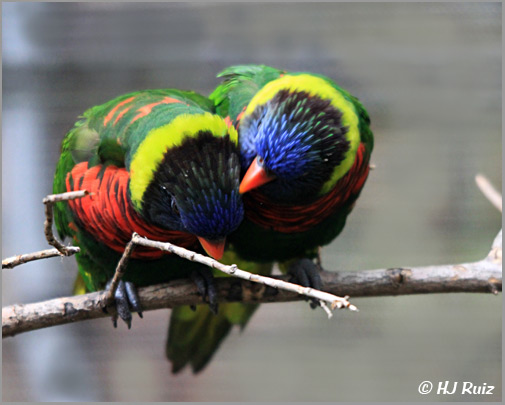
Lorikeet couple
In the males of species without a phallus (see below), sperm is stored in the semenal glomera within the cloacal protuberance prior to copulation. During copulation, the female moves her tail to the side and the male either mounts the female from behind or in front (in the stitchbird), or moves very close to her. The cloacae then touch, so that the sperm can enter the female’s reproductive tract. This can happen very fast, sometimes in less than half a second.
The sperm is stored in the female’s sperm storage tubules for a week to more than a 100 days, depending on the species. Then, eggs will be fertilized individually as they leave the ovaries, before being laid by the female. The eggs continue their development outside the female body.
Many waterfowl and some other birds, such as the ostrich and turkey, possess a phallus. The length is thought to be related to sperm competition. When not copulating, it is hidden within the proctodeum compartment within the cloaca, just inside the vent.
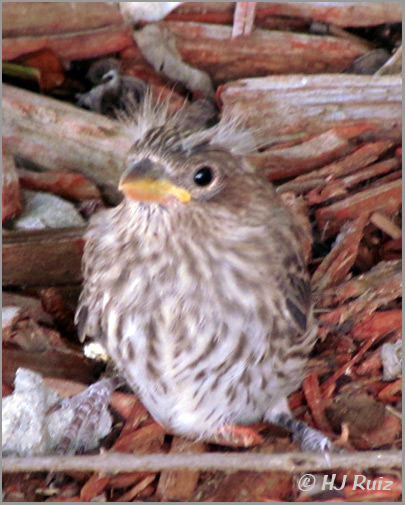
Fledging House Finch
After the eggs hatch, parents provide varying degrees of care in terms of food and protection. Precocial birds can care for themselves independently within minutes of hatching; altricial hatchlings are helpless, blind, and naked, and require extended parental care. The chicks of many ground-nesting birds such as partridges and waders are often able to run virtually immediately after hatching; such birds are referred to as nidifugous. The young of hole-nesters, on the other hand, are often totally incapable of unassisted survival. The process whereby a chick acquires feathers until it can fly is called “fledging”.
Some birds, such as pigeons, geese, and Red-crowned Cranes, remain with their mates for life and may produce offspring on a regular basis.
All photographs are © H.J. Ruiz – Avian 101
Share this:

Green Wood-Hoopoe
Green Wood Hoopoe – Spec. Name: Phoeniculus purpureus
This is a large, up to 44cm long, near-passerine tropical bird native to Africa. It is a member of the family Phoeniculidae, the wood hoopoes, and is formally known as the Red-billed Wood Hoopoe.
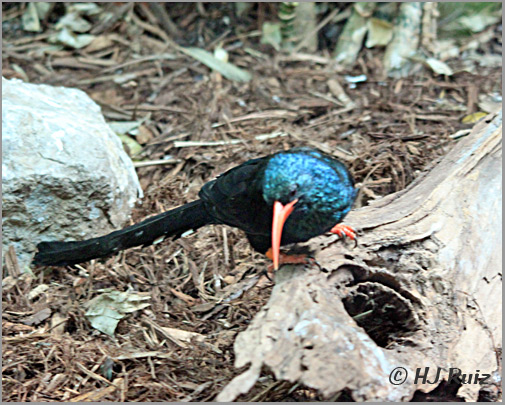
Green Wood-Hoopoe
The Green Wood Hoopoe is a common resident breeder in the forests, woodlands and suburban gardens of most of sub-Saharan Africa. They are found in groups of up to a dozen or so birds with only one breeding pair. The breeding female lays two to four blue eggs in a natural tree hole or old barbet nest and incubates for about 18 days. Upon hatching, she and the nestlings are fed by the rest of the group, even after they have fledged and left the nest hole. This species is parasitised by the Greater and Lesser Honeyguide.
This abundant species is a metallic dark green, with a purple back and very long diamond-shaped purple tail. Distinctive white markings on the wings and white chevrons on the tail edges make it easily identifiable, as does its long thin curved red bill. Sexes are similar, but immatures have a black bill.
The Green Wood Hoopoe is an insect-eating species. It feeds mainly on the ground, termite mounds, or on tree trunks, and will form flocks outside the breeding season. Its specialised claws enable it to easily cling to the underside of branches while closely inspecting the bark for insects.
This conspicuous bird also advertises its presence with its loud Kuk-uk-uk-uk-uk call and other vocalisations.
Widespread and common throughout its large range, the Green Wood Hoopoe is evaluated as Least Concern on the IUCN Red List of Threatened Species.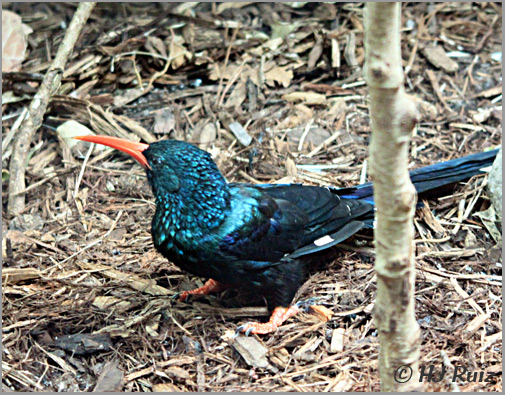
All photographs are © H.J. Ruiz – Avian 101
Text is available under the Creative Commons Attribution-ShareAlike License; additional terms may apply. See Terms of use for details.
Share this:

Song Sparrow Portrait – Video
One more time Lang Elliott does his magical video. He gives us a clear view and sound of a Song Sparrow.
Share this:

This Time of the Year
Yesterday morning we had the first frosted morning of this year! Leaves are falling at a faster rate now with the temperature going low. I always hope to have a slow and gradual Autumn because I love to see the foliage change colors for a longer period of time. I don’t see many birds going to the feeders lately. I know that many species have already began to migrate and the ones that stay local are making preparations to have a safer and warmer shelter or nest. For me is time to start planning my future trips and also do my artist work. I do oil paintings, charcoal and graphite drawings.
One of my projects to travel might be, going to Florida for a few days to see my cousin in Sarasota where he lives and will be having surgery on November. I will be drive with Lucy and Tyler. Later, after our visit we will continue south to Ft. Myers area and visit all the Preserve Parks and Islands. There I’ll see some migratory birds and many wading and beach species.
For a longer trip I have in mind going to Costa Rica for a few days, I still have to convince Lucy to go with me and Tyler. Since we have Tyler living with us we are kind of limited when it comes to traveling. Tyler is only 17 months old and needs a lot of care, this factor makes traveling a bit harder to handle but not impossible. Now we need to get Tyler used to be in a car for longer periods of time without getting bored or getting fastidious. I want to take a drive to Savannah shortly to see how he will behave for more than 5 hours drive. We have tried up to three hours and it wasn’t too bad.
Other Projects for next year
There’s a possibility to go to Prague next year with a group of my wife’s friends. Then another trip that has more contingency:
One month in Peru (1800 species registered), I’ve been reading about different areas supposedly to very interesting there for migratory birds and many locals species, these areas are different that the ones I’ve been before. I’m planning to meet with a relative of mine there, he’s also retired and although a beginner in digital photography he’s very interested in nature. Our plan would be to visit allthe locations mentioned, if we can. If I could achieve all that I planned, I’d be a happy camper! 🙂 Here I have some samples from my backyard:
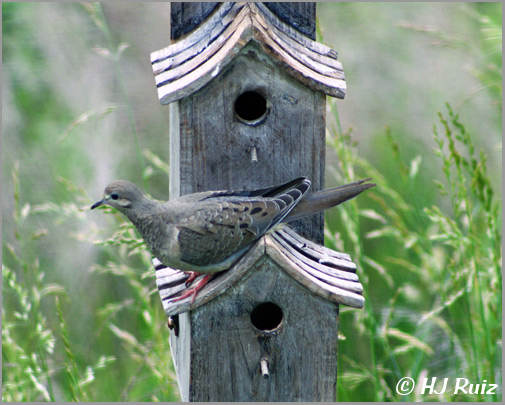
Mourning Dove - Canon 20D - f/5.6 - 1/100 - ISO400

Red-winged Blackbird (F) - Cannon 20D - f/5.6 - 1/250 - ISO400
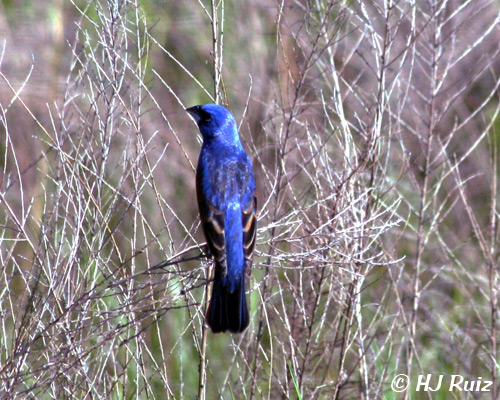
Blue Grosbeak - Canon 20D - f/9.0 - 1/500 - ISO200
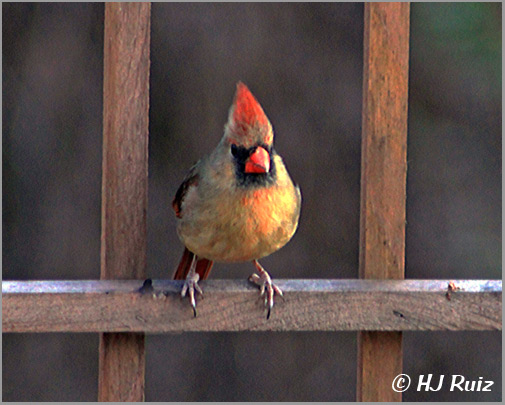
Northern Cardinal (F) - Canon 20D - f/5.6 - 1/200 - ISO800
All photographs are © H.J. Ruiz – Avian 101
Share this:


Read Past Reviews

Book # 69

Quote from the Author
“A good chuckle is healthy, it helps you break the monotony of a serious life.” ~ H.J. Ruiz


You must be logged in to post a comment.