Tricolored Heron
Tricolored Heron a.k.a. Louisiana Heron – Spec. Name: Egretta tricolor
This is a small heron. It is a resident breeder from the Gulf states of the USA and northern Mexico south through Central America and the Caribbean to central Brazil and Peru. There is some post-breeding dispersal to well north of the nesting range.
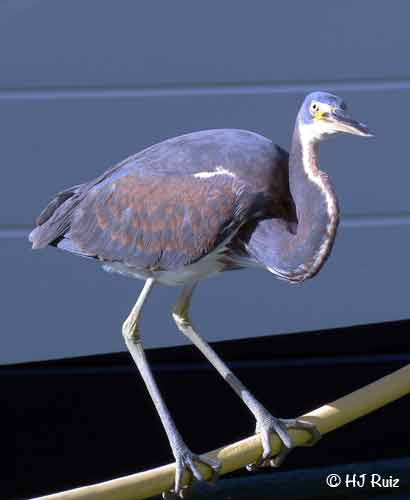
Tricolored Heron
Tricolored Heron’s breeding habitat is sub-tropical swamps. It nests in colonies, often with other herons, usually on platforms of sticks in trees or shrubs. In each clutch, 3–7 eggs are typically laid.
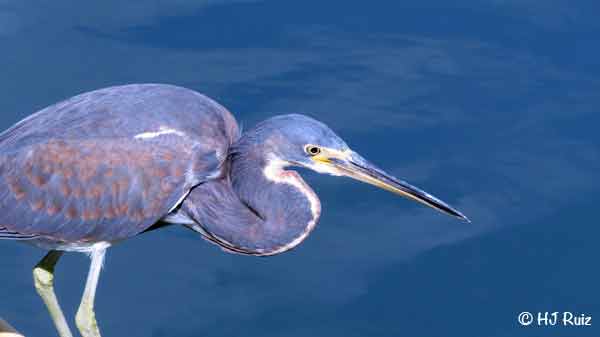
This species is about 56 cm (22 in) long, with a 96 cm (38 in) wingspan and weighs 350 g (12 oz). It is a medium-large, long-legged, long-necked heron with a long pointed yellowish or grayish bill with a black tip. The legs and feet are dark.
Adults have a blue-grey head, neck, back and upper wings, with a white line along the neck. The belly is white. In breeding plumage, they have long blue filamentous plumes on the head and neck, and buff ones on the back.
Tricolored Heron stalks its prey in shallow or deeper water, often running as it does so. It eats fish, crustaceans, reptiles, and insects.

All photographs are © H.J. Ruiz – Avian 101
Text is available under the Creative Commons Attribution-ShareAlike License; additional terms may apply. See Terms of use for details.
Share this:

Land Acquisition in Ecuador…
Will Help Conserve Rare Parakeet and Other Endangered Species
A critical, 318-acre parcel of land in southwestern Ecuador has been acquired as part of the Buenaventura Reserve, and will help protect the globally endangered El Oro Parakeet – a bird that appears to number fewer than 1,000 individuals in the wild.
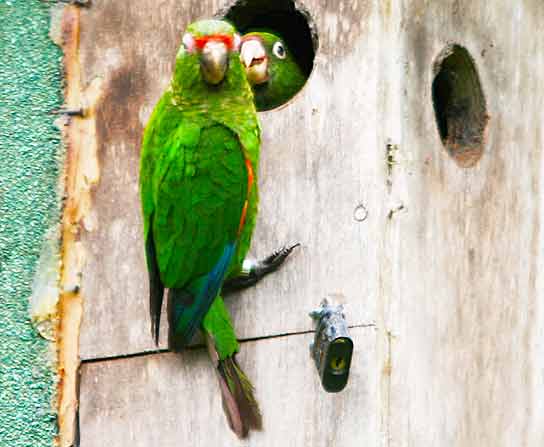
El Oro Parakeet and chick in the Buenaventura Reserve © Benjamin Skolnik
The new acquisition, called the Dianita property, has become part of the 4,000-acre (1,630-hectare) private reserve that is owned and managed by Fundación Jocotoco, the leading bird conservation organization in Ecuador. The purchase was made possible through the efforts of American Bird Conservancy (ABC), Robert Wilson, World Land Trust, World Land Trust US, and the Danish Ornithological Society. The Reserve protects no fewer than 15 globally threatened species, and is the most important single site for the endemic and Endangered El Oro Parakeet and the Ecuadorian Tapaculo.
There are only about 1000 El Oro Parakeets in the wild, and the reserve is home to about one-fifth of them. Fortunately, those numbers have been steadily increasing as a result of a successful conservation campaign that includes the provision of nest boxes to supplement the scarcity of suitable nest-trees,” says Zoltan Waliczky, Jocotoco’s Executive Director. The Buenaventura Reserve, in the heart of the El Oro Parakeet’s range in southwestern Ecuador, protects the largest remnant patch of a unique ecosystem that combines elements of tropical wet and dry forests. As little as 5% of this forest, which once spanned northern Peru and parts of the Ecuadorian Coast, may now remain. What is left is threatened by ongoing habitat destruction for agriculture and cattle pasture, making the Reserve vital for the conservation of the rare, endemic birds of the region. The Reserve had been separated into two parts, but these are now connected by the Dianita property, making it an extremely important purchase.
The newly acquired land is 70% cattle pasture, and will need to be restored. Fortunately, Fundación Jocotoco, with help from ABC and other partners have become adept at reforestation of degraded habitat. In the last three years, Jocotoco has planted more than 40,000 trees in Buenaventura Reserve alone, and over 600,000 plants in their network of eight private reserves, thanks to support from World Land Trust and the U. S. Fish & Wildlife Service.In addition to the El Oro Parakeet and Ecuadorian Tapaculo, the Reserve also protects a stronghold site for the endangered Gray-backed Hawk. This species is typically found only in pairs, but is commonly observed in greater numbers in the Reserve. Other threatened species of interest are the Rufous-headed Chachalaca, Long-wattled Umbrellabird, Red-masked Parakeet, and Pacific Royal Flycatcher. More than 330 species of birds have been recorded at Buenaventura, of which at least 12 are classified as globally threatened; another 34 species are local endemics.
The Reserve also hosts tourists from around the world at the comfortable Umbrellabird Lodge, which is located less than an hour from the airport in Santa Rosa. A well-developed trail system and several bird feeders that attract numerous hummingbirds and songbirds make wildlife observation easy and enjoyable. Buenaventura is part of the Conservation Birding initiative (www.conservationbirding.org), where any funds spent are reinvested into the operational costs of the reserve, assuring long-term conservation of the exquisite plants and animals found there.
The Jocotoco Conservation Foundation was established in 1998 to protect the habitat of globally threatened species of birds in the Andes of Ecuador, together with all associated biodiversity. It also carries out habitat restoration for this purpose, by replanting deforested areas with native trees and shrubs.
American Bird Conservancy (ABC) is a 501(c)(3) not-for-profit membership organization whose mission is to conserve native birds and their habitats throughout the Americas. ABC acts by safeguarding the rarest species, conserving and restoring habitats, and reducing threats, while building capacity in the bird conservation movement.
Share this:

Still thinking about my past vacation
Now that I’m back from Florida I find myself making comparisons in my mind: While being in Florida I had birds galore every day that I could photograph, all these under a bright and warm sunny day. Then, I’m here at home, looking out the window to a dull-gray, rainy day and believe me when I say that I haven’t seen a single bird in days.:(
This is how everybody feels after going on vacation to a beautiful or interesting place far from home and then you have to return home and you feel that you needed a longer vacation. It’s never going to be long enough!
I’m already looking at other places for possible visits.
I got some pictures for you:
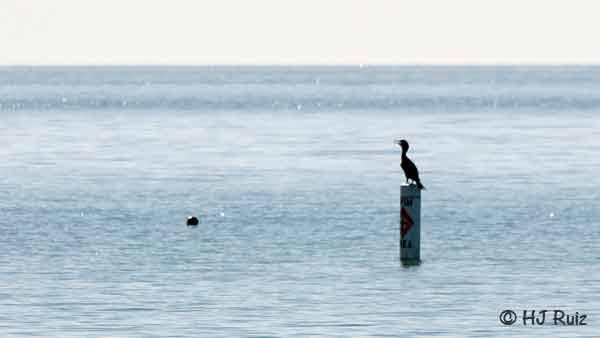
Cormorant drying out the feathers
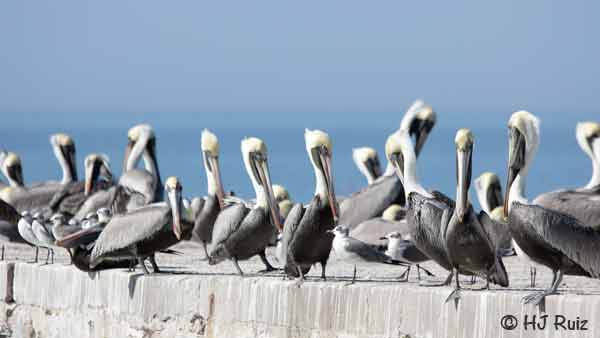
Group of Brown Pelicans enjoying the sun
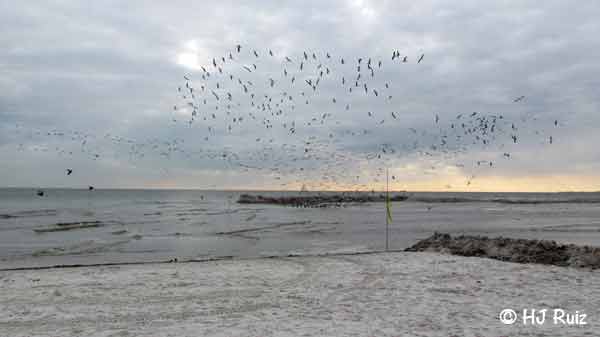
Flock of Black Skimmers flying at sunset

Snowy Egret fishing at sunset
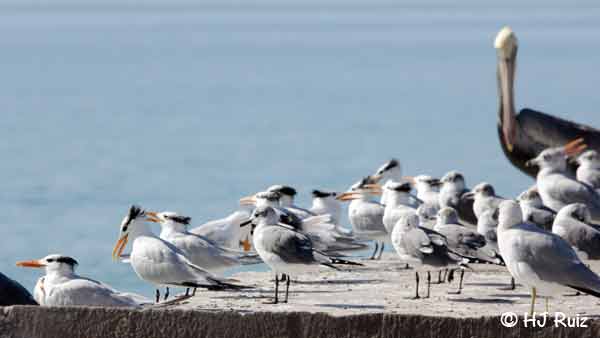
Mixed group of friends: Royal Terns, Laughing Gulls and Brown Pelican
All photographs are © H.J. Ruiz – Avian 101
Share this:

Willet
Willet – Spec. Name: Tringa semipalmata
Formerly in the monotypic genus Catoptrophorus as Catoptrophorus semipalmatus, is a large shorebird in the sandpiper family. It is a good-sized and stout scolopacid, the largest of the shanks. Its closest relative is the Lesser Yellowlegs, a much smaller bird with a very different appearance apart from the fine, clear, and dense pattern of the neck, which both species show in breeding plumage.
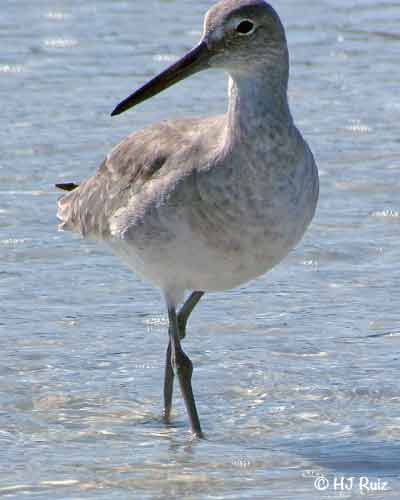
Willet
Adults have gray legs and a long, straight, dark and stout bill. The body is dark gray above and light underneath. The tail is white with a dark band at the end. The distinctive black and white pattern of the wings is a common sight along many North American coastal beaches.
Two subspecies (which may actually be different species)[3] have very different breeding habitats and ranges. The Eastern Willet breeds in coastal saltmarshes from Nova Scotia to Mexico and the Caribbean. It winters on the Atlantic coast of South America. The Western Willet breeds in freshwater prairie marshes in western North America. It winters on both coasts, from the mid-Atlantic states south to at least Brazil on the Atlantic, and from Oregon south to Peru on the Pacific.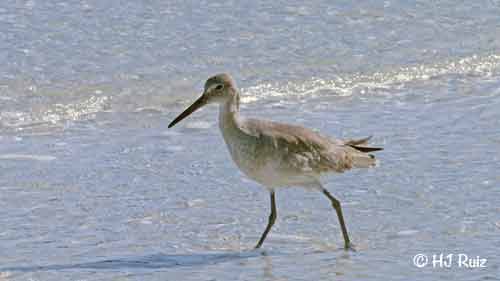
Willets nest on the ground, usually in well-hidden locations in short grass, often in colonies. These birds forage on mudflats or in shallow water, probing or picking up food by sight. They mainly eat insects, crustaceans and marine worms, but also eat some plant material.
The Willet’s population declined sharply due to hunting in the late nineteenth and early twentieth centuries. Their population has since increased, but they are still considered at risk, especially in light of continued habitat loss.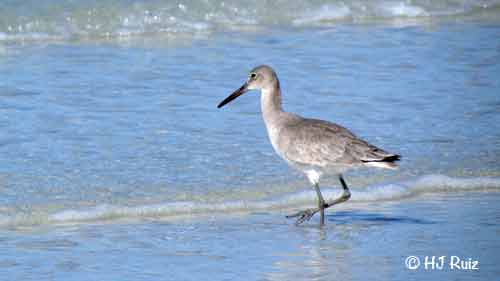
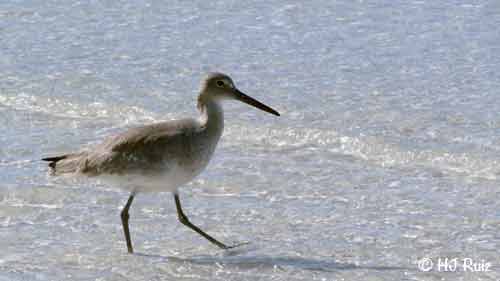
All photographs are © H.J. Ruiz – Avian 101
Text is available under the Creative Commons Attribution-ShareAlike License; additional terms may apply. See Terms of use for details.
Share this:


Read Past Reviews

Book # 69

Quote from the Author
“A good chuckle is healthy, it helps you break the monotony of a serious life.” ~ H.J. Ruiz


You must be logged in to post a comment.