Good Photography in Florida
While I was in Florida I had the opportunity to photograph 24 different species from which 7 of them were “lifers”. I was very happy to have gone to the places I went.
Do you know what helps a lot? When you see somebody watching you shoot, go ask them if they like birds and then ask them where have they seen the most birds locally. They immediately will give you directions and you can be surprised with what you find. Contrary to when I followed some tips from other photographers and got bubkes!
At the shore I was more savvy because I found out that part of the beach was being dredged and there I went. I bet you that you haven’t see so many birds together in your life! Why there were so many? When they dredge sand they also pick up millions of small organisims such us mollusks,plankton, worms, ova etc. which is food for many fish and birds. The fish come to feed as well as the birds.
In conclusion, my trip was in many way perfect. Starting by seeing my cousin feeling well after surgery, being at the beach with Lucy and Tyler. By the way Tyler was elated with the beach, chasing the ripples on the water and digging holes in the wet sand and splashing water all over. Later I had to drag him out from the beach. He was happy! 🙂 Us too!
I could have days like these all the time and live happy!

Boat-tailed Grackles

Sandhill Crane

Flock of Black Skimmers

Red-bellied Woodpecker

Black Skimmers on sand bank

Green Heron

Snowy Egret fishing
All photographs are © H.J. Ruiz – Avian 101
Share this:

Black Skimmer
Black Skimmer – Spec. Name: Rynchops niger,
This is a tern-like seabird, one of three very similar birds species in the skimmer family. It breeds in North and South America. Northern populations winter in the warmer waters of the Caribbean and the tropical and subtropical Pacific coasts, but the South American races make only shorter movements in response to annual floods which extend their feeding areas in the river shallows.

Black Skimmer
The Black Skimmer breeds in loose groups on sandbanks and sandy beaches in the Americas, the three to seven heavily dark-blotched buff or bluish eggs being incubated by both the male and female. The chicks leave the nest as soon as they hatch and lie inconspicuously in the nest depression or “scrape” where they are shaded from high temperatures by the parents. They may dig their own depressions in the sand at times. Parents feed the young almost exclusively during the day with almost no feeding occurring at night, due to the entire population of adults sometimes departing the colony to forage. Although the mandibles are of equal length at hatching, they rapidly become unequal during fledging.
The Black Skimmer is the largest of the three skimmer species. It measures 40–50 cm (16–20 in) long with a 107–127 cm (42–50 in) wingspan. This species ranges from 212 to 447 g (7.5 to 15.8 oz), with males averaging about 349 g (12.3 oz), as compared to the smaller female’s 254 g (9.0 oz). The basal half of the bill is red, the rest mainly black, and the lower mandible is much-elongated. The eye has a dark brown iris and catlike vertical pupil, unique for a bird. The legs are red. The call is a barking kak-kak-kak.

Black Skimmers in Flight
Adults in breeding plumage have a black crown, nape and upper body. The forehead and underparts are white. The upper wings are black with white on the rear edge, and the tail and rump are dark grey with white edges. The underwing colour varies from white to dusky grey depending on region.
Non-breeding adults have paler and browner upper parts, and a white nape collar. Immature birds have brown upper parts with white feather tips and fringes. The underparts and forehead are white, and the underwings as the adult.
The Black Skimmer has three subspecies:
- Migratory R. n. niger breeds on the Atlantic coast of North America, and from southern California to Ecuador in the Pacific.
- R. n. cinerescens is larger, has dusky underwings, and only a narrow white fringe to its black tail, and breeds in northern and northeastern South America and the Amazon basin.
- R. n. intercedens occurs on the rest of the Atlantic coast of South America south to central Argentina.
Skimmers have a light graceful flight, with steady beats of their long wings. They feed usually in large flocks, flying low over the water surface with the lower mandible skimming the water (in order of importance) for small fish, insects, crustaceans and mollusks caught by touch by day or especially at night. They spend much time loafing gregariously on sandbars in the rivers, coasts and lagoons they frequent.
All photographs are © H.J. Ruiz – Avian 101
Text is available under the Creative Commons Attribution-ShareAlike License; additional terms may apply. See Terms of use for details.
Share this:

First U.S. Predator-proof Fence Delivers on Promises
“Important Seabird Species in Hawaii Producing Chicks in Record Numbers!”
The first predator proof fence in the United States is producing dramatic results that may eventually lead to a resurgence in decimated seabird populations in Hawai’i. The Wedge-tailed Shearwater, which nests in the remote coastal dunes on the now-fenced Kaʻena Point at the northwestern tip of O’ahu, has produced the highest number of chicks since the annual survey began in 1994.
“This is extraordinary news. It has been only eight months since the predator-proof fence was installed and already, we are seeing results. This year’s chick count of 1775 is a 14% percent increase over the previous high count in 2007 and the highest number ever recorded at the point. So far, the fence has done a great job of preventing bird predation by rats, cats, mongoose, dogs, and even mice,” said Dr. George Wallace, Vice President for Oceans and Islands at American Bird Conservancy (ABC), the leading bird conservation group in the United States.

Wedge-tailed Shearwater - © George Wallace
The project has been a cooperative effort involving Hawai’i’s Department of Land and Natural Resources (DLNR), the U.S. Fish and Wildlife Service, the Hawai’i chapter of The Wildlife Society, and local communities.
“We are very excited to be moving into the next phase of the project now that the native species are able to exist without predation pressure and we can begin active restoration of the native species. We hope this is the first of many projects like this in Hawai’i” said Lindsay Young, the project coordinator with Pacific Rim Conservation.
Ground-nesting seabirds in the area, which also include the Laysan Albatross, have been targets of predation by introduced mammals, with the result that up to 15% of chicks are killed each year. The predators have especially preyed on the young birds before they can fly, but they also eat seabird eggs and even attack adult birds. Despite intensive efforts to control these predators, they still pose a major threat to the survival of native species. The full moons in October and November often bring particularly devastating attacks on the Wedge-tailed Shearwater chicks as they leave their burrows for the first time at night and become vulnerable to predators roaming the area.
| Access to the area for people was not changed due to this fence. People continue to visit Ka’ena Point Natural Area Reserve for fishing, hiking, bicycling, and other recreational and educational activities, entering through unlocked gates. To minimize the opportunity for predator incursion, a double-door system was employed where both doors cannot be open at the same time. Instead, a person accessing the Reserve must wait for the first door to close before the second door may be opened. The doorway area will be large enough to fit up to nine people or one person with a bicycle or fishing pole.In addition to the shearwaters, native plants such as the endangered ’ohai and other coastal strand vegetation are benefiting from removal of rats and mice which eat flowers, seed pods, and seedlings. Native species are being monitored to document the effects that the removal of predators will have.American Bird Conservancy (ABC) is a 501(c)(3) not-for-profit membership organization whose mission is to conserve native birds and their habitats throughout the Americas. ABC acts by safeguarding the rarest species, conserving and restoring habitats, and reducing threats, while building capacity in the bird conservation movement. |
Share this:

Royal Tern
Royal Tern – Spec. Name: Thalasseus maximus,
This is a seabird in the tern family Sternidae. This bird has two distinctive subspecies. T. m. maximus breeds on the Atlantic and Pacific coasts of the southern USA and Mexico into the Caribbean. The slightly smaller T. m. albididorsalisbreeds in coastal west Africa.
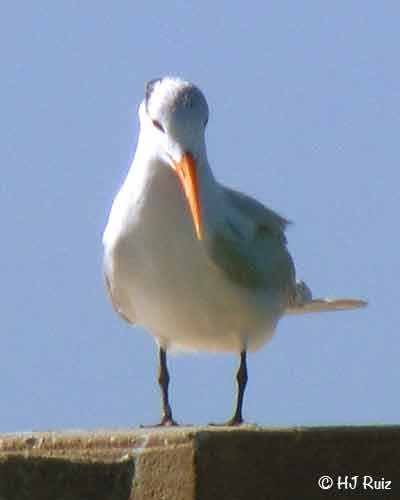
Royal Tern
This is a large tern, second only to Caspian Tern but is unlikely to be confused with the carrot-billed giant, which has extensive dark underwing patches. The Royal Tern has an orange-red bill, pale grey upperparts and white underparts. Its legs are black. In winter, the black cap becomes patchy. Juvenile Royal Terns are similar to non breeding adults. Differences include juveniles having black sploched wings and a yellower bill. An adult Royal Tern has an average wingspan of 130 cm, for both sexes, but their wingspan can range from 125–135 cm. The Royal Tern’s length ranges from 45–50 cm. and their average weight is anywhere from 350-450 grams.
The calls of the Royal Tern are usually short, clear shrills. Some of the shrills sound like kree or tsirr; the Royal Tern also has a more plover like whistle that is longer, rolling and is more melodious.
In various parts of its range, the Royal Tern could be confused with Elegant Tern, Lesser Crested Tern (the other orange-billed terns), and the Great Crested Tern. It is paler above than Lesser Crested Tern and the yellow-billed Great Crested Tern. Elegant Tern has a longer more curved bill and shows more white on the forehead in winter.
American birds migrate south to Peru and Argentina for the winter to escape the cold weather. African breeders move both north and south from the breeding colonies. African birds may reach as far north as Spain. This species has also wandered to western Europe as a rare vagrant, these records probably being from the American colonies.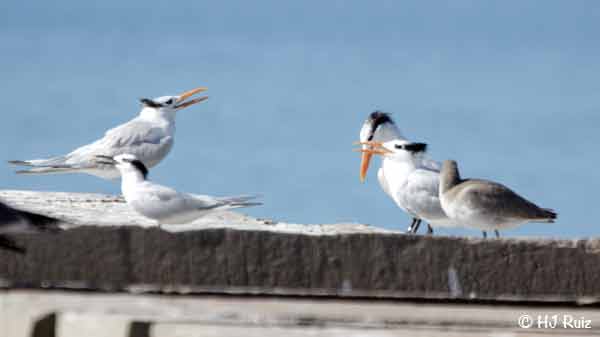
The appearance of apparent Elegant Terns in European waters means that records of Royal and Elegant Terns will need to be re-evaluated, since the latter species was thought an improbable migrant to the area.
The Royal Tern usually feeds on small fish like anchovies, weakfish, silversides, and croakers. Fish are the main source of food for the Royal Tern but they also been found eating insects and shrimps.
The Royal Tern feeds by diving into the water from heights near 30 feet. The Royal Tern is an opportunist that feeds when it finds schools of fish or small crustaceans.
The Royal tern is one of the species that the Agreement on the Conservation of African-Eurasian Migratory Waterbirds (AEWA) applies to. The AEWA covers 255 species that depend on the wetlands for any part of there life. The AEWA covers birds from 64 countries that are in Africa and Eurasia. There are little other conservation efforts because the Royal Tern’s status of least concern. The reason there is little concern for the extinction of the Royal Tern is that the species has not experienced a significant enough decrease in population to become threatened or endangered.
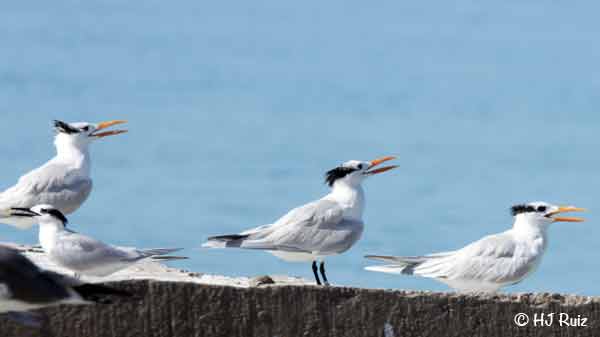
All Photographs are © H.J. Ruiz – Avian 101
Text is available under the Creative Commons Attribution-ShareAlike License; additional terms may apply. See Terms of use for details.
Share this:


Read Past Reviews

Book # 69

Quote from the Author
“A good chuckle is healthy, it helps you break the monotony of a serious life.” ~ H.J. Ruiz


You must be logged in to post a comment.