Birds of the Week # 20
Photo Gallery


1 – Brown Thrasher (Toxostoma rufum) is a bird in the family Mimidae. The brown thrasher is the state bird of Georgia.
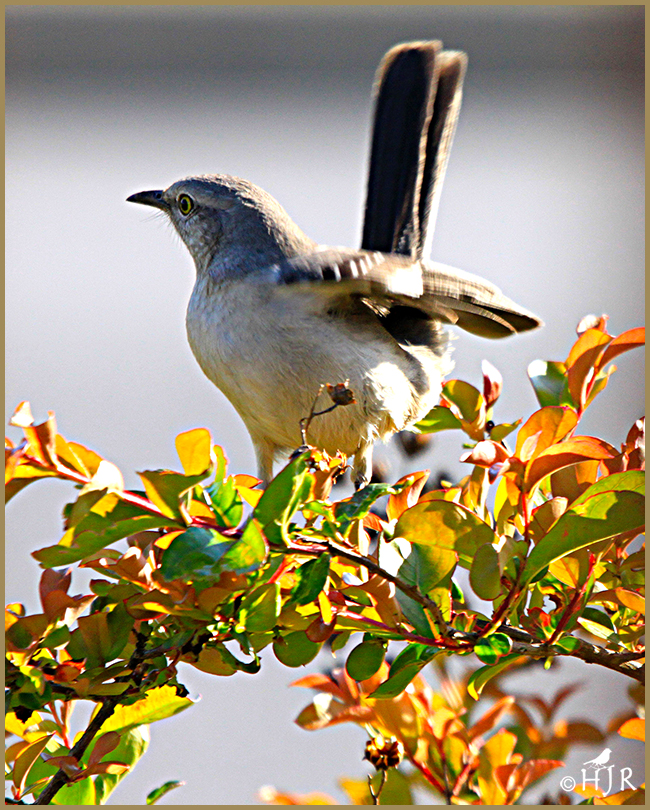
2 – Northern Mockingbird (Mimus polyglottos) is a mockingbird commonly found in North America. The northern mockingbird is the state bird of Arkansas, Florida, Mississippi, Tennessee and Texas, and previously the state bird of South Carolina.
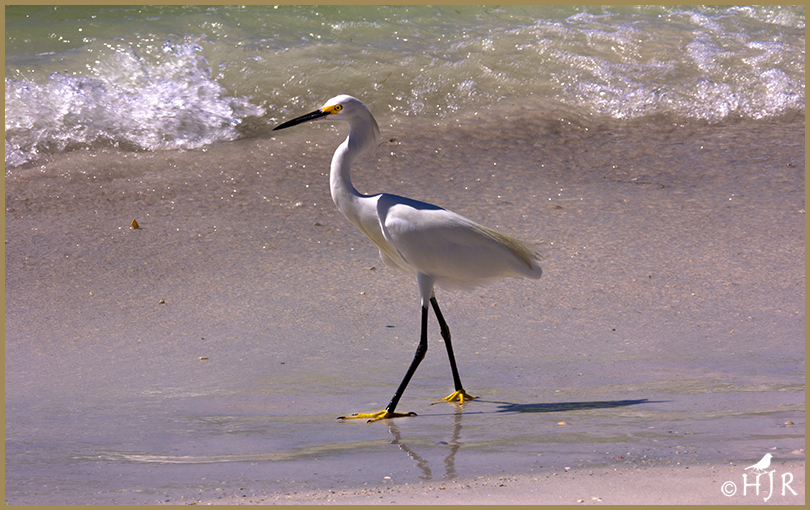
3 – Snowy Egret (Egretta thula) is a small white heron. Fossils of the snowy egret have been reported from the Talara tar seeps of Peru and in Bradenton in Manatee County and Haile XIB in Alachua County in Florida, United States. The deposits were dated to the Late Pleistocene.
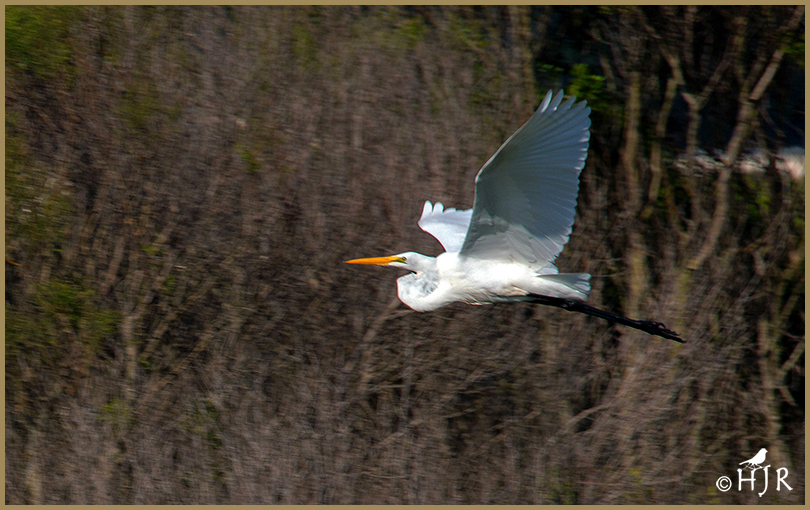
4 – Great Egret (Ardea alba), also known as the common egret, large egret, or (in the Old World) great white egret or great white heron. In 2018, a pair of great egrets nested in Finland for the first time, raising four young in a grey heron colony in Porvoo.
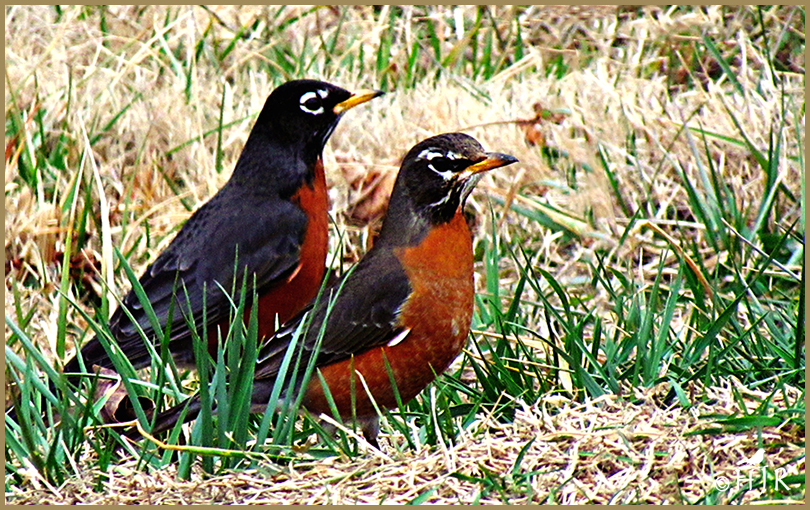
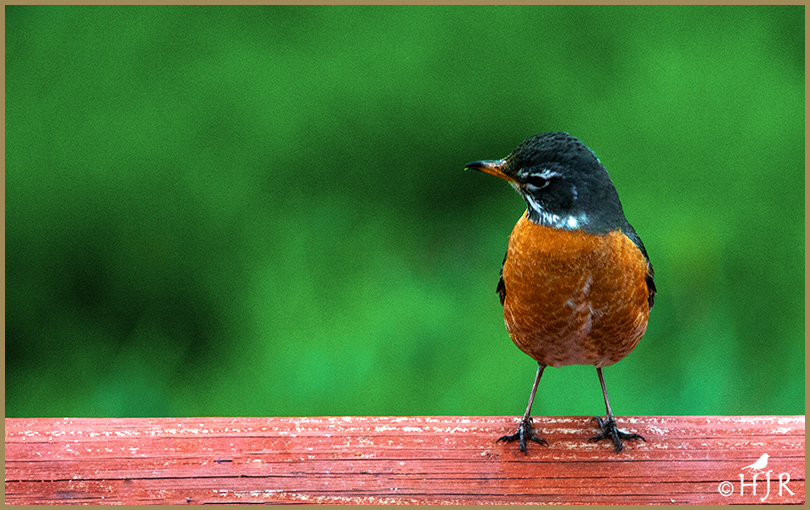
5 & 6 – American Robin (Turdus migratorius) is a migratory songbird of the true thrush genus and Turdidae, the wider thrush family. The longest known lifespan of an American robin in the wild is 14 years; the average lifespan is about 2 years.
7 – Tricolored Heron (Egretta tricolor), formerly known as the Louisiana heron, is a small species of heron native to coastal parts of the Americas. The tricolored heron stalks its prey in shallow or deeper water, often running as it does so. It eats fish, crustaceans, reptiles, and insects.
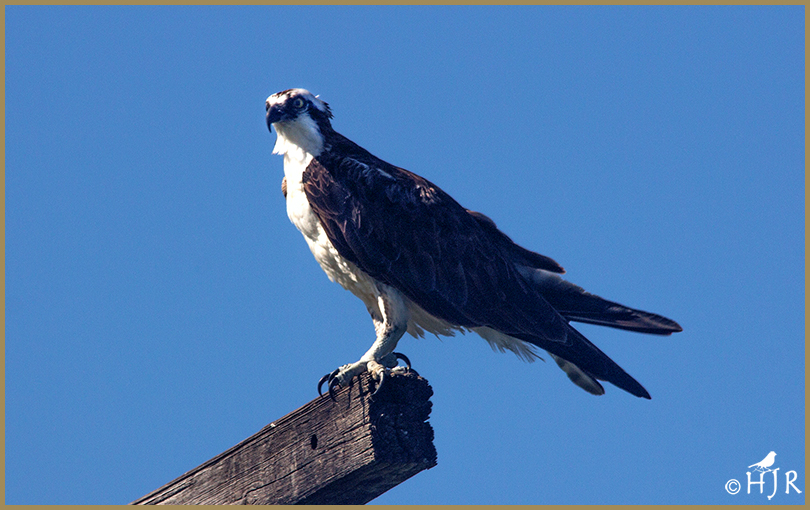
8 – Osprey or more specifically the western osprey (Pandion haliaetus) — also called sea hawk, river hawk, and fish hawk — is a diurnal, fish-eating bird of prey with a cosmopolitan range. European breeders winter in Africa. American and Canadian breeders winter in South America, although some stay in the southernmost U.S. states such as Florida and California. Some ospreys from Florida migrate to South America. Australasian ospreys tend not to migrate.
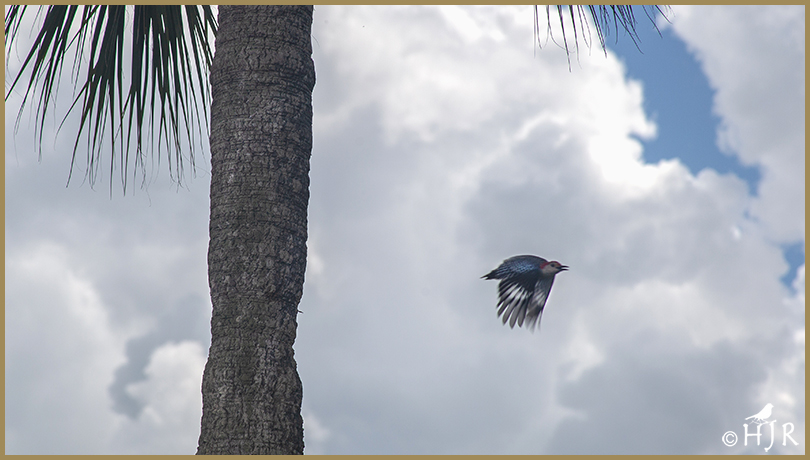
9 – Red-bellied Woodpecker (Melanerpes carolinus) is a medium-sized woodpecker of the family Picidae. In early May, the red-bellied woodpeckers begin breeding activities by drumming patterns; such as, slow taps followed by short rapid drumming. The red-bellied woodpeckers use vocal signals to attract and communicate with potential mates.
© HJ Ruiz – Avian101
Share this:

Special Places # 36
Some Words from the Author
Dear Friends,
I wish that you forgive me for not replying your comments from last Friday on, because I was operated of my right eye that makes it difficult lto use the the computer since I can not stand the light that causes tremendous pain to my eye. I should start by explaining how this started…two years ago I was making preparatives to be operated of a case of starting cataracts in both my eyes, the the eye specialist told me that I had Pterhygium “ Surfer Syndrome” which is that people that spend a lot of time under UV light, beach, fishing, outdoors, etc. Right after I was operated of both eyes, The eye specialist was reluctant to operate the cataracts. Then the lockdown started for Covid-19. However, my vision was decreasing and having difficulty to read text and I noticed the lack on intensity of colors. So, I was reccomended another eye specialist by a friend as a second opinion. This doctor found that my corneas have the curvatures warped that would make it impossible to correct with any glasses, therefore, the cataracts are not the cause but corneas.The operation is to reshape the corneas and have normal measures.Once the corneas are corrected and healed,Then, the cataracts will be removed and interocular lens inserted, this will correct my eye sight.
Thank you for your understanding. H.J.
Ships and Boats
Photo Gallery


1 – Top Left: The Intrepid Sea, Air & Space Museum is an American military and maritime history museum in New York City with a collection of museum ships. It is located at Pier 86 at 46th Street, along the Hudson River, in the Hell’s Kitchen neighborhood on the West Side of Manhattan. The museum showcases the aircraft carrier USS Intrepid, the cruise missile submarine USS Growler, a Concorde SST, a Lockheed A-12 supersonic reconnaissance plane, and the Space Shuttle Enterprise. On the lower deck there is also a reproduction of a World War I biplane.
2 – Top Right – Upper Row: Catamaran anchored in front of Nassau, The Bahamas.
3 – Top Right – Lower Row: Fishing boats at pier, ready to depart asea in Provincetown, MA.
4 – Bottom Left – Upper Row: Motor Boats docked at marina in Pensacola Gulf Breeze, Florida.
5 – Bottom Left – Lower Row: Ocean Liner docked at New York Harbor, Hudson River. NYC.
6 – Bottom Right: Shuttle boat at Hoboken Pier in New Jersey.
© HJ Ruiz – Avian101
Share this:

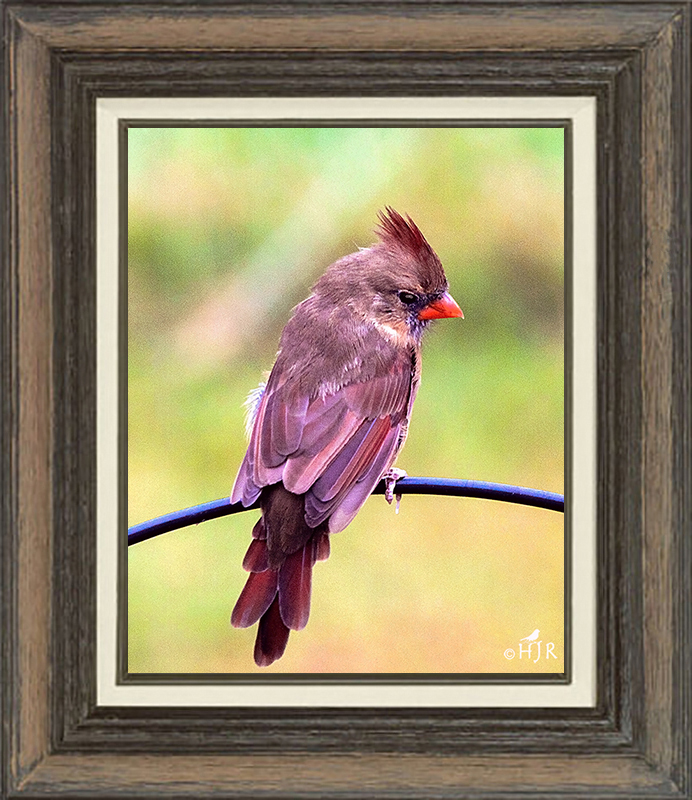
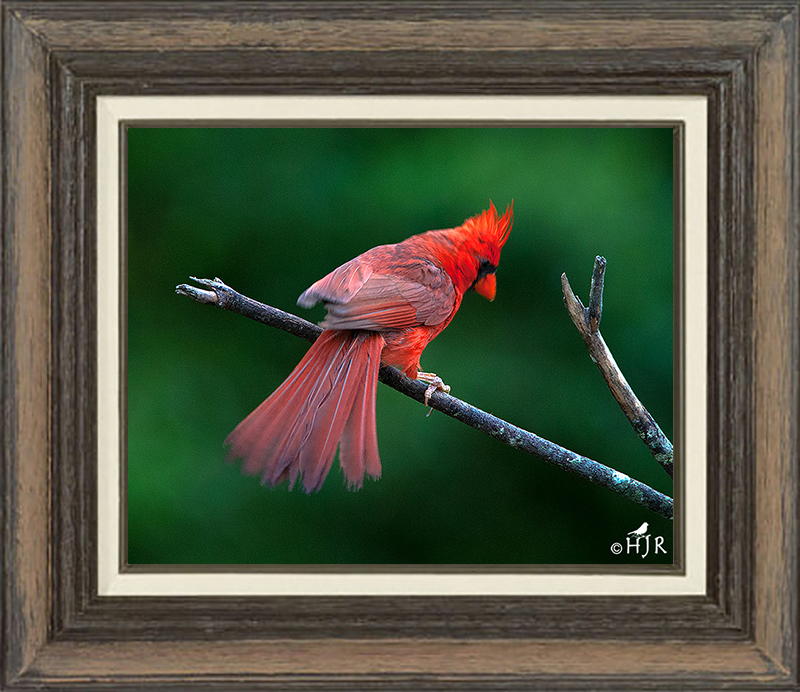
Red Art Gallery – Northern Cardinal # 45
Red Art Gallery
Photo Gallery
© HJ Ruiz – Avian101
Share this:

Birds of the Week # 19
Cooper’s Hawk

Cooper’s Hawk is a medium-sized hawk and largish for an Accipiter. Compared to related species, they tend to have moderate-length wings, a long, often graduated or even wedge-shaped tail and long though fairly thick legs and toes. Their eyes tend to be set well forward in the sides of the relatively large and squarish-looking head (though the head can look somewhat rounded if the feathers on the nape are held flush) and a relatively short but robust bill. They have hooked bills that are well adapted for tearing the flesh of prey, as is typical of raptorial birds. Generally, Cooper’s hawks can be considered secretive, often perching within the canopy, but can use more open perches, especially in the western part of the range or in winter when they may use leafless or isolated trees, utility poles or exposed stumps. On perched hawks, the wing-tips tend to appear to cover less than one third of the tail, sometimes seeming to barely cover the covert feathers. As adults, they may be a solid blue-gray or brown-gray color above.
Turkey Vulture
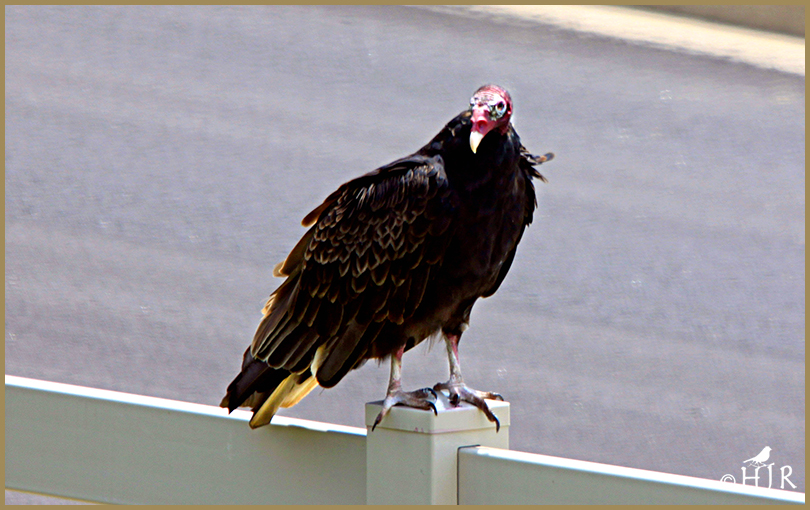
The taxonomic placement of the Turkey Vulture and the remaining six species of New World vultures has been in flux.Though both are similar in appearance and have similar ecological roles, the New World and Old World vultures evolved from different ancestors in different parts of the world. Some earlier authorities suggested that the New World vultures were more closely related to storks. More recent authorities maintained their overall position in the order Falconiformes along with the Old World vultures.
Blue Grosbeak (Female & Male)

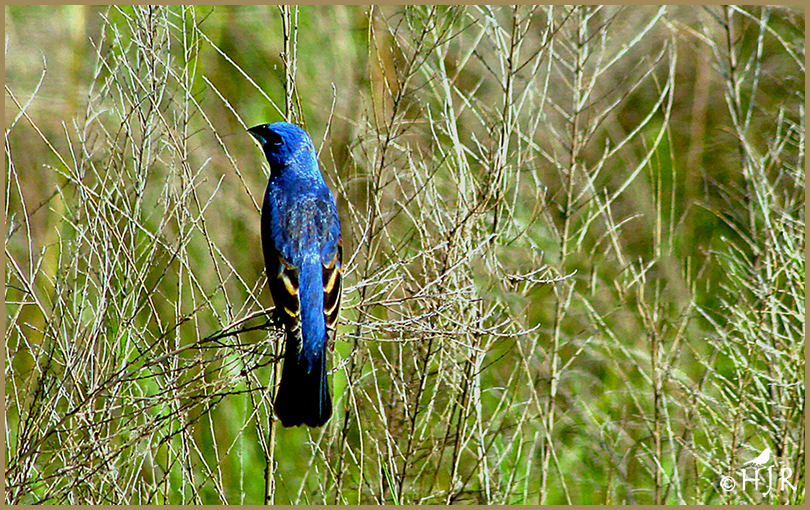
The male Blue Grosbeak is deep blue, with both black and brown on its wings. The female is mostly brown. Both sexes are distinguished by their large, deep bill and double wing bars. These features, as well as the grosbeak’s relatively larger size, distinguish this species from the indigo bunting. Length can range from 14 to 19 cm (5.5 to 7.5 in) and wingspan is from 26 to 29 cm (10 to 11 in). Body mass is typically from 26 to 31.5 g (0.92 to 1.11 oz).
White-breasted Nuthatch

Like other nuthatches, the White-breasted Nuthatch forages for insects on trunks and branches and is able to move head-first down trees. Seeds form a substantial part of its winter diet, as do acorns and hickory nuts stored in the fall. Old-growth woodland is preferred for breeding. The nest is in a hole in a tree, and the breeding pair may smear insects around the entrance as a deterrent to squirrels. Predators include hawks, owls, and snakes. Forest clearance may lead to local habitat loss, but there are no major conservation concerns over most of its range.
Carolina Chickadee

Carolina Chickadees are so similar to black-capped chickadees that they themselves have trouble telling their species apart. Because of this they sometimes mate producing hybrids. The most obvious difference between the three chickadees is that the Carolina chickadee sings four-note song, black-capped sing two-note songs, and the hybrids sing three-note songs.
© HJ Ruiz – Avian101Coop
Share this:

Read Past Reviews

Book # 69
Quote from the Author
“A good chuckle is healthy, it helps you break the monotony of a serious life.” ~ H.J. Ruiz
 H.J. Ruiz - Avian101
You must be logged in to post a comment.