Scientific Classification – Example: Song Sparrow
The Song Sparrow (Melospiza melodia) is a medium-sized American sparrow. Among the native sparrows in North America, it is easily one of the most abundant, variable and adaptable species.This bird will be our subject for this explanation about Scientific Classification.
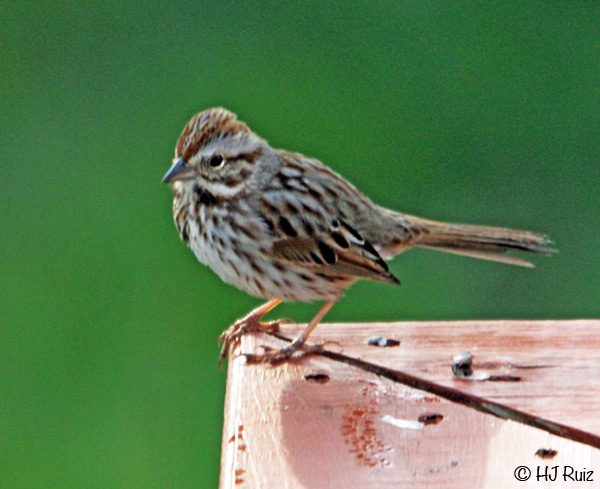 Song Sparrow |
| Scientific classification | |
| Kingdom: | 1- Animalia |
| Phylum: | 2- Chordata |
| Class: | 3- Aves |
| Order: | 4- Passeriformes |
| Family: | 5- Emberizidae |
| Genus: | 6- Melospiza |
| Species: | M. melodia |
Each one of the classifications is explained in more detail below
1- Animals are a major group of multicellular, eukaryotic organisms of the kingdom Animalia or Metazoa. Their body plan eventually becomes fixed as they develop, although some undergo a process of metamorphosis later on in their life. Most animals are motile, meaning they can move spontaneously and independently. All animals are also heterotrophs, meaning they must ingest other organisms or their products for sustenance.
2- The Chordates are animals that comprise the phylum Chordata. Taxonomically the phylum Chordata includes three subphyla: Tunicata; Cephalochordata, comprising the lancelets; and the Craniata, or Vertebrata. The common attributes of the Chordata include having, for at least some period of their life cycles, a notochord, a hollow dorsal nerve cord, pharyngeal slits, an endostyle, and a post-anal tail. The phylum Hemichordata has been presented as a fourth chordate subphylum, but it now is usually treated as a separate phylum.
3- Birds (class Aves) are feathered, winged, bipedal, endothermic (warm-blooded), egg-laying, vertebrate animals. With around 10,000 living species, they are the most speciose class of tetrapod vertebrates. All present species belong to the subclass Neornithes, and inhabit ecosystems across the globe, from the Arctic to the Antarctic. Extant birds range in size from the 5 cm (2 in) Bee Hummingbird to the 2.75 m (9 ft) Ostrich. The fossil record indicates that birds emerged within theropod dinosaurs during the Jurassic period, around 160 million years (Ma) ago. Paleontologists regard birds as the only clade of dinosaurs to have survived the Cretaceous–Paleogene extinction event 65.5 Ma ago.
4- A passerine is a bird of the order Passeriformes, which includes more than half of all bird species. Sometimes known as perching birds or, less accurately, as songbirds, the passerines form one of the most diverse terrestrial vertebrate orders: with over 5,000 identified species, it has roughly twice as many species as the largest of the mammal orders, the Rodentia. It contains over 110 families, the second most of any order of vertebrates (after the Perciformes).
The names “passerines” and “Passeriformes” are derived from Passer domesticus, the scientific name of the eponymous species—the House Sparrow—and ultimately from the Latin term passer for Passer sparrows and similar small birds.
5- The Emberizidae are a large family of passerine birds. They are seed-eating birds with a distinctively shaped bill.
In Europe, most species are called buntings. In North America, most of the species in this family are known as (American) sparrows, but these birds are not closely related to the (Old World) sparrows, the family Passeridae. The family also includes the North American birds known as juncos and towhees.
The Emberizidae family probably originated in South America and spread first into North America before crossing into eastern Asia and continuing to move west. This explains the comparative paucity of emberizid species in Europe and Africa when compared to the Americas.
As with several other passerine families the taxonomic treatment of this family’s members is currently in a state of flux. Many genera in South and Central America are in fact more closely related to several different tanager clades, and at least one tanager genus (Chlorospingus) may belong here in the Emberizidae.
6- Melospiza is a genus of passerine birds in family Emberizidae. The genus, commonly referred to as “song sparrows,” contains currently three species, all of which are native to North America.
Members of Melospiza are medium-sized sparrows with long tails, which are pumped in flight and held moderately high on perching. They are not seen in flocks, but as a few individuals or solitary. They prefer brushy habitats, often near water.
I sure hope that some of this information will clarify some of the questions that you might have wondered when you read about birds.
Share this:

European Starling
The European Starling is native to most of temperate Europe and western Asia. It is resident in southern and western Europe and southwestern Asia, while northeastern populations migrate south and west in winter to these regions, and also further south to areas where it does not breed in Iberia and north Africa. It has also been introduced to Australia, Argentina, New Zealand, North America, and South Africa.
They are insectivorous mostly, eat flies, cicadas, crickets, worms, spiders and occasionally seeds and even garbage. They eat from the ground and they have peculiar ways to get their insects and worms from the ground.
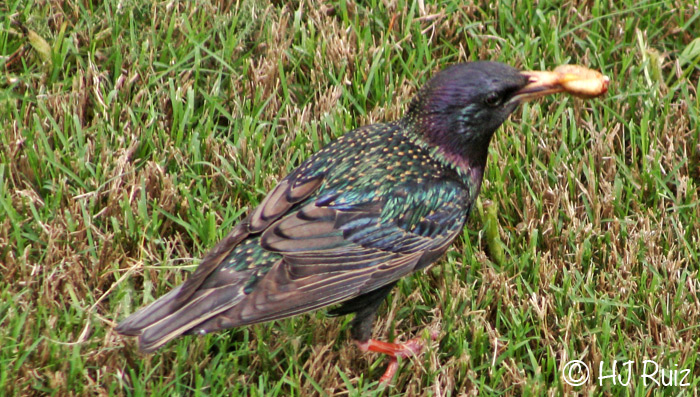
European Starling with catch
They are known gregarious birds, they band in large flocks, they also travel along with other families of blackbirds such as Brown-headed Cowbirds, Common Grackles, Red-winged Blackbirds.
They have been to my backyard in many opportunities. I observed them and somehow I felt that they are kind of shy and they get spooked easily.
These birds are famous by their flying in large flocks and making collective synchronized acrobatics in the air. Large flocks of over a million birds have been seen in Europe.
I saw one flock that I figured about a thousand birds while driving south to florida during their migration. It looked like a small dark cloud that is alive and moving like an amoeba.
Very cool stuff, I kept driving and watching but I didn’t have my camera at hand nor enough time.
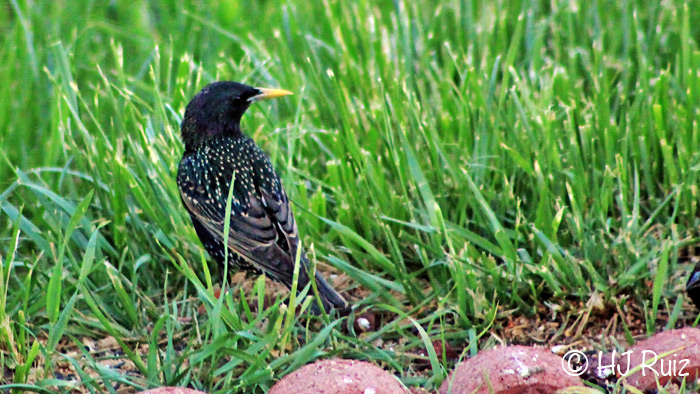
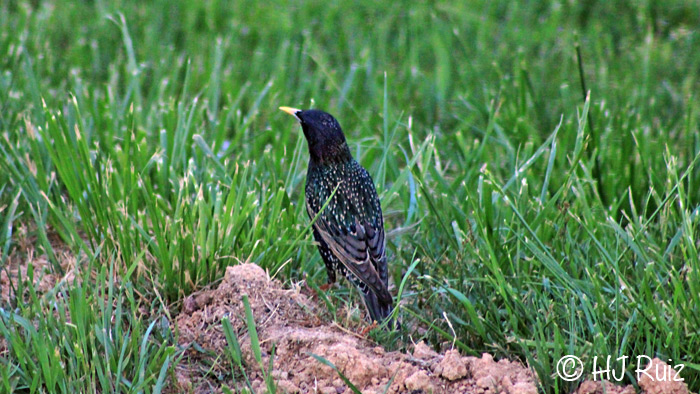
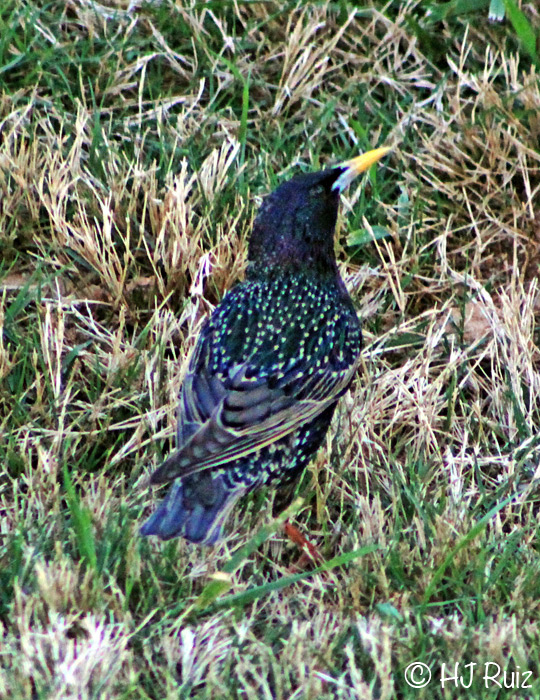
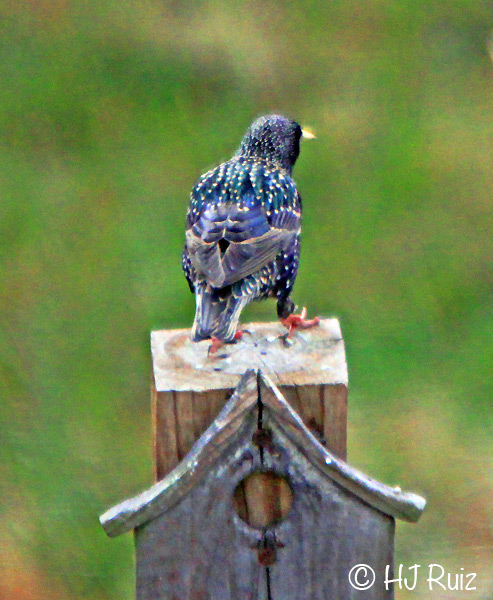
Back detail
Click on images to see enlargements
Text and photographs © H.J. Ruiz – Avian 101
Share this:

Common Grackle
Common grackles are less sexually dimorphic than larger grackle species but the differences between the sexes can still be noticeable. The male is larger than the female,. When adult has a long dark bill, pale yellowish eyes and a long tail; its feathers appear black with purple, green or blue iridescence on the head, and primarily bronze shine in the body plumage. The adult female, beyond being smaller, is usually less iridescent; her tail in particular is shorter. The juvenile is brown with dark brown eyes.
They fly in large flocks when returning from their southern migration and spread almost everywhere in the Country. They make their nest high in trees especially pines.
These grackles are omnivores and feed in almost everything, they forage in urban areas too, from garbage bins to discarded food in parks.
They also practice “anting” which is rubbing ants on their body feathers to use it as repellent for mites or other bird’s parasites.
My backyard gets visited by these “vandals” once in a while, they raid the feeders and cause a ruckus knocking feeders and seeds all over, chasing other birds out and after a while, once the food is gone they leave their mess!
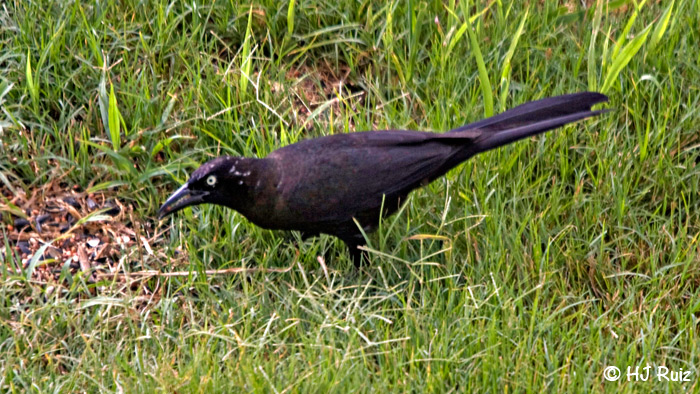
Common Grackle (M)
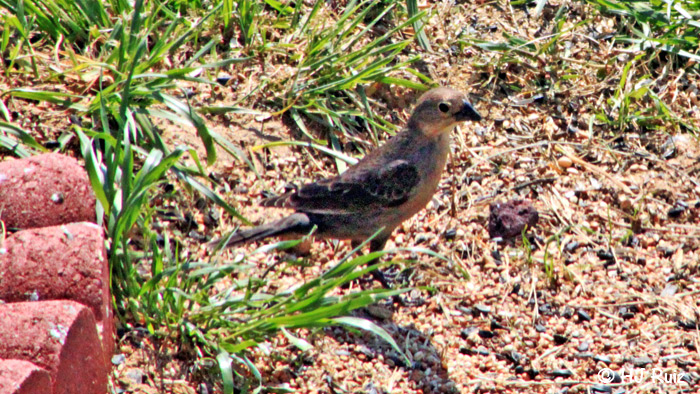
Common Grackle (F)
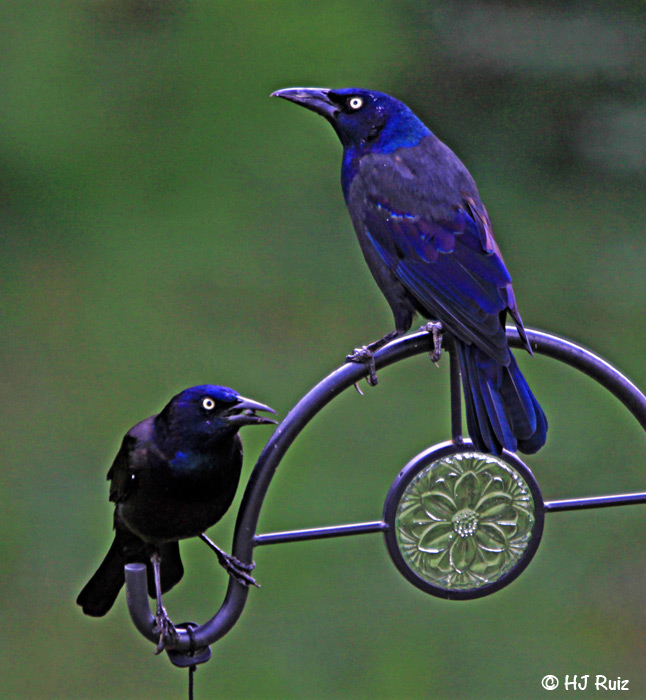
Common Grackle (M)
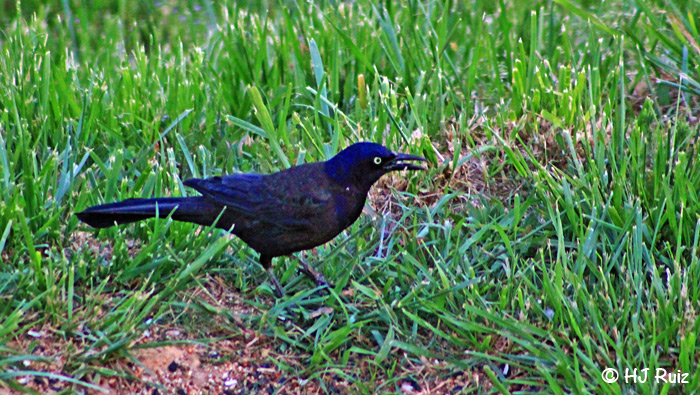
Common Grackle (M)
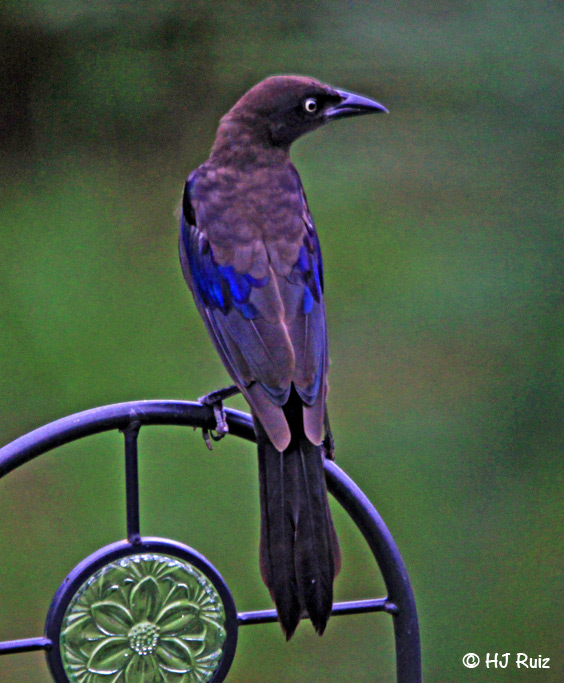
Common Grackle (M)
Click on images to see enlargements
Text and photographs © H.J. Ruiz – Avian 101
Share this:

American Robin
If there’s something I like to do when I see birds is to observe their patterns of behavior. In the case of the bird I picked for today, the mid-size American Robin with their rusty brown breasts and black head, back and tail. Their black eyes present white crescents around them which make them peculiar. The have a sharp pointy yellow bill made to resist pocking the ground hard.
My observations showed that they usually fly in flocks of several individuals and particularly after a rainy day.
After they land they spread at one end of one area and walk separated in one direction as if combing the area. The previous rain has made the ground soft and muddy which makes it easy for them to poke it and go deep enough to get earth worms or grubs, they too surface because of the rain. They are very organized and once they get to the other end they all take flight together. Interesting isn’t it?


Click on images to see enlargements
Text an d photographs © H.J. Ruiz – Avian 101
Share this:


Read Past Reviews

Book # 69

Quote from the Author
“A good chuckle is healthy, it helps you break the monotony of a serious life.” ~ H.J. Ruiz


You must be logged in to post a comment.