
European Starling
The European Starling is native to most of temperate Europe and western Asia. It is resident in southern and western Europe and southwestern Asia, while northeastern populations migrate south and west in winter to these regions, and also further south to areas where it does not breed in Iberia and north Africa. It has also been introduced to Australia, Argentina, New Zealand, North America, and South Africa.
They are insectivorous mostly, eat flies, cicadas, crickets, worms, spiders and occasionally seeds and even garbage. They eat from the ground and they have peculiar ways to get their insects and worms from the ground.
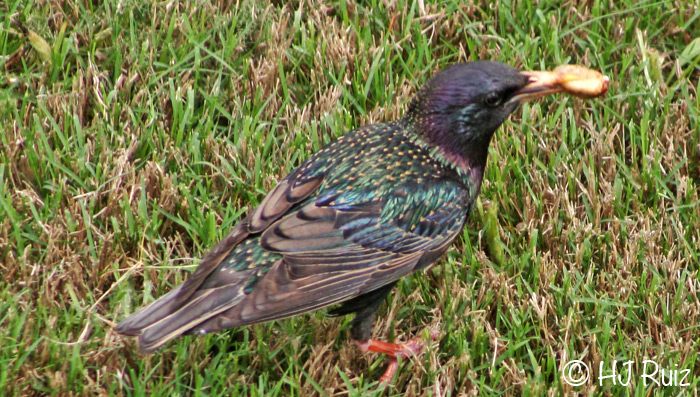
European Starling with catch
They are known gregarious birds, they band in large flocks, they also travel along with other families of blackbirds such as Brown-headed Cowbirds, Common Grackles, Red-winged Blackbirds.
They have been to my backyard in many opportunities. I observed them and somehow I felt that they are kind of shy and they get spooked easily.
These birds are famous by their flying in large flocks and making collective synchronized acrobatics in the air. Large flocks of over a million birds have been seen in Europe.
I saw one flock that I figured about a thousand birds while driving south to florida during their migration. It looked like a small dark cloud that is alive and moving like an amoeba.
Very cool stuff, I kept driving and watching but I didn’t have my camera at hand nor enough time.
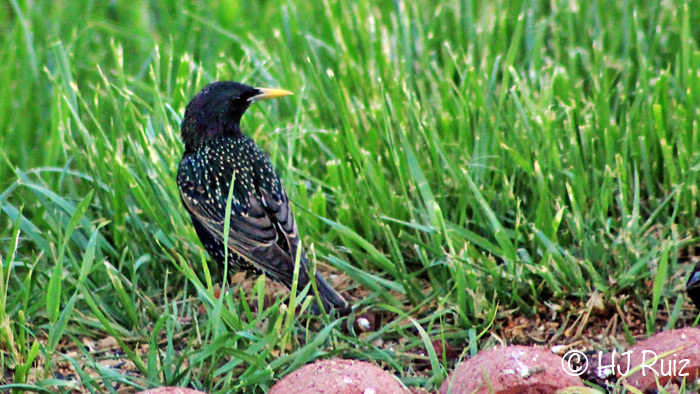
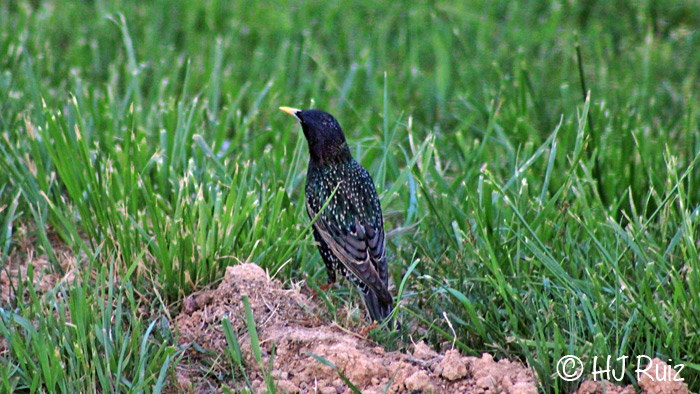
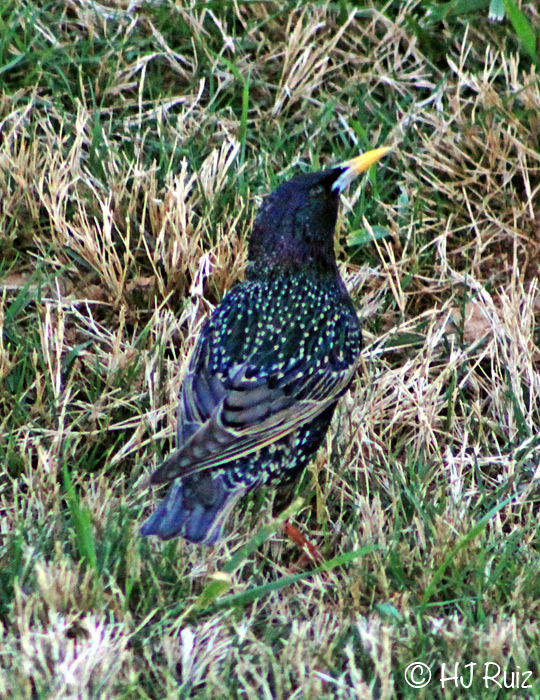
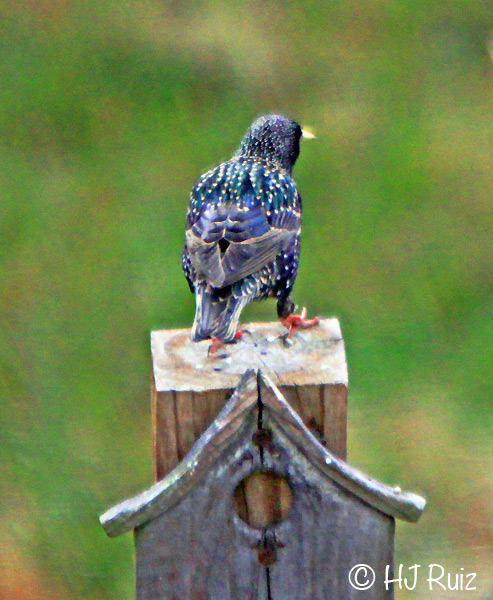
Back detail
Click on images to see enlargements
Text and photographs © H.J. Ruiz – Avian 101





Very nice photos. By the end of the year, I can use your blog as a reference manual on birds!! Thanks for always including the fun facts with your photos!
Thank you! Fun facts are exactly that…fun! 🙂
Despite their reputation, I think the European Starlings are beautiful birds. 🙂
I agree with that Bob! 🙂 Thanks!
What a lovely bird – your photos are, as always, amazing. I don’t even know if we have starlings here!
European Starlings were first introduced to the United States in 1890. Rumor has it that one hundred starlings were released in Central Park in hopes that all of the birds mentioned in Shakespeare’s works would become established in the New World. In the case of the starling, the wish became reality. In the intervening hundred years the starling population has grown to an estimated 150-200 million birds.
Later they were introduced to New Zealand and Australia for reason related to bring down the abundance of insects that decimated crops.
So Julie, you do have European Starlings in Australia, but where I don’t know! 🙂
The color of the wings are amazing. I’ve never seen a starling. What a great photo. Thank you for sharing.
Thank you BD, one day you’ll see it keep your eyes open! 🙂
Pretty! I love getting a good picture of a bird witih its catch. Or any animal with its catch, really.
It’s like seeing you eating at KFC, isn’t it? 🙂
Now, now. I don’t think anyone ever took a picture of me eating at KFC. McDonald’s, yes. lol