
Every Comment is Appreciated
I’m very satisfied and enthusiastic about the legion of people that are involved graciously to the wellbeing of all avians.
People from all backgrounds and from many countries are giving some of their valuable time to the care of the different species of birds, which for many years were ignored and neglected.
I for one, when I get a comment from a reader about any observation of any type of bird, that little message is very valuable for me as it will be later for the person that wrote it. As insignificant this information it might appear to be, it does matter and is important for the sake of the birds! Studies are made that way, observing, reporting and then analyzing. Nature is always evolving and many things change from time to time.
Remember this: Every little comment about birds it helps!
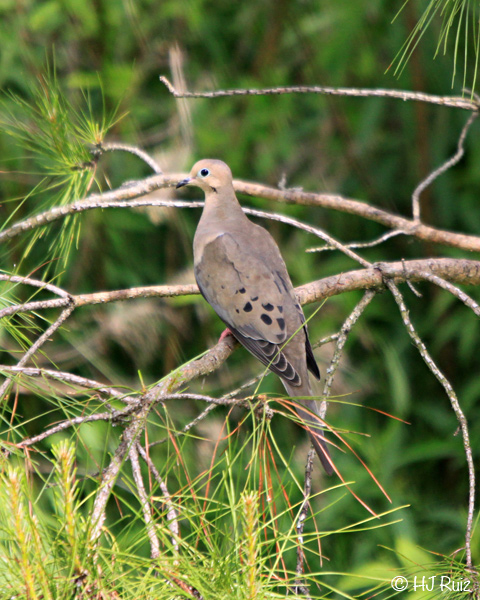
Mourning Dove
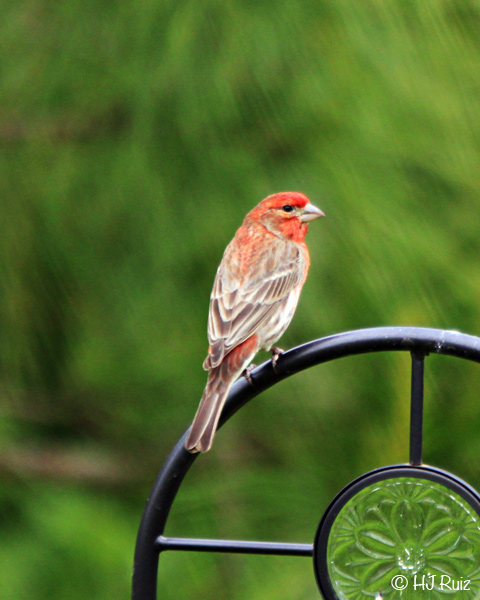
House Finch (M)
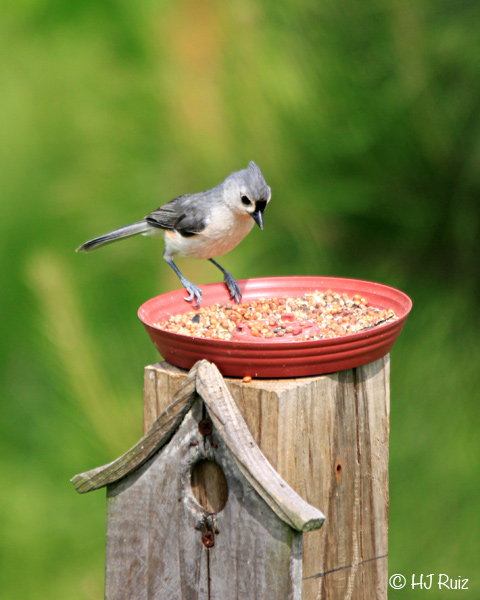
Tufted Titmouse
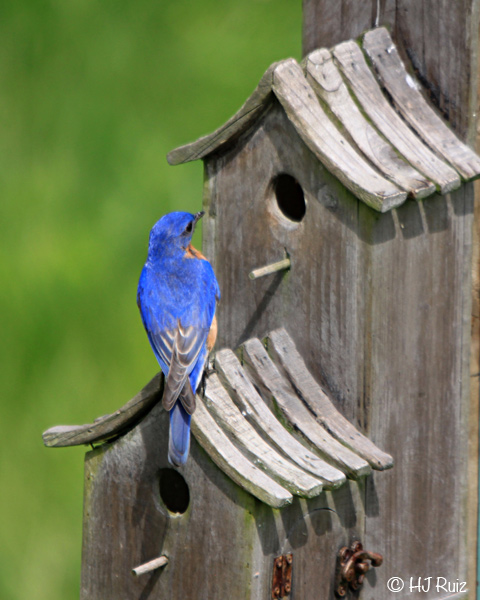
Eastern Bluebird (M)

Red-winged Blackbird (M)
Click on images to see enlargements
Text and photographs © H.J. Ruiz – Avian 101
Share this:

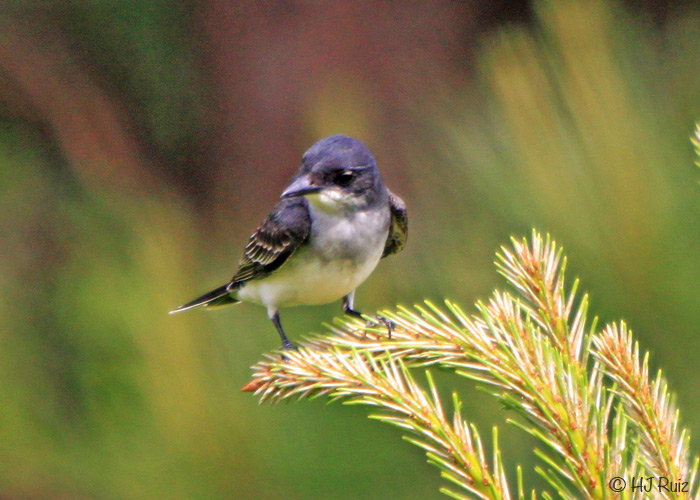
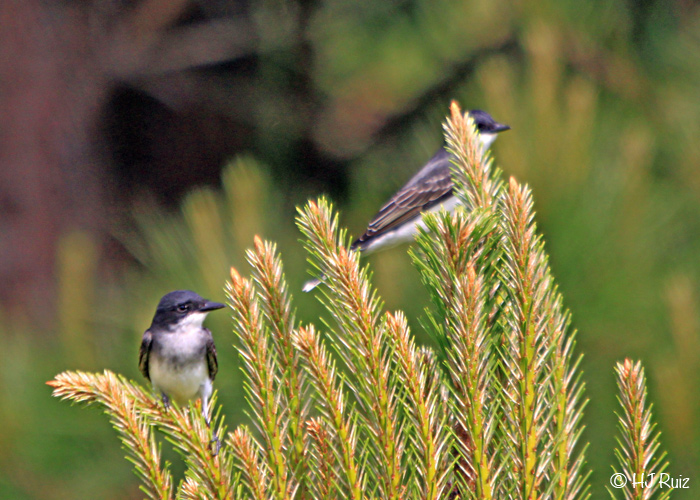
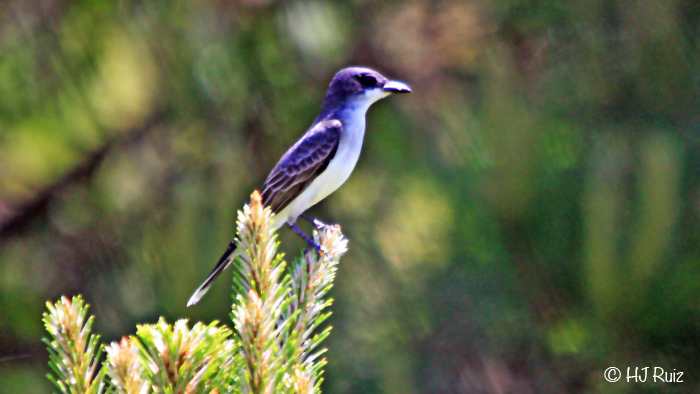
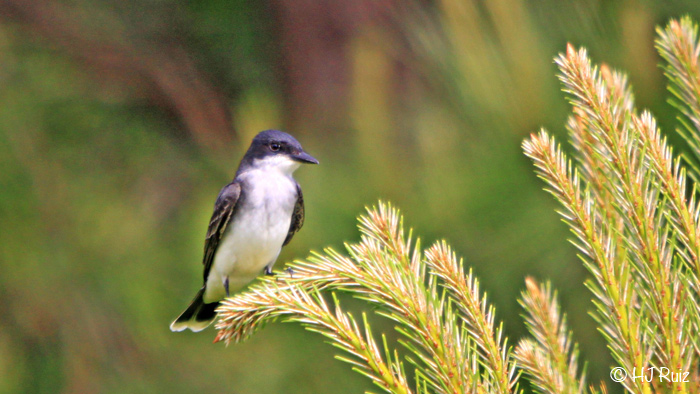
Eastern Kingbird
The Eastern Kingbird adults are grey-black on the upper-parts with light underparts; they have a long black tail with a white end and long pointed wings. They have a red patch on their crown, seldom seen. I’ve never had the chance to see that red patch!
Their breeding habitat is open areas across North America. They make a sturdy cup nest in a tree or shrub, sometimes on top of a stump or pole. These birds aggressively defend their territory, even against much larger birds.
These birds migrate in flocks to South America.
They wait on an open perch and fly out to catch insects in flight, sometimes hovering to pick food off vegetation. They also eat berries and fruit, mainly in their wintering areas.
These birds got me confused when I first saw them, they fly and look like swallows, but once I had the opportunity to see them perched on top of a pine tree, it made it easier to see all their characteristics.
Click on images to see enlargements
Text and photographs © H.J. Ruiz – Avian 101
Share this:

White-crowned Sparrow
The White-crowned Sparrow is a medium-sized sparrow native of North America. Adults have black and white stripes on their head, a grey face, brown streaked upper parts and a long tail. The wings are brown with bars and the underparts are grey.  Their bill is pink or yellow. They are similar in appearance to the White-throated Sparrow but do not have the white throat markings. That is what happened when I first saw these birds I got confused but not for long.
Their breeding grounds are the brush areas of Northern Canada and Western USA.
These birds forage on the ground or in low vegetation, but sometimes make short flights to catch flying insects. They mainly eat seeds, other plant parts and insects. In winter, they often forage in flocks.
White-crowned Sparrows nest either low in bushes or on the ground under shrubs and lay 3–5 brown-marked grey or greenish-blue eggs.
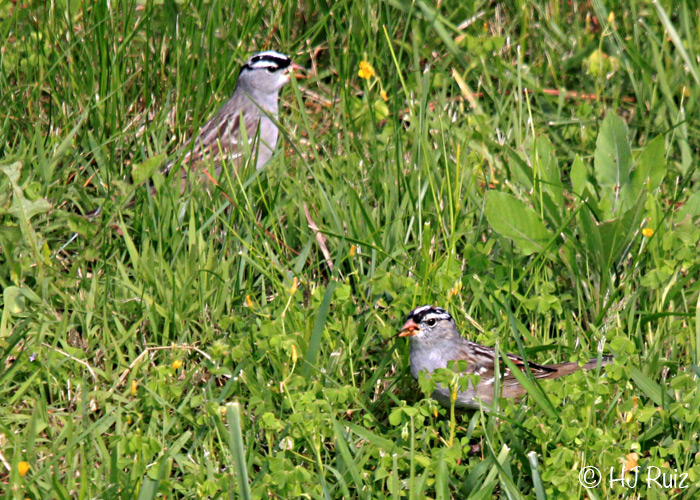


Click on images to see enlargements
Text and photographs © H.J. Ruiz – Avian 101
Share this:

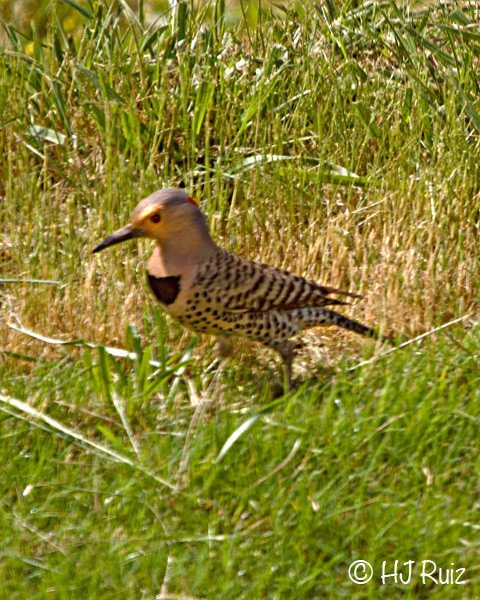
Northern Flicker
Another bird that I see once in a while strolling my backyard is the Northern Flicker. Is a medium-sized member of the woodpecker family. It is native to most of North America, parts of Central America, Cuba, the Cayman Islands, and is one of the few woodpecker species that migrate.
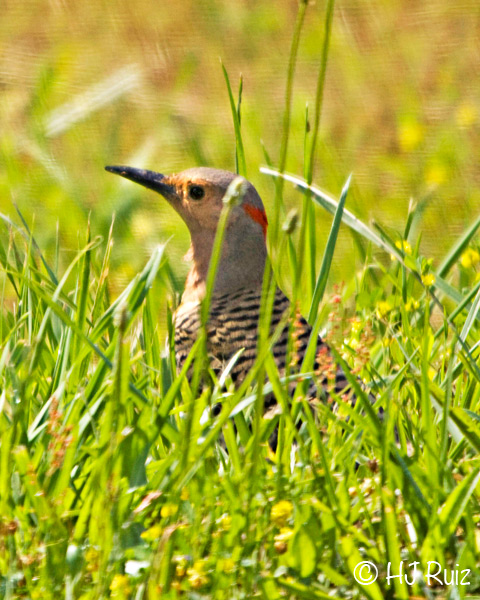
Northern Flicker
This bird has a powerful long pointy bill, brownish body with darks dots all over its body. It has a gold head, underwing feathers and under tail. Also has a red chevron shaped patch at the nape of its neck. It has a crescent shaped black patch on upper part of its breast. Feeds mostly from the ground and it’s omnivorous.
My observations of this bird were the following:
This woodpecker walks at fast pace and does little flying, uses its long bill to poke hard the ground in other to get worms, grubs or any insect on the ground or in the ground. Prefers to feed in places near streams where I inferred that the soil is wetter and most likely to have worms or other invertebrates.
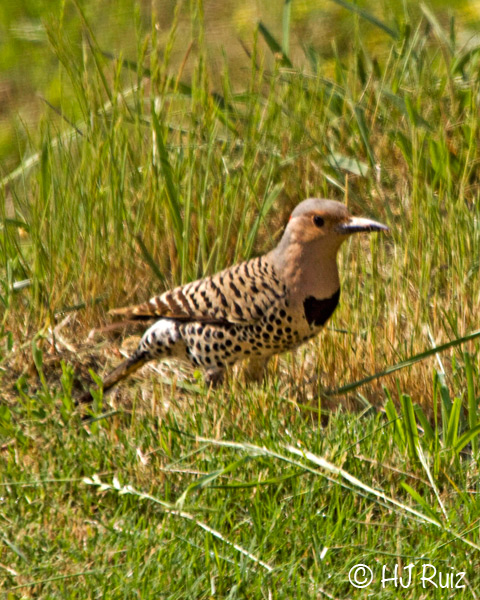
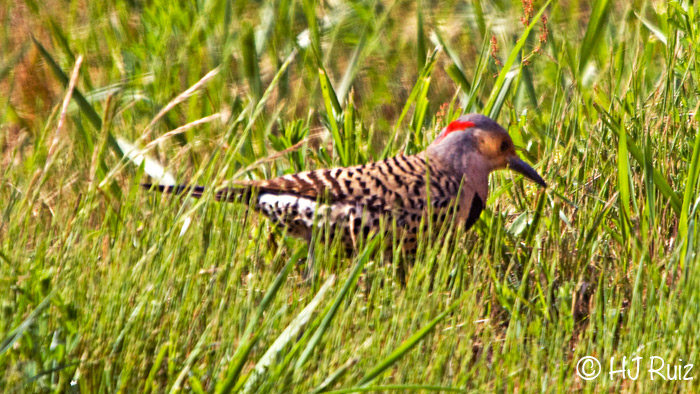
Click on images to see enlargements
Text and photographs © H.J. Ruiz – Avian 101
Share this:


Read Past Reviews

Book # 69

Quote from the Author
“A good chuckle is healthy, it helps you break the monotony of a serious life.” ~ H.J. Ruiz


You must be logged in to post a comment.