Red-bellied Woodpecker
Today’s post is about a woodpecker that is not from my backyard, the photographs are from my trips to west Florida.
The Red-bellied Woodpeckeris a medium-sized woodpecker. It breeds in southern Canada and the northeastern United States, ranging as far south as Florida and as far west as Texas. Its common name is somewhat misleading, as the most prominent red part of its plumage is on the head; the Red-headed Woodpecker however is another species that is a rather close relative but looks quite different. ( That species I have as resident near my backyard)

Red-bellied Wodpecker
Adults are mainly light gray on the face and underparts; they have black and white barred patterns on their back, wings and tail. Adult males have a red head-side going from the bill to the nape; females have a red patch on the nape and another above the bill. The reddish tinge on the belly that gives the bird its name is difficult to see in field identification.
These birds mainly search out arthropods on tree trunks. They may also catch insects in flight. They are omnivores, eating insects, fruits, nuts and seeds. Their breeding habitat is usually deciduous forests. They nest in the decayed cavities of dead trees, old stumps, or in live trees that have softer wood such as elms, maples, or willows; both sexes assist in digging nesting cavities. Areas around nest sites are marked with drilling holes to warn others away.


Click on images to see enlargements
Text and photographs © H.J. Ruiz – Avian 101
Share this:

House Finch
The House Finches have been visiting my backyard since the very first time a placed a feeder and still keep coming and nesting in our area.
Adults have a long, square-tipped brown tail and are a brown or dull-brown color across the back with some shading into deep gray on the wing feathers. Breast and belly feathers may be streaked; the flanks usually are. In most cases, adult males’ heads, necks and shoulders are reddish. This color sometimes extends to the belly and down the back, between the wings. Male coloration varies in intensity with the seasons and is derived from the berries and fruits in its diet. Adult females have brown upper-parts and streaked under-parts.
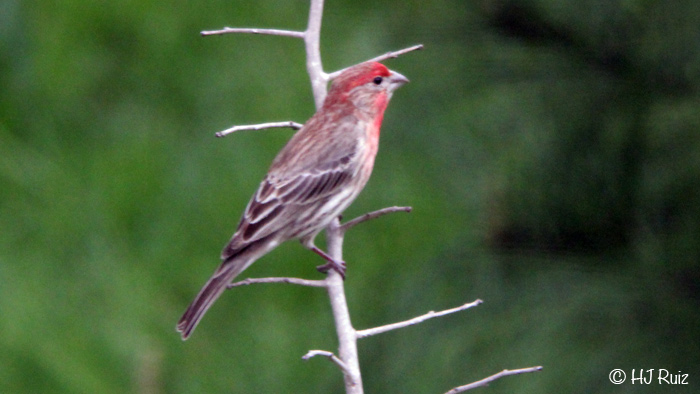
House Finch (M)
These birds are mainly permanent residents throughout their range; some northern and eastern birds migrate south. Their breeding habitat is urban and suburban areas in eastern North America as well as various semi-open areas in the west from southern Canada to northern Florida.
Interesting note:
Originally only a resident of Mexico and the , they were introduced to eastern North America in the 1940s. The birds were sold illegally in New York City as “Hollywood Finches”, a marketing artifice. To avoid prosecution under the Migratory Bird Treaty Act of 1918, vendors and owners released the birds. They have become naturalized; in some unforested areas, they have displaced the native Purple Finch and non-native House Sparrow. We extend the “welcome” matt to them any time!
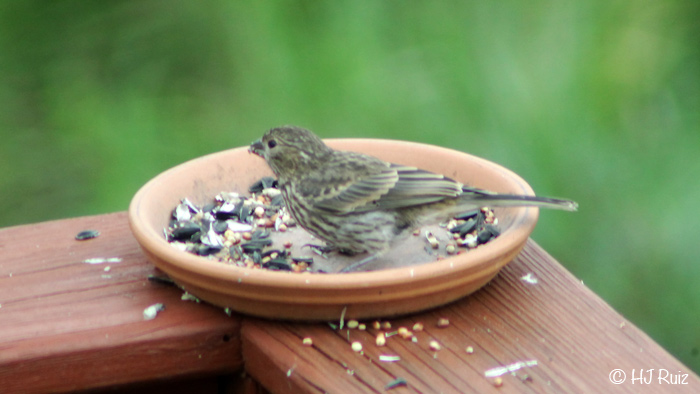
House Finch (F)
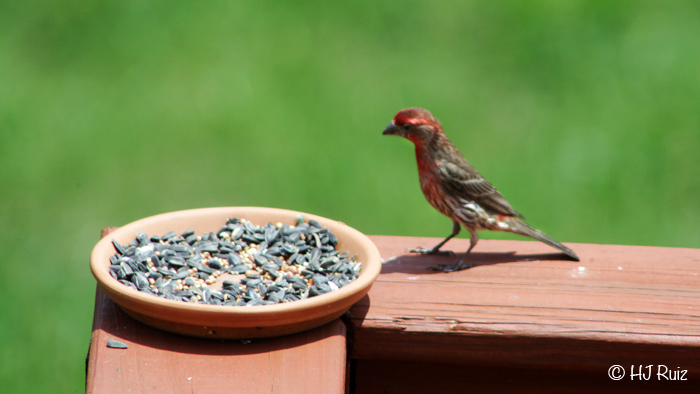
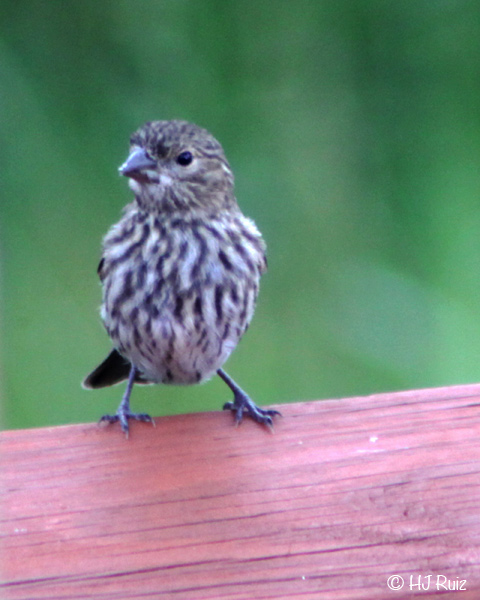
House Finch (I)
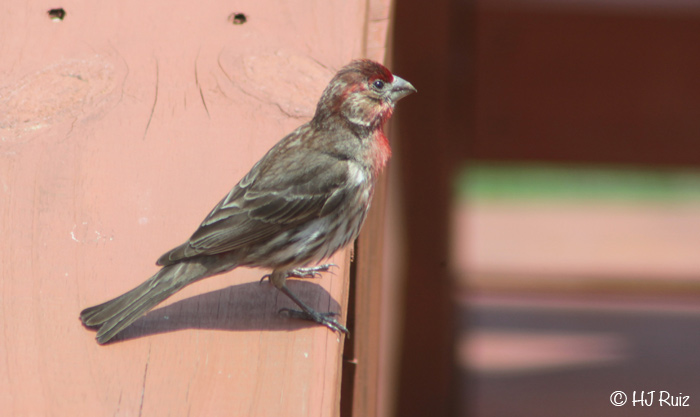
Click on images to see enlargements
Text and photographs © H.J. Ruiz – Avian 101
Share this:

VIBA – (Very Inspiring Blogger Award)
I feel honored that my friend Amy has nominated my blog for the VIBA (Very Inspiring Blogger Award)
“I know that many bloggers avoid going through the task of naming 7 things that people don’t know about yourself, also the list of 5 links for blogs that you may recommend.
Listen friends, this is not the Oscars Academy Award nor will make you rich and famous!. However, it helps other bloggers to get motivation and advance their talents. Why not for simply giving a bit of merit for their time and good will to write a post or display a photo.
There are bloggers like myself that put a lot of my effort and time to anything that I put my mind to do. For no profit at all! When someone across the world writes a kind comment or asks a question about my post is my reward. I imagine that there must be many people that have the same opinion of what blogging is all about.”
This is the list of 7 things you don’t know about me:
1 – My wife Lucy and I live in Georgia with our grandson Tyler, he just turned 2 years old, he’s been with us since shortly after birth. We are raising him.
2 – I do count birds only when I shot their photo. Not when I just saw them.
3 – I’m also an artist, mostly oil painting and drawings.
4 – I love to drive and visit places, even when out of the USA.
5 – I’ve been a founder member of a Chabad Synagogue in New Jersey.
6 – My wife and I were caught in a hail and rainstorm on top of Masada in Israel and later got stranded.
7 – When I was a kid I while in an Air Show I saw an Air Force Jet crash near the field.
This is the list of Blogs I nominate for VIBA, based on their merits:
1 – My Mind by Beedie
2 – musicbirdblog by Lisa Rest
3 – David R Wetzel Photography by David Wetzel
4 – Nature’s Hues by John Jeevaratnam
5 – Local Exploration by Derrick Eidam
Do not feel obligated to accept this award, I will respect your opinion and continue to appreciate all your efforts as a Blogger. Thank You!
H.J. Ruiz – Avian 101
Share this:

American Crow
The American Crow is a distinctive bird with iridescent black feathers all over. Its legs, feet and bill are also black. Males tend to be larger than females.
The most usual call is a loud, short, and rapid caaw-caaw-caaw. Usually, the birds thrust their heads up and down as they utter this call. American Crows can also produce a wide variety of sounds and sometimes mimic noises made by other animals, including other birds.
Most wild American Crows live for about 7–8 years. Captive birds are known to have lived up to 30 years.
The range of the American Crow extends from the Pacific Ocean to the Atlantic Ocean in Canada, on the French islands of Saint-Pierre and Miquelon, south through the United States, and into northern Mexico. Virtually all types of country from wilderness, farmland, parks, open woodland to towns and major cities are inhabited; it is absent only from Pacific temperate rain forests and tundra habitat where it is replaced by the Raven.
Many times these American Crows perch atop a large oak tree a hundred yards from my house by the creek and you can hear them calling very loudly to the top of their lungs!
When I was shooting the pictures displayed on this post, there was a Northern Mockingbird dive-attacking the Crow continuously. Brave bird!


The American Crow is upset because there’s a N. Mockingbird attacking him!
Click on images to see enlargements
Text and photographs © H.J. Ruiz – Avian 101
Share this:


Read Past Reviews

Book # 69

Quote from the Author
“A good chuckle is healthy, it helps you break the monotony of a serious life.” ~ H.J. Ruiz


You must be logged in to post a comment.