
Neotropic Cormorant
The pictures displayed on this post were taken at different locations in the State of Florida.
Birds of the southern populations tend to be bigger than the more northerly birds. It is small and slender, especially compared to the larger, heavier-looking Double-crested Cormorant. It has a long tail and frequently holds its neck in an S-shape. Adult plumage is mainly black, with a yellow-brown throat patch.

Neotropic Cormorants
During breeding, white tufts appear on the sides of the head, there are scattered white filoplumes on the side of the head and the neck, and the throat patch develops a white edge. The upper wings are somewhat greyer than the rest of the body. Juveniles are brownish in color.
Its diet consists mainly of small fish, but will also eat tadpoles, frogs, and aquatic insects. This bird is largely a permanent resident, with some birds occasionally wandering north in the warmer months.


Click on images to see enlargement
Text and photographs © H.J. Ruiz – Avian 101
Share this:

Royal Tern
The photographs I’m displaying today for this post were taken in the west coast of Florida.
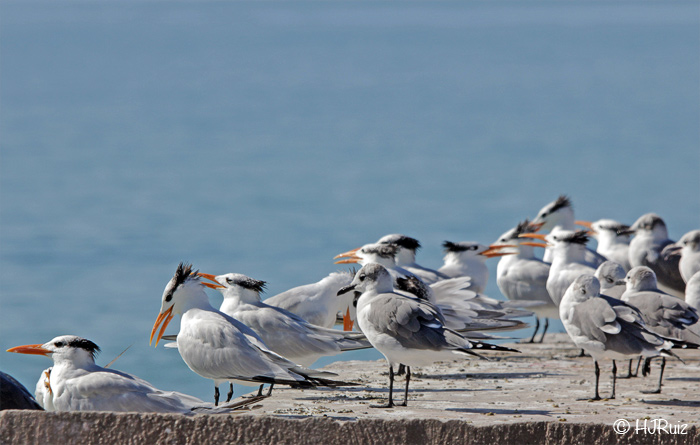
Royal Tern
The Royal Tern has a red-orange bill and a black cap on the top of its head during the breeding season, but in the winter the cap becomes patchy. The Royal Tern is found in Europe, Africa, the Americas, and the Caribbean islands. The Royal Tern lives on the coast and is only found where there is salt water, they do not live where there is fresh water.
The Royal Tern typically feeds in small secluded bodies of water such as estuaries, mangroves, and lagoons. Also, but less frequently, the Royal Terns will hunt for fish in open water, typically within about 100 yards off the shore.
In the Americas the Royal Terns on the east coast, during the breeding season(April–July), occur in the US north to Virginia, occasionally drifting north to Maryland. The southern end of their breeding range is Texas. The wintering range for on the east coast is from North Carolina south to Panama and the Guianas, also the Caribbean islands. On the western coast of the Americas the Royal Tern spends the breeding season from the US state of California to Mexico, wintering from California south to Peru.

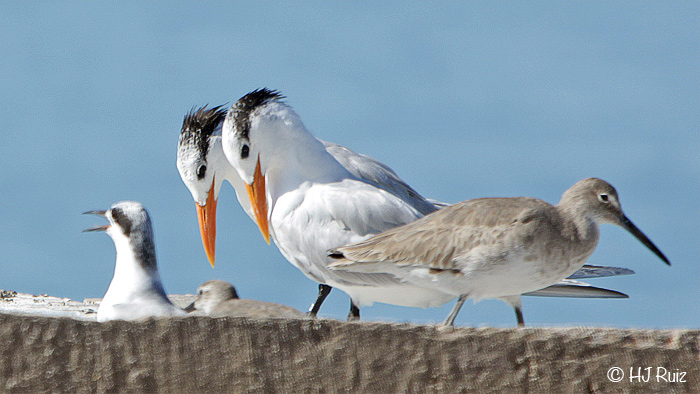
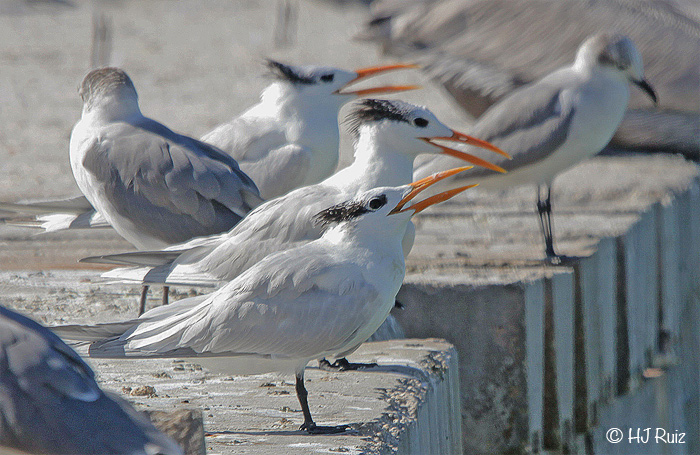
Click on images to see enlargements
Text and photographs © H.J. Ruiz – Avian 101
Share this:

Sandhill Crane
Photographs for this post were taken at Celery Fields Refuge in Florida.
The Sandhill Crane is a species of large crane of North America and extreme northeastern Siberia. The common name of this bird references habitat like that at the Nebraska’s Sandhills in the American Midwest.
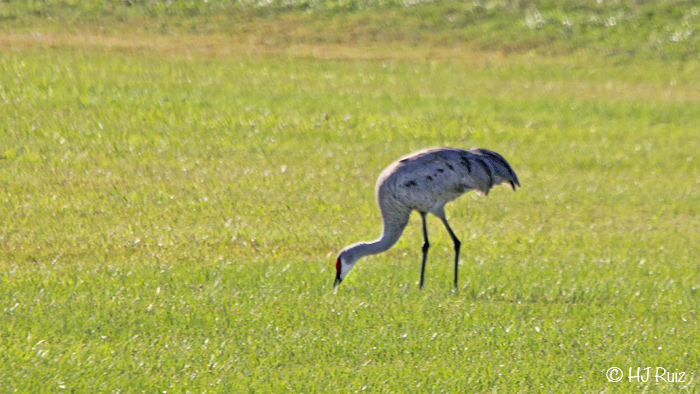
Sandhill Crane
Adults are gray overall; during breeding, the plumage is usually much worn and stained, particularly in the migratory populations, and looks nearly ochre. The Sandhill Crane has a red forehead, white cheeks and a long dark pointed bill. Its long dark legs trail behind in flight, and the long neck is kept straight in flight. Immature birds have reddish brown upper-parts and gray under-parts. The sexes look alike.
This crane frequently gives a loud trumpeting call that can be heard from a long distance.
The sandhill crane’s large wingspan makes this a very skilled soaring bird similar in style to hawks and eagles. Utilizing thermals to obtain lift, they can stay aloft for many hours, requiring only occasional flapping of their wings and consequently expending little energy.
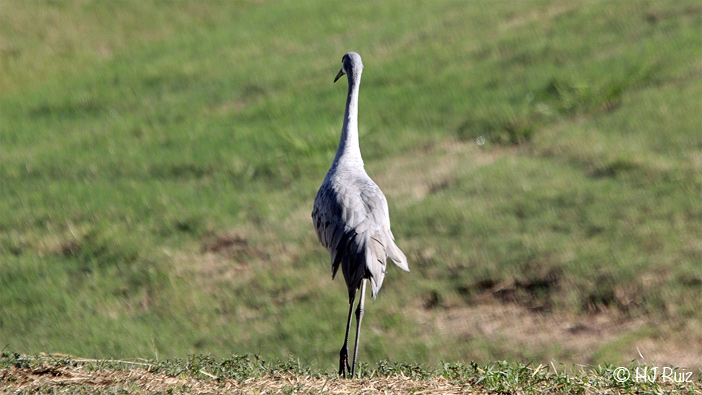
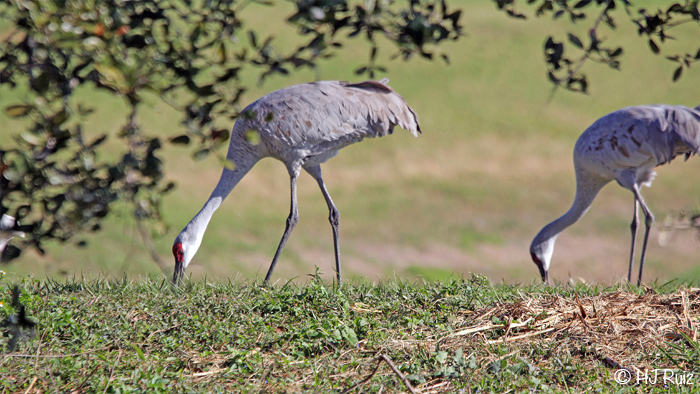
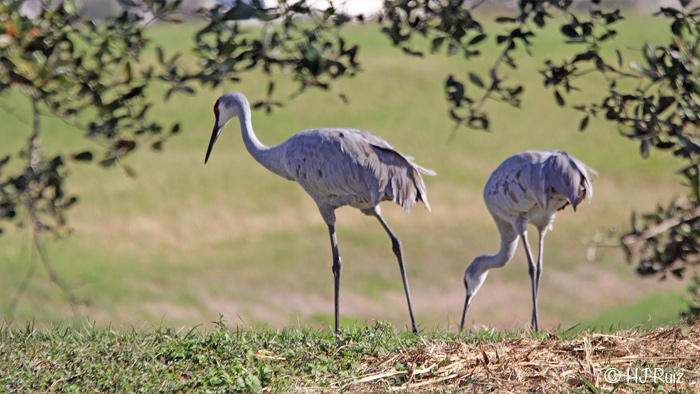

Click on images to see enlargements
Text and photographs © H.J. Ruiz – Avian 101
Share this:

White-eyed Vireo Portrait – Video
Short but beautiful video by © Lang Elliott about the White-eyed Vireo.
Share this:


Read Past Reviews

Book # 69

Quote from the Author
“A good chuckle is healthy, it helps you break the monotony of a serious life.” ~ H.J. Ruiz


You must be logged in to post a comment.