Chestnut-sided Warbler – Video
Here’s another wonderful video courtesy of © Lang Elliott
Share this:

Red-shouldered Hawk
The photos displayed on this post were shot in locations of Georgia, Florida and Alabama.
The Red-shouldered Hawk is a medium-sized hawk. Its breeding range spans eastern North America and along the coast of California and northern to northeastern-central Mexico.

Red-shouldered Hawk
Adults have brownish heads, reddish chests, and pale bellies with reddish bars. Their tails, which are quite long by Buteo standards, are marked with narrow white bars. Red “shoulders” are visible when the birds are perched. These hawks’ upper parts are dark with pale spots and they have long yellow legs. Western birds may appear more red, while Florida birds are generally paler.
While in forested areas, these birds typically wait on a perch and swoop down on prey. When in clearings, they sometimes fly low to surprise prey. Small mammals are typically the most important prey, with voles, mice and chipmunks locally favored. Other prey can include amphibians, reptiles (especially small snakes), small birds, and large insects.
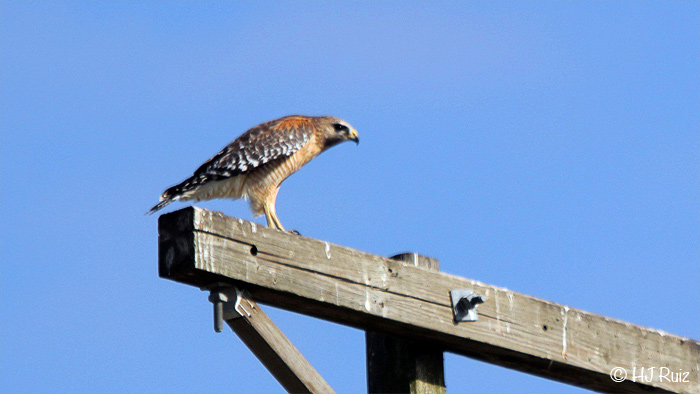
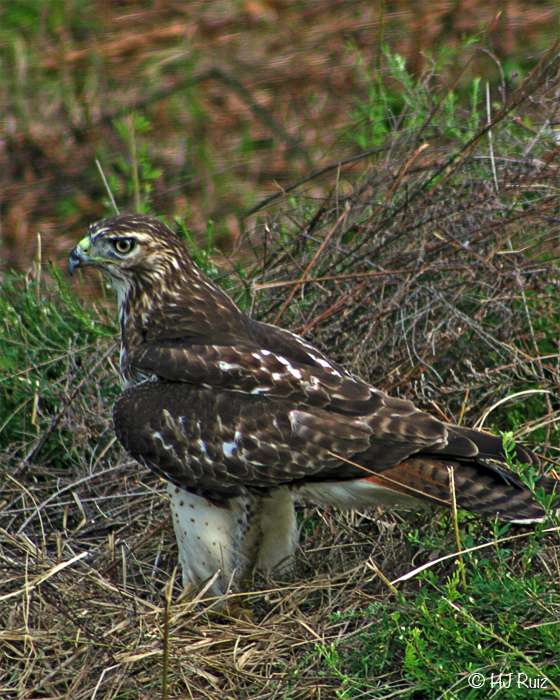
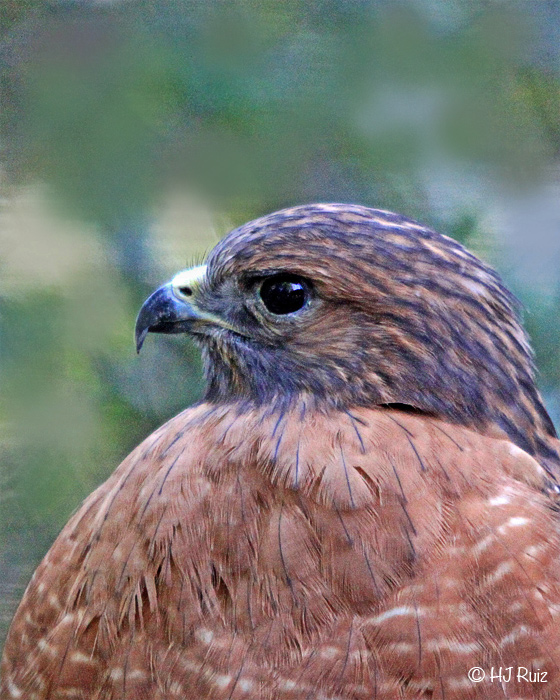
Click on images to see enlargements
Text and photographs © H.J. Ruiz – Avian 101
Share this:

Black Skimmer
The photographs displayed on the post were taken at different time at a sandbar on the west coast of Florida.
The Black Skimmer is a tern-like seabird. It breeds in North and South America. Northern populations winter in the warmer waters of the Caribbean and the tropical and subtropical Pacific coasts.
Parents feed the young almost exclusively during the day with almost no feeding occurring at night, due to the entire population of adults sometimes departing the colony to forage. Although the mandibles are of equal length at hatching, they rapidly become unequal during fledging.
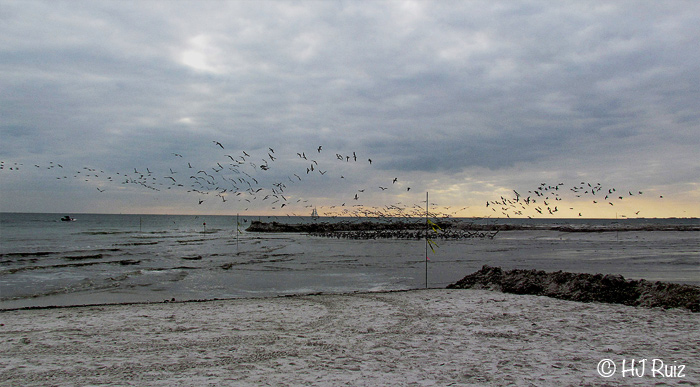
Large flock of Black Skimmers in flight and on sandbar
The basal half of the bill is red, the rest mainly black, and the lower mandible is much-elongated. The eye has a dark brown iris and catlike vertical pupil, unique for a bird. The legs are red.
Adults in breeding plumage have a black crown, nape and upper body. The forehead and underparts are white. The upper wings are black with white on the rear edge, and the tail and rump are dark grey with white edges. The underwing color varies from white to dusky grey depending on region.
Skimmers have a light graceful flight, with steady beats of their long wings. They feed usually in large flocks, flying low over the water surface with the lower mandible skimming the water for small fish, insects, crustaceans and mollusks caught by touch by day or especially at night. They spend much time loafing gregariously on sandbars in the rivers, coasts and lagoons they frequent.
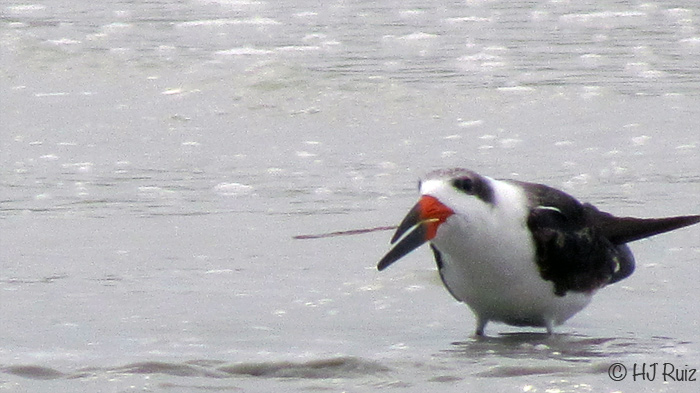
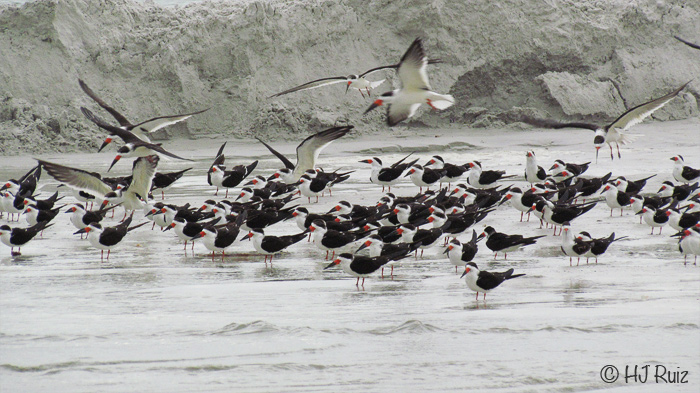
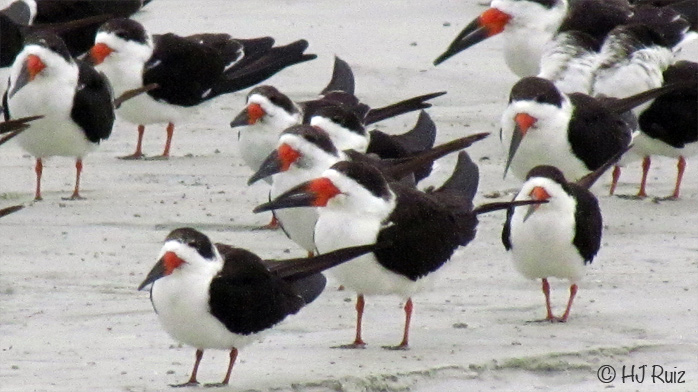
Click on images to see enlargements
Text and photographs © H.J. Ruiz – Avian 101
Share this:

Laughing Gull
The birds displayed on this post were photographed at different locations in Georgia and Florida.
The Laughing Gullis a medium-sized gull of North and South America. It breeds on the Atlantic coast of North America, the Caribbean, and northern South America. Northernmost populations migrate further south in winter, and this species occurs as a rare vagrant to western Europe.
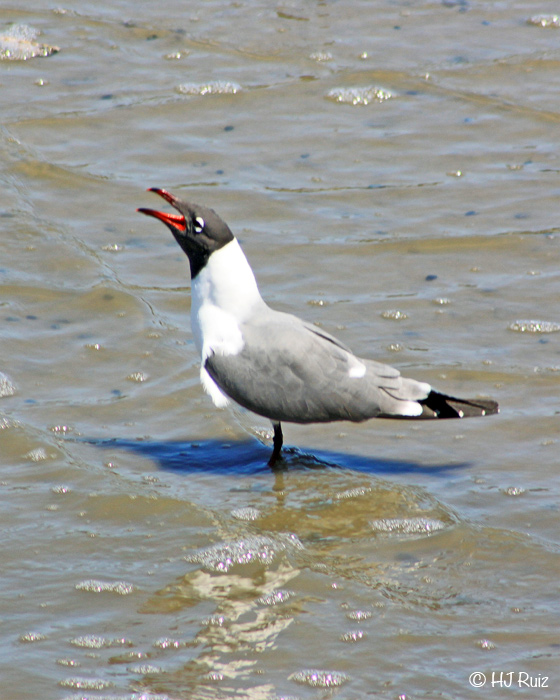
Laughing Gull
The summer adult’s body is white apart from the dark grey back and wings and black head. Its wings are much darker grey than all other gulls of similar size except the smaller Franklin’s Gull, and they have black tips without the white crescent shown by Franklin’s. The beak is long and red. The black hood is mostly lost in winter.
Laughing Gulls take three years to reach adult plumage. Immature birds are always darker than most similar-sized gulls other than Franklin’s. First-year birds are grayer below and have paler heads than first-year Franklin’s, and second-years can be distinguished by the wing pattern and structure.
Laughing Gulls breed in coastal marshes and ponds in large colonies. The large nest, made largely from grasses, is constructed on the ground. The 3 or 4 greenish eggs are incubated for about three weeks. These are omnivores like most gulls, and they will scavenge as well as seeking suitable small prey.
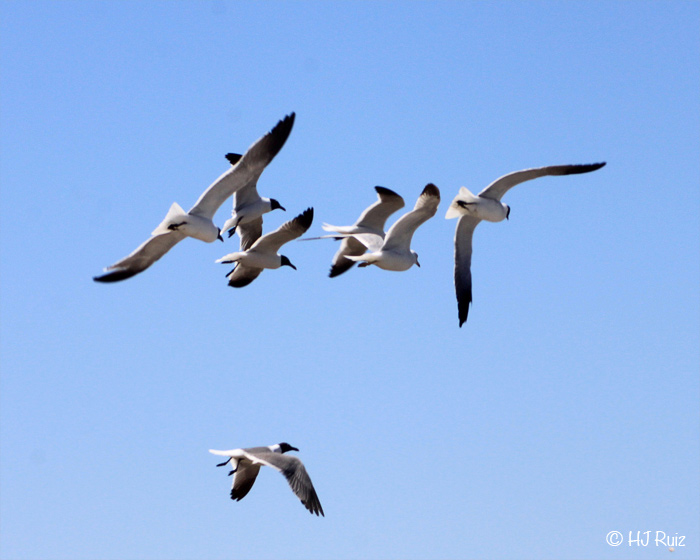
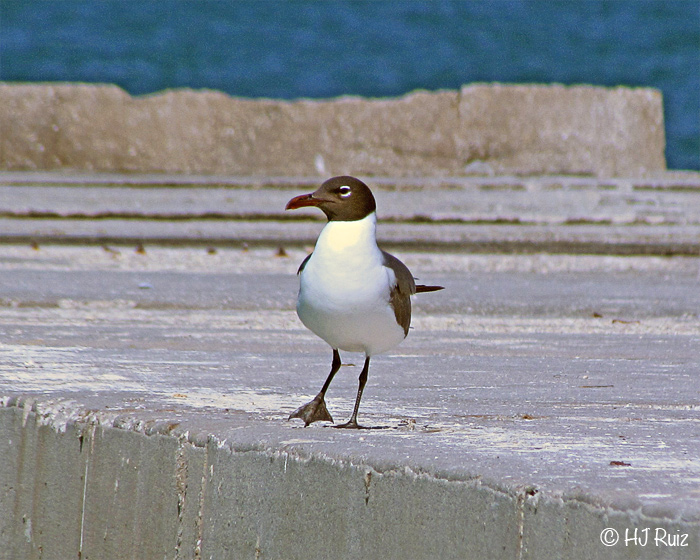
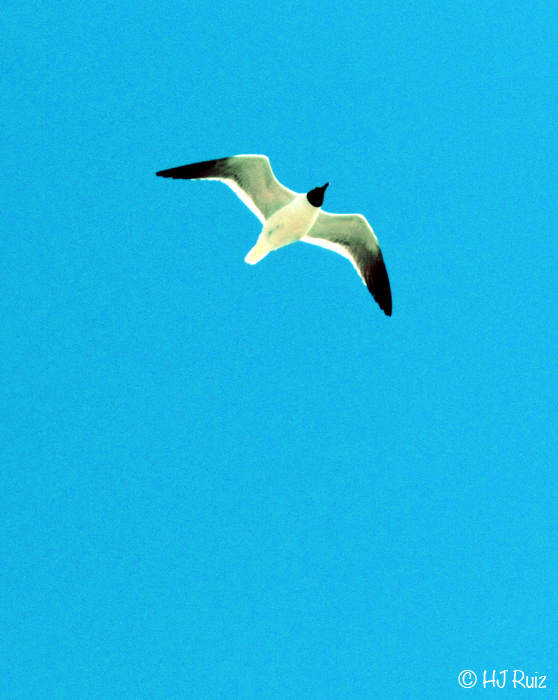

Click on images to see enlargements
Text and photographs © H.J Ruiz – Avian 101
Share this:


Read Past Reviews

Book # 69

Quote from the Author
“A good chuckle is healthy, it helps you break the monotony of a serious life.” ~ H.J. Ruiz


You must be logged in to post a comment.