Birds Online
You don’t have to have Internet to be “online” as you can see on the photographs that follow this article. Yes, I ask you to pardon my pun about the wording but sounded attractive and I did it!
One of the most popular perches for birds are the different kinds of utility and communication lines, everywhere the man has reached to colonize. I’m sure that all of you have seen bird perched on lines when you have traveled by road or train, haven’t you? That’s exactly why I’m writing this post today. In a way these lines provide comfort to birds to take a rest after a long journey or resting when migrating to short or long distance places!

European Starlings

Rock Pigeons

Robust Rock Pigeon


European Starling
Click on images to see enlargements
Text and photographs © H.J. Ruiz -Avian 101
Share this:

American White Ibis
The photographs displayed on this post were shot at different locations of the west coast in Florida.
The white plumage and pink facial skin of adult American White Ibises are distinctive. Adults have black wingtips that are usually only visible in flight. In non-breeding condition the long down curved bill and long legs are bright red-orange. During the first ten days of the breeding season, the skin darkens to a deep pink on the bill and an almost purple-tinted red on the legs.

American White Ibis
It then fades to a paler pink, and the tip of the bill becomes blackish. It is difficult to determine the sex of an adult American White Ibis from its external appearance, since the sexes have similar plumage. However, there is sexual dimorphism in size and proportion as males are significantly larger and heavier than females and have longer and stouter bills.
Their diet consists primarily of small aquatic prey such as insects and small fishes. Crayfish are its preferred food in most regions; however, it can adjust its diet according to the habitat and prey abundance. It is a tactile non-visual forager, whose main foraging behavior is probing with its beak at the bottom of shallow water to feel for and to capture its prey.


Click on images to see enlargements
Text and photographs © H.J. Ruiz – Avian 101
Share this:

Sanderling
The photographs displayed on today’s post were shot on the beach in an island off the coast of Georgia.
The Sanderling is a small plump sandpiper. The winter bird is very pale, almost white apart from a dark shoulder patch. This is the source of the specific name, alba, which is the Latin for “white”. Later in the summer, the face and throat become brick-red.

Sanderling
The juvenile bird is spangled black and white, and shows much more contrast than the adult. Sanderling behavior is distinctive, but visually, if the size is misjudged, a breeding plumage sanderling can be mistaken for some varieties of stint, or a winter plumage sanderling can be mistaken for a Dunlin or Red Knot. It can be told from other small wading birds, given good views, by its lack of a hind toe. Sanderlings feed on invertebrate prey buried in the sand in the upper intertidal. In North America this largely consists of the isopods, and the mole crab. When the tide is out these crustaceans live in burrows some way beneath the surface. When the tide comes in, they move into the upper layers of sand so as to be able to feed on the plankton and detritus that washes over them with each wave. They then burrow rapidly down again as the water retreats.

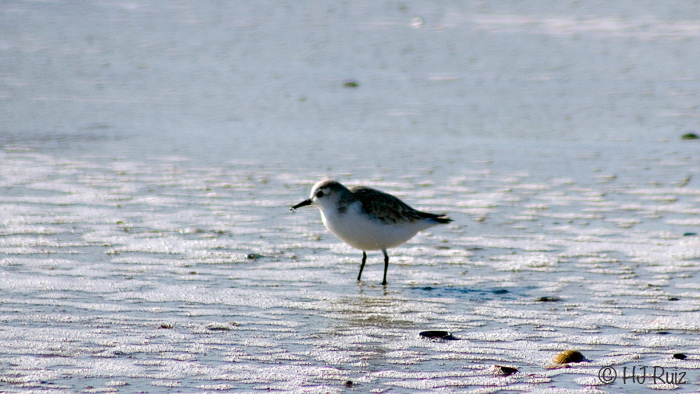
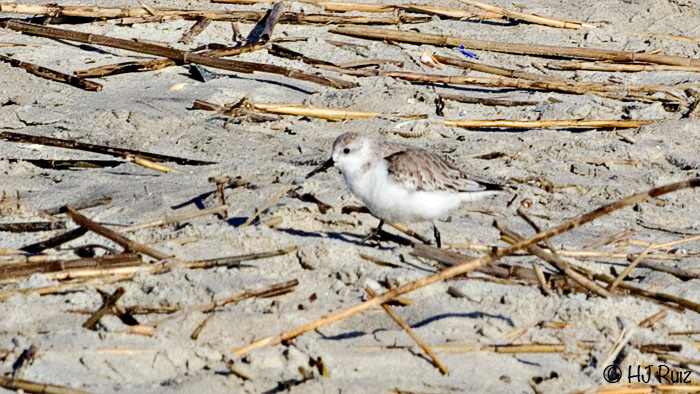
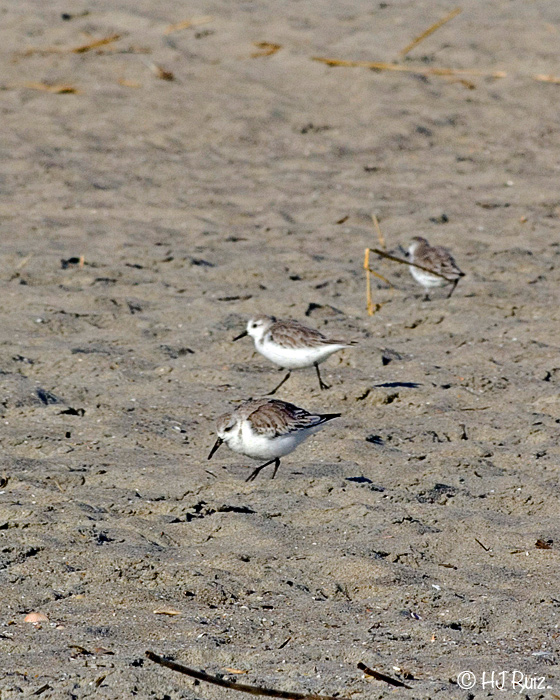
Click on images to see enlargements
Text and photographs © H.J. Ruiz – Avian 101
Share this:

Palm Warbler
The photographs displayed on this post were taken at Celery Fields location in the west coast of Florida.
The Palm Warbler is a small songbird of the New World warbler family.
The species comprises two distinct subspecies that may merit specific status.
Yellow Palm Warbler has brownish-olive upper parts and thoroughly yellow underparts with bold rufous breast and flank streaking. It migrates later in the fall.

Palm Warbler
Palm Warblers breed in open coniferous bogs and edge east of the Continental Divide, across Canada and the northeastern United States. Their nests take the form of an open cup, usually situated on or near the ground in an open area.
These birds migrate to the southeastern United States, the Yucatán Peninsula, islands of the Caribbean, and eastern Nicaragua south to Panama to winter. They are one of the earlier migrants to return to their breeding grounds in the spring, often completing their migration almost two months before most other warblers.
Palm Warblers forage on the ground much more than other warblers, sometimes flying to catch insects. These birds mainly eat insects and berries.


Click on images to see enlargements
Text and photographs © H.J. Ruiz – Avian 101
Share this:


Read Past Reviews

Book # 69

Quote from the Author
“A good chuckle is healthy, it helps you break the monotony of a serious life.” ~ H.J. Ruiz


You must be logged in to post a comment.