
About Adventure… I’ll Tell You!
I believe that Sunday is a good day of the week when you can just relax and read a few words about any subject and still feel relaxed. For this reason I take the opportunity to write a bit about what my trip to Peru was about.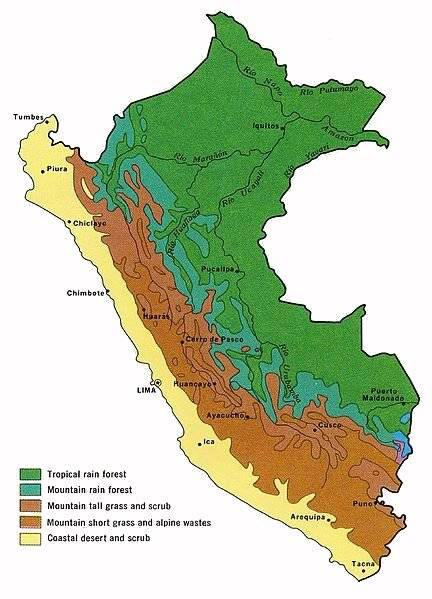
Let’s begin by mentioning the following about Peru, it’s the third largest country in South America, it’s territory is divided naturally in three regions, the Pacific Ocean coast, the Andean region that runs along the top to bottom of the country and then we have the vast Amazon jungle to the east.
I’ve been to the Andean and Amazon regions in previous occasions and had extraordinary experiences.
Since those precious journeys I had been planning to return to Peru and explore the coastal region this time.
That’s exactly what I did. It wasn’t easy at all, but my Indiana Jones spirit drove me to complete my mission.
There was a time while I was there shen I felt like forgetting about the whole thing and just returning home, I spoke on the phone to my wife Lucy and she convinced me to follow my plan. I finally figured that since I was already half way done with my plan that maybe I should stick around and just keep pushing!
Who would’ve thought that my trip made a turn for the better and things went not too bad.
One thing I learned form this experience: I’m not a young fellow anymore!

HJ & Leo

HJ

Pucusana fishing town

Asia Beach and Island
Text & photographs © H.J. Ruiz – Avian 101
Share this:

Miscellaneous
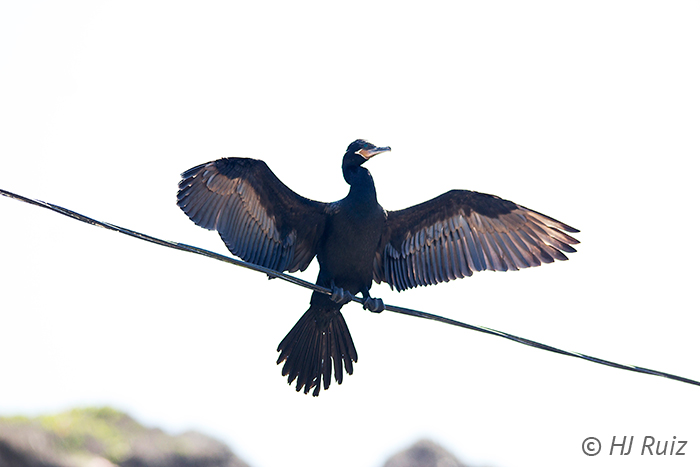
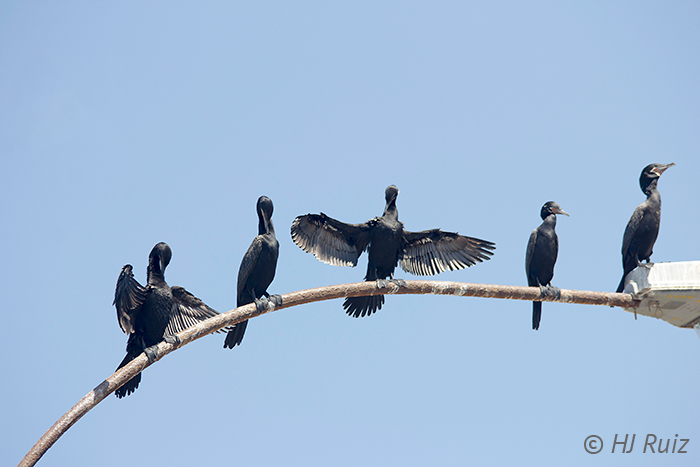
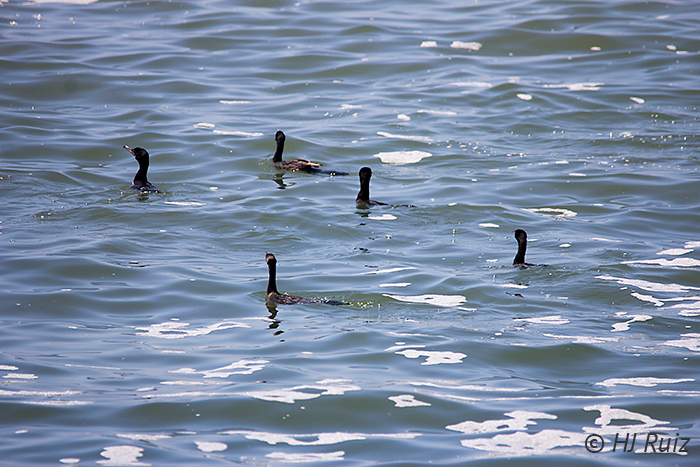
Although you’ve seen photos of Neotropic Cormorants on my blog previously, there’s no reason why I shouldn’t show you some new shots of them from my recent trip to Peru.
These are some of them:
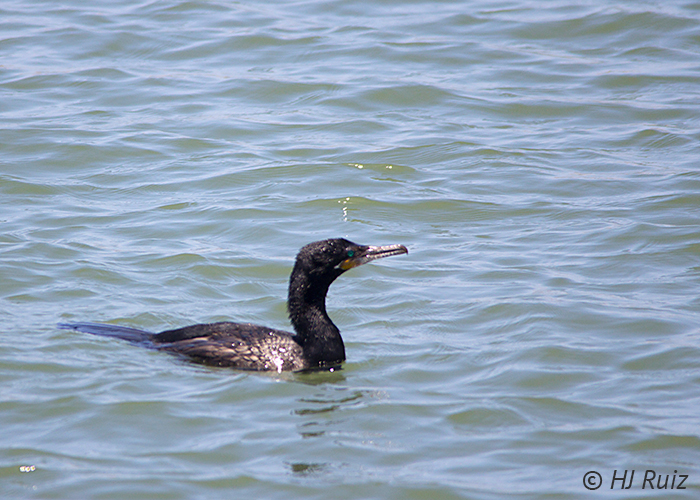
Photographs © H.J. Ruiz – Avian 101
Share this:

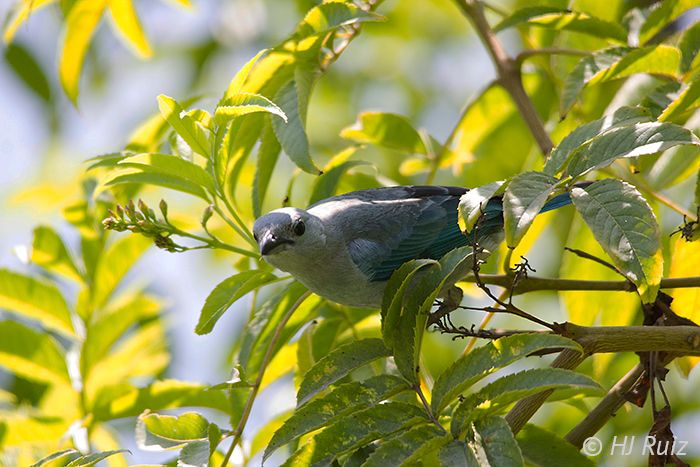
Blue-gray Tanager
Blue-grey Tanager – Latin name : Thraupis episcopus
This is a medium-sized South American songbird of the Tanager family, Thraupidae. Its range is from Mexico south to northeast Bolivia and northern Brazil, all of the Amazon Basin, except the very south. It has been introduced to Lima (Peru). OnTrinidad and Tobago, this bird is called Blue Jean.
The Blue-grey Tanager is 16–18 cm (6.3-7.1 in) long and weighs 30-40 grams (1.1-1.4 oz.) Adults have a light bluish head and underparts, with darker blue upperparts and a shoulder patch colored a different hue of blue. The bill is short and quite thick. Sexes are similar, but the immature is much duller in plumage.
The song is a squeaky twittering, interspersed with tseee and tsuup call notes.
13-15 subspecies are commonly recognized, differing according to the exact hue of blue of the shoulder patch versus the rest of the plumage; they may be greyish, greenish or purplish-blue, with a lavender, dark blue or whitish shoulder patch. For example, T. e. berlepschi (endemic to Tobago) is a brighter and darker blue on the rump and shoulder, T. e. neosophilus with a violet shoulder patch occurs in northern Venezuela,Trinidad, eastern Colombia and the far north of Brazil, T. e. mediana of the southern Amazon basin has a white wing patch, and T. e. cana in the northern Amazon has blue shoulders.
The breeding habitat is open woodland, cultivated areas and gardens. The Blue-grey Tanager lives mainly on fruit, but will also take some nectar and insects. This is a common, restless, noisy and confiding species, usually found in pairs, but sometimes small groups. It thrives around human habitation, and will take some cultivated fruit like papayas (Carica papaya).
One to three, usually two, dark-marked whitish to grey green eggs are laid in a deep cup nest in a high tree fork or building crevice. Incubation by the female is 14 days with another 17 to fledging. The nest is sometimes parasitised by Molothrus cowbirds.
Widespread and common throughout its large range, the Blue-grey Tanager is evaluated as Least Concern on the IUCN Red List of Threatened Species.
NOTE: The Blue-gray Tanager is a new addition to my List of Birds as # 159
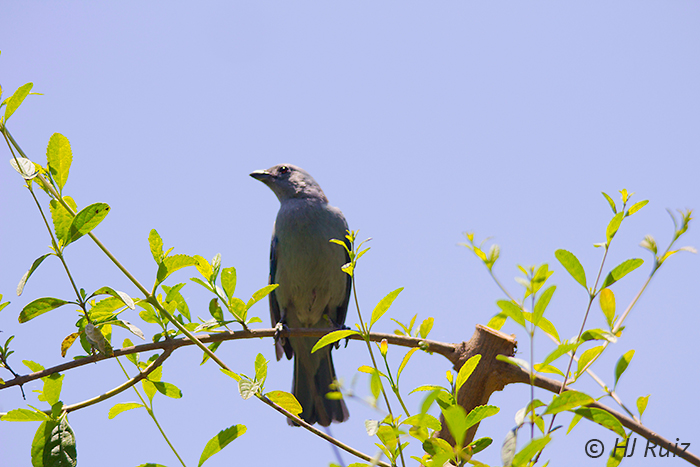
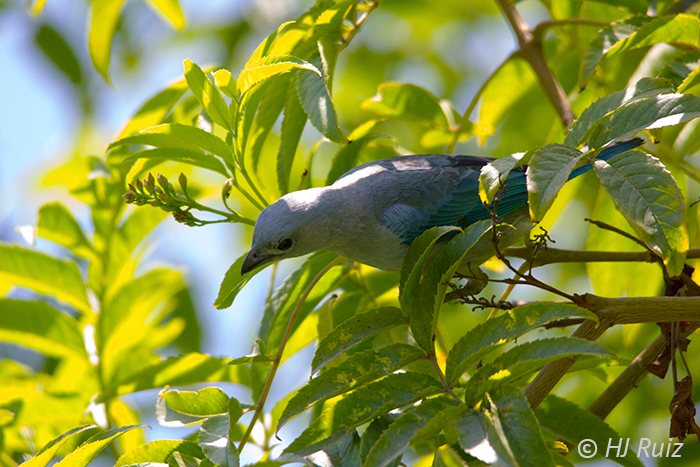
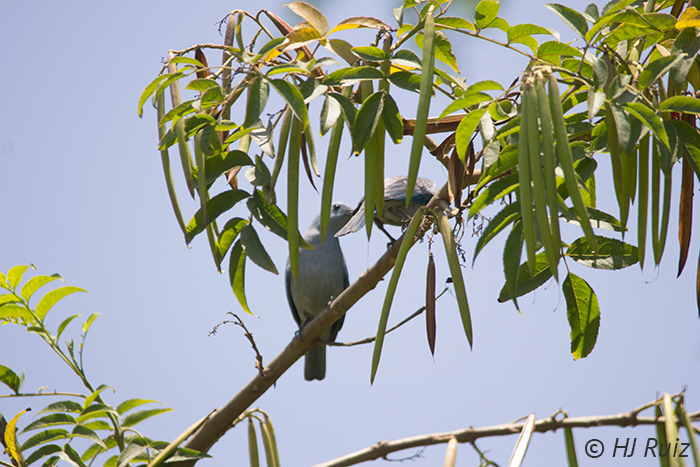
Text © Wikipedia – All photographs © H.J. Ruiz – Avian 101
Share this:

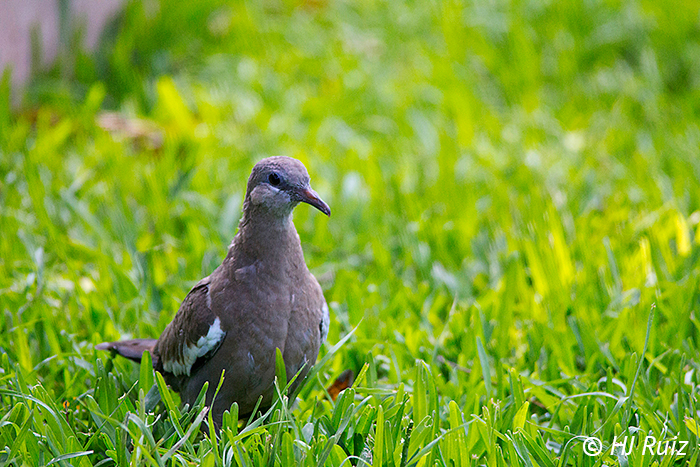
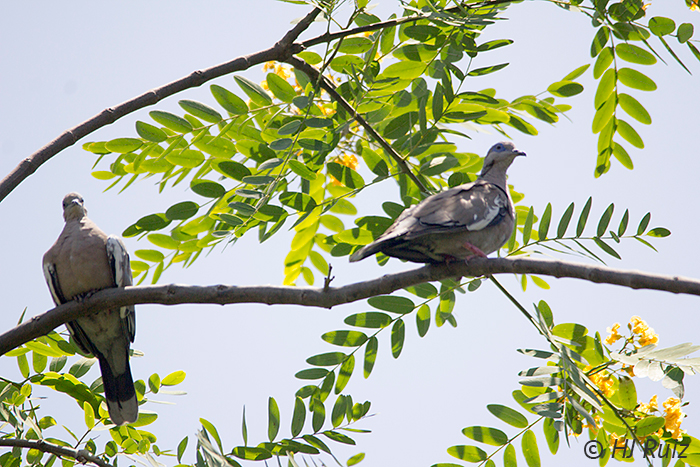
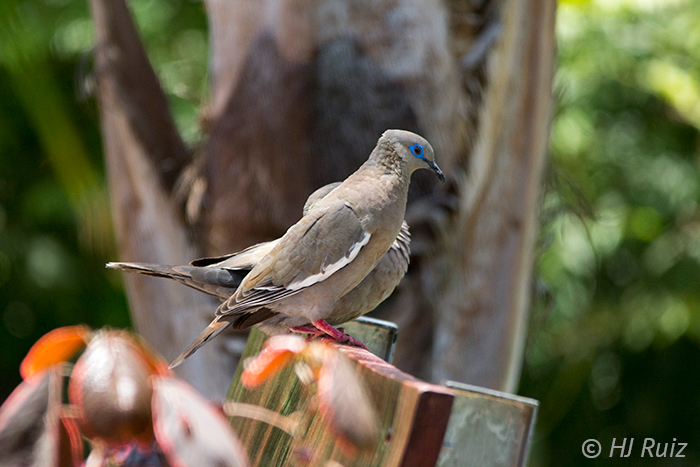
West Peruvian Dove
West Peruvian Dove- Latin Name: Zenaida meloda
Was first described in 1843 by the Swiss naturalist Johann Jakob Baron von Tschudi. It is closely related to the North American White-winged Dove (Zenaida asiatica), but is now considered a separate species by ornithologists due to genetic and behavioral differences (Johnson & Clayton, 2000). Specimens are brownish-gray above and gray below, with a bold white wing patch that appears as a brilliant white crescent in flight and is also visible at rest. Adults have a bright blue (almost indigo), featherless patch of skin around each eye. The legs and feet of adults are red, but unlike Z. asiatica, their eyes are brown. Both sexes are similar, but juveniles have a lighter color than adults, they do not have blue eye rings, and their legs and feet are brownish-pink.
It is classified as LC (i.e. “Least Concern”) on the IUCN Red List.
Its native range extends along the Pacific coastal plains from southern Ecuador to northern Chile. Contrary to unscientific internet sources, the species is not found on San Andrés. This species has a large range, with an estimated global Extent of Occurrence of 187,000 km. Its global population has not been estimated, but is believed to be large as the species is described as ‘common’ in at least parts of its range. Global population trends have not been quantified, but the species is not believed to approach the thresholds for the population decline criterion of the IUCN Red List (i.e. declining more than 30% in ten years or three generations). For these reasons, the species is evaluated as Least Concern. (IUCN Red List).
NOTE: The West Peruvian Dove is a new addition to my Bird List = # 158

Text © Wikipedia – All photographs © H.J. Ruiz – Avian 101
Share this:


Read Past Reviews

Book # 69

Quote from the Author
“A good chuckle is healthy, it helps you break the monotony of a serious life.” ~ H.J. Ruiz


You must be logged in to post a comment.